Time to stir things up. And there is no better way to do that than a post on anchoring that takes a lot of accepted wisdom to task. (Being stuck in an apartment on a walker makes me feisty.)
So the question is: Should you use one anchor or two, and if two, in what circumstances?
OK here it comes: If your boat is properly set up and equipped you should almost never need to set more than one anchor. Here is why:
Two Anchors Off the Bow
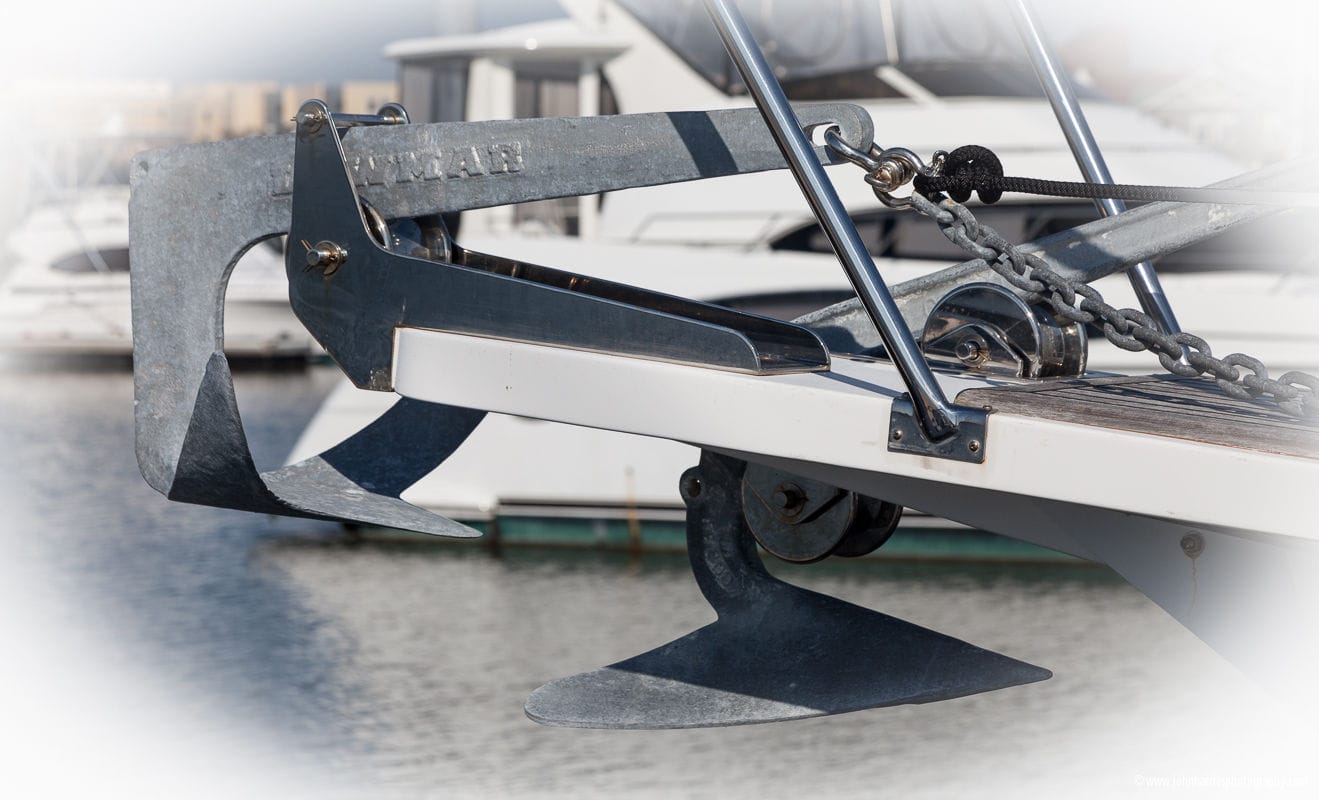
OK, I admit it. We have two bow rollers on Morgan’s Cloud, and back in the bad old days when we used a CQR as our bower (primary anchor) we often, particularly when heavy weather was forecast, backed it up with another and different type of anchor set at about a 45 degree angle from the bower. And in those days it probably even made sense, since we could never be sure of either anchor, so if one did drag, maybe the other would hold. Today, it makes no sense, and here is why:
- It is pretty much impossible to share the load equally between the two anchors even when the wind is from a constant direction, since the boat will shear back and forth, first loading one rode and then the other. Even worse, when the almost inevitable (in any blow) wind shift comes, one anchor will be taking all the load. Shared load is an illusion.
- You can only put so much weight on the bow of your boat. And, given point one above, it makes a great deal more sense to put all of that weight into one big anchor, rather than into two smaller ones.
- Sooner or later, your boat will make a 360 degree turn around the anchors and probably more than one. And Mr. Murphy, being the kind of guy he is, will make sure that all the turns are in the same direction. Sorting the mess out can be a pain in the neck at the best of times and downright dangerous if the wind is up when you want to leave or you need to leave the anchorage in an emergency.
There is one situation when two anchors off the bow might make sense and that is when the anchorage is too small to afford swinging room on one anchor. This is the classic Bahamian moor situation, in which the anchors are set in line with the boat equidistant between them. Use this technique if you must, but be prepared for a hell of a mess as well as the very real possibility of fouling a rode on the keel, rudder, or prop. Also be aware that if the wind comes from a right angle to the line of the two anchors, the loads on each will be larger than they would be on one anchor (assuming that the rodes are quite tight).
Anchoring Bow and Stern
OK, I really don’t like this one. Here is why:
- Assuming that the reason for so anchoring is a small anchorage, either anchor dragging will result in the boat going ashore, therefore the safety of the boat depends on the holding ability of the smallest anchor. And most of the stern anchors we see are small, sometimes laughably so.
- The loads on the rodes and anchors of a boat moored fore and aft can be truly frightening due to the boat’s inability to swing to the wind. How much more are the loads? Matt Marsh, engineer and yacht designer has calculated that for Morgan’s Cloud the loads would be fifteen times higher when the wind is on the beam, in comparison to a boat freely swinging to the wind direction!
- So now you have trusted your boat to an anchor that is smaller than your best bower and increased the load by a big factor. Does not seem like a good idea to me.
Better a Shorefast
In small anchorages, we generally prefer one anchor and one or more shorefasts to both of the above anchoring techniques, because:
- The shorefast(s) can be more easily dropped (and retrieved later in the dinghy) in the event that the anchorage becomes untenable.
- A properly rigged shorefast is, in most cases, stronger and more reliable than a light secondary anchor. (Of course this does depend on having something strong like a boulder or a big tree on the shore to tie to.)
Tandem Anchoring
OK, hold on to your hats, the fur is about to fly. Tandem anchoring, beloved of many high latitude voyagers, in which two anchors are set one behind the other on the same rode, is supposed to be the ultimate storm survival anchoring technique. And maybe it was in the days before new generation anchors. Here is why it’s not now:
- It is very difficult to properly set both anchors. One or the other is almost certainly going to be taking the load, while the other is lying on its side not set.
- In that inevitable wind shift we wrote about above, either the closer anchor will drag over to be in line with the bow of the boat and the further anchor, or it will stay set and not move. Either way, you are now on one anchor.
- If you have to move while it’s still blowing, getting your tandem rig back on deck will be a manoeuvre that will range from very difficult to very dangerous.
- We have never, in 14 years of using it from the Bahamas to Greenland, had our 120 pound SPADE drag once set. If you have a big enough new generation anchor like a SPADE or a Rocna, ultimate holding is simply no longer a problem. So why add the complication of tandem anchoring for a benefit that is an illusion?
The Two Anchor Seduction
Before you dismiss what I have written as rubbish, think really carefully about why you are anchoring with two or more anchors. Is your decision based on sound reasoning, or are you setting two anchors just because the activity itself makes you feel like you have done your best to prepare for a coming storm? I certainly know I have succumbed to this type of self-delusion.
But even if it makes you feel better, setting multiple anchors may be a poor idea. Here is an example: Some years ago we were anchored awaiting a brush from a category one hurricane with expected winds to 70-knots. Another boat our size came into the anchorage and proceeded to spend three hours laying not one, not two, but four anchors. I’m sure the skipper felt seamanlike and that he had done everything possible.
But here is the thing. Not one of that careful skipper’s anchors was a new generation design and not one was as big as the single 120 lb SPADE that we were lying to. Worse still, one was a fisherman type, which was near useless in the mud of that anchorage. I would venture to assert that all of his anchors combined would not add up to the holding power of our single big SPADE. And that assuming his anchors would share the load, which of course, as the boat sheared about and the wind shifted, they would not.
But it gets worse. That oh so careful skipper had used every anchor he had on the boat. Suppose he had to slip at the height of the blow, say due to another boat dragging down on him, or an unexpected wind shift—hurricanes can wobble at the last moment—bringing a big sea in through the anchorage entrance? What then?
On Morgan’s Cloud we only had one anchor down, but we also had two more on deck with one completely rigged and ready to drop in case we had to slip the bower and move. (One good use for a second bow roller.) Who do you think was really safer? I guess I already voted.
Big Anchor, Good
Do note that all of my arguments assume that your single anchor is a big one of the new generation. For voyaging sailboats we recommend at least one size larger than the anchor manufacturer’s recommendation (ours is two sizes larger). And if you are worried about weight on the bow, consider changing to schedule 70 chain, the weight savings of which will more than compensate for the larger anchor.
Simple is Good
Our gradual change over the last 15 years to only using one big anchor, except in very rare circumstances, is just another part of our commitment to and belief in simplicity.
Comments
Let the fur fly. Feel free to disagree but please keep the discourse civilized and polite. Please leave a comment.


mark boden December 14, 2012 at 6:46 pm
I agree with everything you’ve written John,
Chris December 14, 2012 at 6:52 pm
John,
Glad to see the fall didn’t affect your mind.
In years (far) past we have used Bahamian and tandem arrangements. The Bahamian nearly cost us the boat, and the tandem saved it in Hurricane Fredrick ’79. In each case we would have liked a single anchor solution. We have moved to an oversized Spade this season. Only time will tell if this was wise.
Stan December 14, 2012 at 9:26 pm
Hi John:
I need to set up a shorefast on my boat. How have you sized your shorefast, what material is it made of and how long is it.
Thanks
Stan
John December 15, 2012 at 8:59 am
Hi Stan,
I have a piece on our shore fast system coming some time this winter.
Until then, you can get a lot of information by entering “shore fast” into the search box next to the menu.
Shane December 15, 2012 at 12:46 am
Hi John,
Our first season, after a few weekends of anchoring, my wife agreed she preferred being on the hook. Once I received that green light, a 10kg Rocna (w/chain) went on the bow of our 3200 lb. boat, as I knew the first time dragging would likely be our last time anchoring. We usually manage a pretty restful sleep.
Matt Marsh December 15, 2012 at 2:16 am
“Bow and stern…. How much more are the loads?…. I would hazard a guess that they are at least three times greater if the wind is blowing from the beam.”
Sounds a bit low…. let’s check. Knowing Morgans Cloud‘s dimensions, I’d peg her projected area as about 3.75 times greater when viewed from abeam as when viewed from ahead.
From the photos you’ve shared with us, I’d guess her drag coefficients beam-on are about 2-3x larger (above waterline) and ~5x larger (below waterline) than their head-on counterparts.
So, as a very rough first guess using a metric boatload of crude approximations, you might be looking at (3.75 * ~4) = 15 times the forces if she is held beam-on, versus being held bow-on.
I think I’ll reserve that stern anchor for kedging off, thank you very much….
John December 15, 2012 at 9:07 am
Hi Matt,
Wow, 15 times! I knew the problem was bad, but I had no idea how bad. Then when you consider that wind pressure goes up with the square of speed the whole thing gets very scary.
Your calculation really makes you think about using shore fasts too.
Thanks so much. I will change the post to reflect this new ( to me) information.
Matt Marsh December 16, 2012 at 11:12 am
I hadn’t thought of it either, John, until you brought it up.
That a boat beam-on presents 3-4x more area to the wind and waves is, to most people, obvious.
That her drag coefficients are so much larger beam-on than bow-on should not be surprising- from the bow, she’s a streamlined body; from the side, she’s nearly a flat plate.
Combine the two, and you get some scary numbers. For shorefasts, I suspect it’s not as bad, because you (a) know the prevailing wind/wave direction, and (b) often leave enough slack that she can re-align herself by 30-45 degrees if she needs to.
John December 16, 2012 at 11:38 am
Hi Matt,
Actually, in most cases where shorefasts are used they are kept really tight to stop the boat surging about and then coming up hard. Also, shorefasts are usually used in small coves where the wind gusts from a multitude of different directions. So I think the problem of high loads is at least as bad. On the bright side, if the small cove selected is tree surrounded the wind and gusting is dramatically reduced. This may be why shorefasts are much loved and used by those who cruise in Patagonia, but not so much by those of us who confine our cruises to the north where there are no trees.
Martin Spaans January 16, 2013 at 6:37 pm
The calculation of drag-coefficient and area resulting in an overall increase of approximately 15 x seems a bit over the top to me (especially the drag-coefficient part).
However, an other engineering aspect will also play its role. It is the working components (vectors) of the forces in the two lines. The working components shall equal the forces exerted by beam-wind and beam-current where these vectors are only (very) small relative to the line tensions. This is the case when the lines are tight. The working vectors become more effective when the lines are less tight and allow for better angles to act against the wind and tide.
Having said all this I would agree with both of you that the increase in line tension is unexpectedly big and that such positioning could end in unexpected failures where breaking of the fore rode is probably the worst.
Matt Marsh February 26, 2013 at 9:02 pm
Cd for a streamlined body with a blunt stern, like a sailboat hull end-on, is in the range 0.04 to 0.1 by projected area.
Cd for a beam-on hull is hard to figure exactly but, approximating from primitive geometric forms, should be confined to the range 0.3 to 0.8 by projected area.
Cd for the superstructure is on the order of 0.7 in either direction, but wind load on a trunk cabin and dodger is tiny compared to the forces of the water, waves and wind on the hull itself.
Projected area beam-on is, for a monohull, at least 3 times more than projected area head-on.
I didn’t believe it at first either, until I checked the Cd figures against several different tables. If you hold a boat like John’s at bow and stern so that it’s beam-on to everything, you’ll get about 15x the force as if you let it swing bow-on. That’s just the total force on the boat- not the tension on the rodes, which as Martin points out will depend on the exact vectors involved.
Colin Farrar December 15, 2012 at 2:31 am
Good stuff. This matches advice from the likes of Steve and Linda Daschew, but of course it’s superbly written and backed by your experience, John. Other advocates of the one-big-anchor school are Nick and Josie of s/v Jedi, a Sundeer 64, which rode out Hurricane Ivan (Cat 5) on Grenada, hanging on their big Bruce and 3/8″ G70 chain and chain stopper (the snubbers melted and parted).
Jonathan Neeves December 15, 2012 at 2:40 am
Query:
The recommendation is for an anchor one or even two sizes too big, for our 38′ x 6t cat we’ed then need a 25kg instead of the ‘modern’ 15kg Anchor Right Excel we carry (not that in the grand scheme of things 10kg is very much). But what else to carry, Mr Murphy is out there and he has an insatiable appetite for anchors, so we have need of another 25kg anchor which will sit grumpily in the anchor locker (that is if Mr Murphy is already saitiated by someone less fortunate). We prefer the shore line (which might be afixed to a well buried anchor) and or 2 bow anchors, in your definition – underweight (in our case at 90 degrees and of equal size to the 15kg Excel – alloy makes a good fall back (Fortress or Spade). But depends on the anchorage, any fall back anchorage, and what the winds is lilely to do.
Beyond 25kg I would certainly prefer humping 2 smaller anchors than one big one and as long as the primary is strong enough (a big unknown) then the secondaries as alloy ensures remedial spine work is unnecessary.
Bob Hinden December 15, 2012 at 2:46 am
I like the approach you describe. On my Valiant 42, I have a 66# Spade on the bow with an all chain rode. I have a backup Spade #44 (disassembled) in the bilge with a mixed line and chain rode in the bow anchor locker.
I hope I never have a reason to use the backup anchor, but it wouldn’t take too long to get it out and bring it to the bow.
I also have a Fortress anchor on the stern, but the only use I have had for that is when bow in at a bulkhead.
Jonathan Neeves December 15, 2012 at 3:28 am
You had suggested stirring things up
It might have been in an earlier thread but why this fascination with Rocna and Spade? The same pairing appears in (an)other thread(s). What is wrong with Spade and Supreme or Boss or Excel or SARCA or Fortress. All (named brands) have holding capacity beyond anything most people will need (if sized correctly). 2 concave anchors looks like overkill, roll bars are very 1970′s, two galvanised anchors (spine threatening – depends on yacht size and strength of partners). Just seems parochial and ‘restrictive(?)’ but – its your website
But I was never considered as a mover and shaker.
John December 15, 2012 at 9:20 am
Hi Jonathan,
Note that I say “new generation anchors LIKE the SPADE and Rocna” which clearly implies that there are other options.
Having said that, here at AAC, we only recommend products that we have extensive first hand experience with, or verified second hand experience from multiple sources who we know personally and trust.
Our readers come to AAC for experienced based facts, not speculation. They can get enough of the latter on the forums.
Incidentally, if you look under anchors in the menu, you will find our thoughts on the Luke and Fortress.
Ken Page December 15, 2012 at 8:14 pm
Thanks John, it’s why I trust this site.
I always slept well with my 35# CQR (bottom permitting) on a 30′ boat. My next boat will have at least twice the recommended size.
Dick Stevenson December 15, 2012 at 5:19 am
John,
Very nicely stated and the least controversy I have ever seen generated from an anchor article.
With respect to tandem anchor set ups, I used tandem (19# hi tensile Danforth on a 60# CQR) to good effect when on the US east coast in hurricane country, especially in the really soft stuff of the Chesapeake. This was before we moved to using a 66# Spade 4-5 years ago now (on our Valiant 42) and although we have been whacked by a few storms, on this side of the pond there is less occasion to do the kind of storm preparation that hurricane’s generate.
I have kept tandem anchors in mind though.
I am not sure I agree with the second anchor “lying on its side not set”. It is hard to know what is going on down there on the bottom and I suspect with careful deployment both anchors could be laid down ready to set. The issue (unlike my old CQR) might be that the Spade would set quickly not giving the second anchor an immediate chance to set itself. That might remedy itself when the storm hits.
I suspect you may be correct in observing that a wind shift may have you lying on one anchor. One could argue the second was just backup in this case.
Your third point is the kicker for me as I am loathe to set up anchors where the ability to get underway is compromised. To that end I set up the tandem with a short rode (less than depth of water) and a pennant to grab so as to easily secure the “hanging” second anchor. With the anchor roller far from the hull, the Valiant is well set up to motor a bit with the second anchor dangling but unlikely to hit the hull in a fire drill. We could not go to sea like that, but we could roam the anchorage looking for another spot if need be.
I agree about that this generation of anchors and getting “over” sized has changed the anchoring techniques that many of us were weaned on. With a down side so minimal, I will likely keep tandem anchoring in my possibility repertoire. It still makes sense to me, although I am aware that going to the trouble of setting up tandem anchors may be doing more for my anxiety level than to actually hold the boat in place.
One scenario where multiple anchors still have a place, I believe, is where the storm/hurricane forecast is such that you choose to anchor the boat and go ashore for safety. Hurricane Bob was one such for us. Ginger looked at me with our 3 children and said we were going ashore and that the worst consequences were what insurance was for. We used multiple anchors. Other storms we stayed aboard and then we were prepared to work the boat in ways such as you described and felt ok with less ground tackle deployed.
Good discussion and all good anchoring points. Thanks, Dick Stevenson, s/v Alchemy
Dick Stevenson December 15, 2012 at 5:27 am
Jonathan, Not “parochial and ‘restrictive” from my point of view, but rather predicated on lots of 1st hand experience and reports from skippers and boats who range widely in the most marginal of conditions and pay a lot of attention to what works. Spades and Rocnas have met the test so far. Others may follow and surpass.
Dick Stevenson, s/v Alchemy
Dietmar Segner December 15, 2012 at 5:38 am
John,
your paper is spot on. Though we until now haven’t done any high latitudes sailing, we have a 42kg/92 pound Bugel anchor on our 48′ aluminum boat and with a decent bow roller and anchor windlass it is very manageable.
The main problem is often to convince the designer/builder of the boat to accept that the future owner wants a “ridiculously large” anchor. In their mind it seems that their customer is not capable to set the anchor properly. It takes some self-conciousness to stop the discussion and say “I want it done like that, period”.
The second problem is to find shackles, swivels, chain hooks, and stoppers that are up to the job considering the high holding power of a large anchor of the new generation.
Thanks again for the post, even if it didn’t stir so much controversy with this audience ….
dietmar
John December 15, 2012 at 9:34 am
Hi Dietmar,
Thanks for the support.
I would agree with Dick on shackles and swivels. Here are our thoughts:
http://www.morganscloud.com/2007/09/01/which-anchor-shackles/
http://www.morganscloud.com/2010/09/12/anchor-swivels/
Dick Stevenson December 15, 2012 at 5:55 am
Dietmar,
I do not use swivels or chain hooks, but for shackles, the only match for G4 chain that I have come across are made by Crosby (http://catalog.thecrosbygroup.com). For 5/16 inch g4 chain I use 1017450 = 3/8″ G-209A shackle doubled with either 1017472 = 7/16″ G-209A shackle, or the 1017494 = 1/2″ G-209A shackle to the anchor. They are an alloy and preclude the shackles being the “weak” link and last as well or better than the galvanized shackles one finds everywhere.
Dick Stevenson, s/v Alchemy
Simon Fraser December 16, 2012 at 3:25 am
John and Dick have here alerted me to the Crosby catalogue of anchor shackles. I notice that they catalogue some round pin shackles (with split pin securing) as anchor shackles, as well as screw pin shackles.
I find screw pin shackes with a large flange for screwing, are awkward in an anchoring system: the flange can foul on the bow roller, and if used as joining shackles in the middle of a chain can also foul on the winch gypsy.
I would be interested to know what you think of round pin shackles with split pin to secure the pin, in an anchoring system?
John December 16, 2012 at 11:53 am
Hi Simon,
I’m not sure I would want to use split pin secured shackles since I would worry about the pin being damaged on a rock and failing. We have used normal shackles for years (wired of course) without problems. Maybe our anchor roller is wider than yours?
Also, we don’t recommend joining chain at all since we have never yet seen an elegant way to do that which is both as strong as the chain and will go over the windlass wildcat.
Svein Lamark December 15, 2012 at 7:08 am
Hey John!
I sail like you with a 25kg Spade and a 60 kg Spade. It is a good solution. The Spade is the best anchor I ever had. But there are types of bottom that the Spade can not handle: Tall grass and very hard clay. Tall grass I find east of Denmark and west of Sweden. The solution on tall grass is that on deeper bottom close by, there is always soft clay. You have to move a little. On very hard clay I use tandem anchor. Two old traditional ship anchors and lots of chain will do it. Then it is the steel weight that holds the ship, not the grip of the anchor.
The vikings used often shorefast (or landrope as they called it) and a light anchor on a short line. This is a good metode on the west coat of Norway. Many places you will find steel poles ashore marked with a bulls eye for landrope purpose. Even if this pole could look very private, you have as a sailor the legal right to use the pole. I always bring fittings to fasten the landrope. Moutain climbers have developed many good products here. When close to a glacier, a landrope is often the only safe anchor metode because of very strong fall winds.
I hope your leg is getting better and I never understood why people put boats ashore and stop sailing in winter time, it is too much risk taking.
Best regards Svein
John December 16, 2012 at 10:51 am
Hi Svein,
All good information, thank you. You must have really hard clay in Scandinavia! I have yet to find a bottom of clay too hard to get our SPADE to set in.
And yes, we have used the “fortoyningesbolta” in small anchorages in Norway many times, they are just great and amazingly common.
You are right, the land is way too dangerous! Still on a walker, which is making me crazy, but slowly getting better.
Jonathan Neeves December 15, 2012 at 7:12 am
Strangely Spades are not available, unless you order individually at rather high freight rates, in Australia. (This I might add is Australia’s loss – its a good anchor. But its expensive in Europe and with freight, wallet crunching here). I have seen 3 in 15 years (including ours), in Australia. Equally oddly we enjoy the same taxing weather as most other marine areas. Actually because we overlap Capricorn we also enjoy Cyclones (that you might call Hurricanes, and our distant neighbours Typhoons), because we are geographically large we also overlap The Roaring Forties and we also have yachtsmen who have suffered from the effects of Tsunami when visiting our very close neighbours. Despite the diversity of these natural phenomena (and the absence of Spade) we seem to cope quite well. As far as I am aware Australian’s are as intrepid as anyone else, on the water, but possibly reticent (?)
. There are other experiences and anchors that you might consider and these experiences might be to the benefit of many.
If, in your book, there are only 2 anchors – and we only have easy access to one (whose history has been, to say the least, chequered) then you are not to engender much response if you will summarily dismiss our practice and experiance as not meeting your standards (because we do not use the anchors you consider of merit).
Maybe there is a Luddite in us all:)
Jonathan
John December 15, 2012 at 7:59 pm
Jonathan,
You don’t have to agree with me, but please stop putting words in my mouth.
One more time:
Note that I say “new generation anchors LIKE the SPADE and Rocna” which clearly implies that there are other options.
Having said that, here at AAC, we only recommend products that we have extensive first hand experience with, or verified second hand experience from multiple sources who we know personally and trust.
Our readers come to AAC for experienced based facts, not speculation. They can get enough of the latter on the forums.
Incidentally, if you look under anchors in the menu, you will find our thoughts on the Luke and Fortress.
richard s. December 15, 2012 at 8:40 am
informative and interesting article…i have intuitively always shied away from using more than one anchor…now i understand better why this is a good approach normally…i have a 55lb delta as the bower for my new dufour 425 and it always performs well…do you consider this among the new generation anchors ? do you like deltas ?
richard s. in tampa bay
s/v lakota
John December 15, 2012 at 9:29 am
Hi Richard,
I have no first hand experience with the Delta, but based on reliable second hand reports I would say that it is one of the better of old generation plow types.
However none of these older plow types hold a candle to the new generation anchors. If it were me, I would replace it with a SPADE or a Rocna.
Dave Benjamin December 15, 2012 at 6:38 pm
We have a Delta and agree that it’s one of the better “old generation” types. A Rocna, Spade, or Manson is on our list of potential acquisitions.
chris December 17, 2012 at 5:24 pm
On our 30 footer we had a 22 lb Delta and it did perform very well. We have since replaced it with a 25 lb Manson Supreme and it is far superior. The Manson sets almost instantly.
I could always break the Delta free the next day by hand. Sometimes it would take a good bit of effort but I could do it. The Manson laughs at me. Once set it does not budge and we have to use the engine and power over it to get it to break free.
Going to the Manson and 8 plait line was one of the best upgrades we made to our boat.
Bill Balme December 15, 2012 at 9:11 am
Our 80lb Manson Supreme aboard our Outbound 44 seems to fit your specification well – we certainly feel secure with it and have not been tempted into a 2 anchor lay. I agree that I might be tempted into it – just to satisfy the need to “do something proactive.” I like the idea of prepraing a second rode ready for deployment – maybe that will satisfy my do something needs!
My back-up anchor is probably a bit weak in your opinion – a Fortress 23 – but it stows nicely! I guess we could replace that with a 25kg Spade but I’m not sure if my money might be better spent on something else…
Steve December 15, 2012 at 11:15 am
John, it seems to me your anchoring is well thought out, well practiced, and now well said. And , the comments that have followed have been stimulating. However, I have to ask, if the Spades set and hold so well why do they need to be “oversized”? Is it for the overall strength of the anchor? Is it to assist the initial set of the anchor which you test so rigorously? Or, possibly to assist the reset of the anchor if it rolls over in a wind shift? Thanks.
Steve
John December 15, 2012 at 4:43 pm
Hi Steve,
We recommend that all anchors for voyaging boats be at least one size larger than that recommended by the manufacture, not just SPADE anchors.
And no, it’s not about setting, resetting, or tensile strength.
The reason is that we would guess that most anchor designers will produce a size table based on general use. We also assume that different anchor designers are making different assumptions about what general use is. Bottom line, there are a lot of assumptions going into the process of calculating a sizing table, and many of those assumptions are pretty arbitrary.
On the other hand, a voyaging boat will, sooner or later, be faced with an anchoring situation that is extreme, not general use, maybe a hurricane, or a really nasty fall storm, and in this case the ultimate holding of a larger anchor may save the boat.
Westbrook December 15, 2012 at 11:50 am
The Mt. Murphy of whom you and Jonathan Neeves speak was my grandfather. I’ve developed a corollary to his law: “If anything can go wrong, it already has: you just don’t know about it yet.”
Roland December 15, 2012 at 12:29 pm
I do agree with your statements. We converted to a Rocna from Delta.
Here are in short the advantages we noticed:
1. Set much faster. Instant I would say.
2. Cut thru kelp much better. Tested in Norway.
I´m sure Manson, Ultra anchor are more or less as good.
When would I consider 2 anchors? I´m not sure. If I was in a hurricane hole waiting for the big one, I would hesitate as I have to little experience with 2 anchors. It would not be the right moment to gather experience.
Horatio Marteleira December 15, 2012 at 4:17 pm
Another good reason for not having two anchors on your bow is that somebody might steal one…the best one, of course, and not feel too guilty because they still left you with one.
That’s what happened to me in the marina in Peniche.
Maybe they were making a statement that I only need one anchor!!! (just joking about this last part)
I’m in total agreement with you.
Carolyn Shearlock December 15, 2012 at 5:33 pm
Agree 100%. In Hurricane Marty in the Sea of Cortez, there were some boats in the same hurricane hole at Puerto Escondido as us, who decided to use two anchors or an anchor and a mooring in various configurations.
All but a few had problems with fouling and dragging (I did a questionnaire and article for CW on the anchors used and results). Their big problem was that they could not retrieve the tangled anchors in the middle of the storm, while those dragging with just one anchor out could do so and reset.
We only had one anchor out and didn’t drag, but watching boats get swept past us as they vainly tried to get things under control convinced us to never try any sort of a tandem anchor arrangement!
John December 15, 2012 at 7:48 pm
Hi Carolyn,
Great real world experience, the very best kind of information. Thank you.
Jonathan Neeves December 15, 2012 at 6:20 pm
I also wonder of your reasoning for choosing an anchor 2 times the size. Most modern anchors would be considered to have 2 times the holding capacity of the earlier designs yet most suppliers of modern anchors recommend the same size of their more efficient models as the less efficient older designs. So most modern anchors would have twice the holding capacity of the earlier models – yet you still want to go oversize. Possibly you are being cautious given that the hard won experience of you and your correspondents is based on the original specifications of your preferred roll bar model and you are taking into account the underspecified models (of which there are still 100′s sitting on bow rollers) and the fact that the new production has a shank that is ‘claimed’ adequate, but undefined. (Adequate for lunch or adequate for a hurricane?)
Interestingly if you ask Spade they will tell you the materials from which their shanks are made. Manson advertise the quality of steel in their shank. Anchor Right actually quote the brand name of the steel in the shank of their Excel. If you ask Fortress they will tell you the alloy they use and would point out that their shank is twice the thickness of an equivalently sized gal anchor. You obviously have questions of your prefered roll bar model or you might not be quite so cautious.
If the anchor is engineered and designed correctly then 2 sizes too big is simply extra weight, extra investment, might need a new windlass (given the mud these concave anchors can lift). 100′s of us anchor with the recommended sized Spade, Supreme, Excel, Fortress etc we anchor (at times) under arduous conditions. I do not think any of us would consider buying another anchor, with the same efficiency as our already adequate anchor, 2 sizes too big.
John December 15, 2012 at 7:47 pm
Hi Jonathan,
I guess we will have to agree to disagree on that one.
See my answer to Steve above and do keep in mind that I have two SPADE’s, one the recommended size and our bower that is two sizes bigger. We have had both for 15 years and some 60,000 miles, anchoring from the Bahamas to Greenland. In other words our recommendations are based on practical experience, not theory.
Look around any anchorage frequented by cruisers and you will find that anchor size scales pretty accurately to miles cruised. Example: Steve and Linda Dashew, who have over a quarter of a million miles under their belts, size there anchors at twice the size I do!
Steve December 15, 2012 at 6:40 pm
Thanks John, I knew there was a reason for two oversized anchors on our bow. 8>)
Another reason, if one were needed, for not setting two anchors 45 degrees off the bow is fear of the boats ahead dragging back into your trap. Certainly their dragging anchor will catch upon one of your rodes and either dislodging the anchor or dragging them into your boat. Having been in this situation in Scotland we set up fenders and lines to attempt to catch a dragging boat before it caught our anchor. Miraculously the dragging boat’s anchor caught hold just before they arrived for midnight tea. That was our last dual anchor/dual rode set.
John December 15, 2012 at 7:41 pm
Hi Steve,
A really good point. Kind of like setting a spider web for your fellow cruisers!
John Douglass December 15, 2012 at 6:49 pm
John:
I absolutely agree with yours assertion: one modern design, over-sized anchor. Over the years I’ve tried many combinations of multiple anchors all with the same result: fouled anchors and foul language from the fore deck. The one thing I have not tried, but makes eminent sense to me, is adding weight (chunk(s) of lead) to the chain to increase the catenary effect and decrease the shock loads on the hook.
Anyone have experience with this approach to increase the holding power of a single anchor?
John
S/V Sargo
John December 15, 2012 at 7:39 pm
Hi John,
This whole catenary, shock damping issue comes up over and over again, and for good reason, since it sounds so compelling.
However, several good engineering studies have shown conclusively that heavy chain and kellets don’t help at all in holding power or shock damping. In fact heavy chain may make the shocks worse since the boat will be pulled further in toward the anchor in the lulls and have further to go back again in the gusts.
The key thing that these studies have all shown is that at about gale force (34 knots) the chain is pulled out bar straight, no matter how heavy (within what a boat can carry). So at the very moment you need the shock absorption and better angle to the anchor, it goes away.
We can also confirm this from observation: At about gale force “Morgan’s Cloud” pulls our entire 340-feet of 7/16 G4 chain out bar taut.
Dave Benjamin December 15, 2012 at 6:58 pm
John,
I agree with the article other than the omission of one situation where the second anchor can add greatly to comfort. On the Pacific coast of Mexico we have some anchorages that can be quite rolly and it’s common practice to set out a stern anchor simply to keep the bow into the swell. This is solely for comfort, not safety. Of course it could be argued the better rested crew is safer. On Exit Strategy we simply row the stern anchor out rather than dropping it prior to setting the bow anchor.
My suggestion is to use a fairly light anchor because it should not require much holding power to simply hold the bow to the swell. In fact, I’d rather see the stern anchor break loose readily in the event of a surprise like what happened to us one day in Matanchen Bay near San Blas. The forecast showed nothing unusual so we were anchored towards the middle of the bay, well out of the reach of the bugs that populate the shoreline around dusk.
In the middle of the night, the wind picked up and the direction of the seas changed almost 90 degrees putting us beam to the 2-3 foot waves. I elected to extend the rode of the stern anchor and make it a second bower anchor. This actually worked quite well and we enjoyed a peaceful night after that.
When we head back south, (hopefully with a new Rocna, Spade, or Manson), I’ll add a lighter anchor to add to the inventory for these rolly anchorages. In hindsight, I could have simply buoyed the stern anchor and set it loose completely for later retrieval.
John December 15, 2012 at 7:28 pm
Hi Dave,
Now there’s a good point. Have done the same in the Eastern Caribbean.
Dick Stevenson December 15, 2012 at 7:10 pm
Jonathan,
I think of larger anchors as a gaining a great deal while loosing little. For my 40 foot boat, 35 lbs might be recommended, I am heavy so go to 45. I do have 66 lbs. For that 20 or 30 pounds difference I consider myself safer by a considerable margin, way more than twice. For everyday piece of mind it is worth every pound of weight and dollar I spent, let alone for storms. For ex.,I am better able to leave the boat for long hikes without worry. I sleep like a rock and rarely do “anchor watches” after a quick check, even in quite potent winds. Further I spend considerably less time attempting to get the anchor set; generally I stick it and its done. Far less re-anchoring/futzing etc than was the case with smaller or less competent anchors. So the weight on the bow is not a big deal for me. Nor is the money when thought of over the life of the anchor or when one spends significant numbers of nights every year at anchor.
Dick Stevenson, s/v Alchemy
John December 15, 2012 at 7:29 pm
Hi Dick,
Now there’s a lot of good sense packed into a small space. I could not agree more.
Jonathan Neeves December 15, 2012 at 7:21 pm
I have often wondered.
I predicate the question with the idea we are using modern highly efficient anchors.
If you take the recommended sized anchor and set it properly then, for the sake of argument, it sits with the top of its shank at seabed level. If you have a 2 sizes bigger anchor it will not set so deeply, your engines in reverse will not rev higher. You could drive the boat backwards using momentum but that will develop a snatch/dynamic load.
So we have one anchor set fully and the other set ‘less fully’. A storm cell passes through and winds switch suddenly through 90 degrees. Will these 2 anchors have the same holding capacity at 90 degrees or will the well set, lighter one, be better or worse.
To put another way is a well set smaller anchor better then a less well set larger anchor. And if weight comes into the answer – would one be better with a well set gal Spade or a 2 sizes bigger less well set alloy Spade?
My scenario is based on sudden wind changes, really strong gusts and assumes the anchors were as originally set.
C. Dan December 17, 2012 at 5:59 pm
It seems that a “bigger badder anchor” would require a “bigger badder windlass”, no?
I wonder what would be the 120lb Spade analog for the Adventure 40? 100lbs? More?
Do you envision for the A-40 a windlass system that could recover the anchor manually? It seems like a manual-only option would save a great deal on costs; in any case, if we are talking about anchor sizes that are virtually impossible to recover by hand, it seems like a manual-power option would be prudent.
What is your contingency plan on Morgan’s Cloud for anchor recovery if your windlass motor (or engine power) fails?
As always thanks for the informative posts and discussion – hope you are feeling well.
(And yes, I did go back and read your post on windlasses before commenting)
John December 18, 2012 at 9:05 am
Hi C. Dan,
Yes, certainly bigger anchors require bigger windlasses, although, having said that, my reasoning for advising the installation of oversized windlasses is more to do with the loads imposed on anchor retrieval in high winds.
The Adventure 40 will certainly have an anchor at least one size bigger that the anchor manufacture’s recommendation chart, in keeping with our basic thinking on that point. So, with a SPADE or Rocna that would equate to around 45 pounds. Keep in mind that “Morgan’s Cloud” is over twice the size of the Adventure 40.
As to a windlass for the Adventure 40, I really have not done any research on the options. Manual is certainly one way to go.
As to backup on MC, our Ideal Windlass has a manual backup. We also carry a spare motor for it, although we have never had to use it.
Nick Kats December 15, 2012 at 7:46 pm
Excellent article!!
Diffidently diffidently disagree on one thing, based on my experience with my last boat. A modern lightweight 30′ LOD cutter she sailed horribly on single anchor in intense wind.
When I put out a 2nd anchor, a vee of 2 anchors off the bow, she merely wiggled on the same spot. Which makes sense. This cuts down enormously on forces working on the anchor from different angles & on chafe.
So for those boats that sail at anchor in high winds, I would think a vee of 2 anchors is a good solution.
My current boat, a 39 LOD Colin Archer type has no such trouble – 1 anchor off the bow in F10 is no problem – she barely shuffles a few degrees off the wind.
A 2nd rode is insurance in more than 1 way – a rode might part due to chafe, or the anchor in play might drag til the 2nd anchor comes into play.
If retrieval is inconvenient just buoy the secondary anchor for later pickup.
Regarding comments on weight on the bow. I’m 200 pounds & my boat couldn’t care less if I’m standing with a pal on the pulpit under sail. So it is fine to have a ‘huge’ anchor!!! Have to totally ignore the racer’s maxim for minimum weight!!
Regarding comment on boats dragging into a trap of a vee of two anchors. If on board & on watch, just let out one rode til slack & well sunken. You can wait til,the last minute to choose which rode to let out to dodge a boat dragging down onto you.
John December 16, 2012 at 10:35 am
Hi Nick,
All interesting points. (For those who don’t know him, Nick has a lot of experience including some pretty impressive high latitude voyages.)
A few thoughts on your points:
Back when we used to anchor on two anchors from the bow, I never found that it made a great deal of difference to the boat’s tendency to sail. Having said that, different boats have different characteristics. Be that as it may, the key issue to me is that even if the two anchors have a positive affect on sailing, that will only be so as long as the two rodes are equally loaded. As soon as the front (common in most storms) comes through with its attendant wind shift, that benefit will go away. I think a much better solution for boats that sail at the anchor a lot is a small riding sail set aft. These work amazingly well, as shown by some friends that kept their boat on a mooring in a windswept harbour on the north coast of Norway though the winters. Before setting a riding sail, they thought they would lose her in the frequent hurricane force storms, due to the violent sailing she did. With the sail, the problem was solved and she lay quite head to wind with much less load on the mooring.
As far as a second rode as insurance against chafe,, I think that is a very good point if you are anchored on rope, and particularly if you believe that there are sharp obstructions on the bottom.
I still think that dropping a shorefast is easier and safer than buoying an anchor, particularly if it is blowing really hard and you in a hurry. Also, much less subject to error, say fouling the life lines or pulpit. (I have done both in storm force conditions.)
I don’t think that slacking a rode will help you much in the real world of boats dragging in very strong winds, that Carolyn wrote about. First off, with the blowing spray and in the dark you won’t even see the boat about to drag on to you. Second that boat will still be dragging her anchor(s) along the bottom, where they are likely to snag your rode, even if slacked. Third, slacking rodes and pulling them in again in the type of conditions that Carolyn is referring to is a pretty dangerous activity.
Nick Kats December 23, 2012 at 3:23 pm
Hi John, think I should clarify this.
My last boat was a lightweight coastal sailor & a total disaster on one anchor in high winds. Vicious sailing to & fro, 180 degrees to either side of the anchor, severe heeling as she raced from tack to tack, with extreme forces on the anchor as it whipped the bow around to start the other tack. Ghastly.
On two anchors she was gentle as a kitten. Yes there was shuffling sideways but essentially the bow stayed on the same spot. The rode opposite the tack she was on pulled her around before there was any momentum. Back & forth. A totally different behavior. The alternation of force from one rode to the other did not matter. It was highly effective.
I suspect that many modern sailboats, being lightweight, with minimal keel, and a lot of windage up forward, handle like my old boat did at anchor. And that many of their owners, like me, never got around to getting a riding sail. On my part that was due to laziness, not ignorance.
Owners of such boats, if without riding sails, are likely to have several anchors onboard, and they do need to know about the possibility that deploying 2 anchors will really help.
Of course a riding sail is far far better, and for many reasons.
bruno December 15, 2012 at 8:51 pm
Hi Gents,
good article, thks, mostly agree on all,
we, on hopperdredgers (here 20.000t deadweight, 142m long), are always on a kind of bahamian moor to hold our ships in position when pumping sand ashore on reclaimation sites, through the floating line connected on the bow, meaning one bow anchor and one (big) floating line connected to the shoreline, no other choice unless you a powerfull Dynamic positioning system …
this works well on most occasions as we pump out in less then one tide or tide change, but we usually have to reset the whole thing if/when the tide is changing, especially on high current rivers like the Thames, Schelde or Singapore strait … if we don’t wanna crash on the river sides …
We also use aft anchors, combined with the bahamian as above to limit the side movments, but i comfirm that this always become very messy when things go wrong, or if you don’t reset BEFORE any tidal change ! we avoid as much as we can, and prefer keeping the stern free,
Another thing we discovered on the forums lately is this new anchor design for tandem anchoring :
http://shop.wemar.com/product.php?id_product=46
interesting idea, like any new ones ! but … not really KISS, again,
as i definitely like the (non-commercial) tech talks one can find on Peter Smith’s site on anchoring and others (e.g. :
http://www.petersmith.net.nz/boat-anchors/tandem-anchoring.php
i took the liberty to ask him his toughts abt it,
i guess he would agree for me to share those on aac, here is the answer :
Bonjour Bruno, Thanks for your feed back.
I have looked at the design you refer to. I can see no merit. It is playing on inexperienced sailors perceptions and fears. It is just an attempt to make the deployment and recovery of a tandem system more user friendly and find a market niche.
The design still uses the Delta/ fixed shank plough principle which is further compromised hence the inclusion of the roll bar.
The principles and negative aspects of Tandem anchoring as discussed in the article on my web site are still relevant and have not been addressed. To set both anchors one anchor must be dragged to set the other. Deltas tend to require a substantial drag distance before they set.
In strong winds any deviation from a straight in line pull will dislodge the first anchor which then just becomes a ‘kellet’. The second anchor must then be dragged before the first can reset.
The extra complexity adds extra, possibly dangerous complications on the foredeck at a time when they are not needed. .
Why not just take the combined weight of the system and install a bigger or properly sized anchor.
EG. If the two anchores in the tandem system weighed 20 and 15 KG. plus chain and shackles, say 5kg = 40kg combined weight with the high chance only one anchor is ever set.
In the case of Rocna, the recommended all condition anchor would be a #20kg. If a #33 was installed the vessel would be anchoring on a Hurricane proof anchor at all times with no added complexity or compromises in the system and you would still have less weight on the foredeck.
The most experienced High Latitude Professional Charter skippers I know such as Jerome Poncet, Dion Poncet, Wolf Kloss, Steve Dashew et al all anchor on single adequately sized big modern achors (Rocna’s) .
Regards, Peter.
Conclusion, i just got myself a Rocna … by the way on sales here :
http://www.nauticadirecta.com/anchor-and-dock/rocna-anchors.html
John December 16, 2012 at 12:00 pm
Hi Bruno,
Interesting about how you handle the anchoring the dredger. I’m always fascinated by how you commercial mariners do the extremely tricky things you do in confined waters.
And yes, I agree with you and Peter on the TANDEM ANCHOR EXTRA–talk about a solution looking for a problem, and way too complicated. Peter’s last point is the killer: “Why not just take the combined weight of the system and install a bigger or properly sized anchor.”
Jonathan Neeves December 15, 2012 at 8:52 pm
Differences in setting large or small anchors and then enjoying a 90 degree wind shift:
Anchor shanks are ‘L’ shaped (excepting a Fortress). There are thus 2 lever actions possible, one vertical and one horizontal. A bigger anchor will have greater lever actions than a small one, longer shank – therefore longer levers.
If both anchors are set to the same ‘capacity’ – and I cannot see why a bigger one will set to a higher capacity than a smaller one (if the same yacht) then the longer lever actions of the larger anchor will pull out the larger anchor more easily than the smaller one. This lever action will be greater for the large anchor because the seabed will offer less support to the larger shank – because it is set less deeply. Consequently the larger anchor has more chance of pulling out under a dynamic load than the smaller one. Considering the care with which the anchor is first set the thought that a larger one might more easily pull out seems to contradict the idea of using a larger anchor. This is especially so with roll bar anchors that in weed can choke – and never re-set
You wanted contrary views?
Jonathan
Nick Hallam December 16, 2012 at 12:14 pm
I wouldn’t worry too much about all the theories: that lovely little comment about “anchor size scales pretty accurately to miles cruised” tells you all you need to know. The ancient 25lb CQR on my 3500 kg Nicholson Half-Tonner is now officially designated as garden ornament, to be replaced by a 35lb ‘something new-generation’. I’ve already got a 35lb CQR lashed down in my midships oilskin locker, with its own rope-chain set ready to go, so I guess I can’t carry any food…..
John December 16, 2012 at 8:56 pm
Hi Nick,
Our CQR is a garden ornament in Arctic Norway. I wonder how many there are in such use world wide?
Thanks for the support.
Peter Weber December 16, 2012 at 2:45 pm
As a designer of Wemar Tandem Anchor System I feel the need to explain some of the priciples implemented. It is not just about the holding power as anticipated in the forum, it actually brings many other useful features:
1. The system allows to use only one anchor for daily stops, so no more heavy loads on the windlass when unnecessary.
2. The system allows to use much heavier combined weight of the anchors as the windlass only handles one anchor at a time.
3. There is much less swing of the boat, especially when main anchor is set closer to the boat.
4. It provides a choice of options, both anchors can be set at any distance desired.
5. For the first time, it introduces redundancy and therefore additional safety while staying at anchor. Would you jump out of the plane with single parachute?
John December 17, 2012 at 9:47 am
Hi Peter,
Yours is a difficult comment for me to answer because you have obviously invested a lot of effort to engineer your tandem anchoring system.
But, on the other hand, since a lot of people rely on this site for information about offshore voyaging, I do feel compelled to answer.
I’m sorry, but I just can’t see any benefit in your system over a single new generation anchor of the same weight. Worse still, I see a lot of disadvantages, of which most are fundamental to tandem anchoring that I have already detailed in the post above. In addition to those points, your system uses plow type anchors and both multiple tests and experience have shown new generation concave fluke anchors to be superior to plows. Also, testing and experience have show that anchor effectiveness seems to increase at a more than linear rate with size. In other words, one big anchor sets and holds substantially more than doubly better than an an anchor of half its weight.
Further, I really can’t agree with any of your points above:
Windlass load is, in my opinion, simply not relevant since I feel very strongly that windlasses should be powerful for other reasons. I’m also confused as to how your system decreases the swing of the boat. In fact, the swing circle will be exactly the same as a single anchor as long as your nearer anchor holds, and substantially more when that anchor is dragged into line with the farther anchor.
As for the parachute metaphor, I think that’s flawed too: With your system, the user is still hanging on a single rode and you have upped the complexity over a single anchor substantially. Further to that, a skydiver carries a spare parachute because he or she has no way to know if the primary parachute will function properly until it is too late to fix it. That is not the case in anchoring since we can back down with the engine and set it, thereby knowing that it is functioning properly. And, as I have said many times, in 14 years of using a new generation anchor I have never had it drag once set.
scott flanders December 16, 2012 at 5:54 pm
CQR’s and Bruth’s and Danforths are girl anchors. Spade, Rocna and Buguls are boy anchor. One BIG anchor is spot on.
However we did drag in Easter Island. Scoured bottom, at night of course, big blow, scarey.
S.
bruno December 16, 2012 at 9:30 pm
on the difficulties to have an openminded but mediated forum, compromises, courtesy and tolerance are essentials and well respected at AAC, i feel, even if i don’t always agree !
if i don’t, i just keep reading looking for convincing arguments, and if not, i just leave others to their minds and experiences,
anyhow,
anchors, scopes and anchoring is definitely a sensible and rageous subject around the planet, where everyone will make his essential life choice before going asleep in any anchorage,
when i rediscovered sailing, i kept surprised that most cruisers don’t run watches when at anchor …we, on big ships, never leave the bridge alone …
PS : my new Rocna is smaller then my old Danforth (which will stay o/b …), own personnal compromises !
enjoy sailing and anchoring !
Rgds
Ted December 17, 2012 at 8:54 am
An interesting and well-written article, thank you.
I generally rely on a single anchor, but my focus is as much on using heavy chain as it is on the weight of the anchor itself, as well as using a lot of scope.
My feeling is that the combined weight of the ground tackle is significant in ensuring holding in strong wind, but that scope is critical to the prevention of ‘snubbing’ that can overload the anchor.
Having had accurate information on the wind direction for a hurricane’s arrival at Bermuda, I was able to ride it out safely anchored ‘open hawse’ (about 60 degrees), with scope of almost 20:1 in the water. Despite 85 knots of wind, we were ‘snug’.
This was in a heavyweight and old fashioned yacht, so we have a good windlass for handling the cables.
Colin Farrar December 17, 2012 at 3:05 pm
I’m guessing most already know this, but for the case in which the boat is not aligned with the swell, there is an alternative to a stern anchor or shore fast. You can use a spring line, attached to the anchor rode forward of the bow with a hitch, led to the stern quarter. Tension the spring to yaw the bow towards the swell. The downside is that it requires adjustment as the wind and current shift around. And it’s for benign conditions. Let the spring go slack if the wind really picks up.
Dave Benjamin December 17, 2012 at 5:53 pm
Colin,
The method you describe is well suited for a short duration stay. As you mention, changes in wind or current will necessitate an adjustment, which in our cruising grounds would translate to getting up in the middle of the night. To be effective it should be tied far enough down the rode (away from boat) to provide some leverage.
RDE (Richard Elder) December 18, 2012 at 11:20 am
Hi C-Dan
The Simpson Laurence 555 two speed manual windlass (no longer available) used to be the standard for serious cruisers. Never had a burned out motor! I can testify that it will retrieve 360′ of 3/8 BBB plus a 45# CQR and 100# of kelp. And you won’t have to take along a set of barbells to keep in shape!
Seriously, the downside to a manual windless comes when you need to retrieve the anchor rapidly and get underweigh for safety. This is a serious consideration, and for me sufficient reason to choose a power windlass (but one with good manual back-up capability.
John December 18, 2012 at 12:59 pm
Hi Richard,
Thanks for the information and thoughts. I think you are right that we will need to go electric, both for the reason you state, and because, although I have not researched it, I’m not sure that any really good manual windlasses are being made today. Does anyone out there know of one?
Sverre December 19, 2012 at 8:05 am
Hi John,
I know of two manual windlasses being made today, the Goiot 308 and the Royal Windlass by Lofrans. I have no experience with either, but found out about them while researching kit for my 22-footer which is under construction.
In the end I decided to pull in a 10kg Rocna bower by pure musclepower assisted by a chainstopping pawl, but am leaving space for a manual windlass just in case I’m not as strong as I fancy myself to be
.
John December 19, 2012 at 9:53 am
Hi Sverre,
Thanks for the information. One of the very cool things about small cruising boats is the option of going really simple like you have.
RDE (Richard Elder) December 18, 2012 at 10:46 pm
One final note before this contentious topic blows away—(LOL).
Give me a choice between a 30 year old reconditioned SL 555 manual and any size Lewmar V series and I’ll take the SL in a minute. Of course there is a story, but suffice to say that any piece of equipment that requires thousands of pounds of pull from a masthead high tech halyard to disassemble has no place on my boat.
For that matter, no vertical capstan windlass meets the minimum criteria of having an adequate manual back up capability. And if you cruise for very long you will need it at some time. (Ideal and Lighthouse may be the exceptions that prove the rule, but they are horizontal capstan designs and have good manual modes as well)
Dave Benjamin December 18, 2012 at 11:53 pm
No way I’d put up with a manual windlass on a 40 footer. If the windlass is of good quality, properly installed, and properly maintained it will give many years of service. To have to deal with a manual windlass for years of anchoring based on the fear of an electric windlass malfunctioning is not my idea of a good time. It’s a lot easier to make the decision to re-anchor when you have a powered windlass. I’ll leave the old SL 555′s to the purists.
RDE (Richard Elder) December 19, 2012 at 11:21 am
Hi Dave,
The specific Lewmar windlass I was referring to is a V2 series, the largest one available and installed on a two year old $2m plus custom sailboat. Undersized Delta anchor, 3/8 chain. It failed with stripped drive gears when we were anchored on an open ocean reef off Honduras. After five hours of struggle to disassemble it I finally resorted to a halyard, spinnaker pole spreader and a power winch to separate the components so it could be removed from the boat. Incredibly poorly designed piece of gear that deserves to be thrown overboard.
And yes, I too would prefer to have a good quality horizontal windlass with manual back up over the old SL 555.
George Wall December 18, 2012 at 6:19 pm
You didn’t mention the use of a kellet/sentinal on the rode. I let out all my chain (125′) until it still is just on the gypsy, or less if that length is not required.grab the chain forward of the bow roller, shackle a 10lb mushroom anchor on and set the total nylon/chain rode to the appropriate length. Advantages:pull when setting the anchor is directly along the bottom, acts as a shock absorber, providing a cushion that reduces peak loads on the anchor. The chain never gets taut.
John December 19, 2012 at 9:47 am
Hi George,
I did not mention kellets because I’m not a fan of them. While I think that they may have some marginal benefit in getting an old style anchor like a CQR to set on a rope rode, other than that they, in my opinion, do nothing to increase ultimate holding or damp shock loads. In fact I think they may even make shock loads worse in a blow since they will pull the boat forward toward the anchor in a lull, leaving her more distance to go back, building speed all the way, in a gust.
I’m not the only one that thinks this way either, in that there is solid engineering analysis that shows that a rode weighted by a kellet, or its own weight (chain), will be pulled out straight in gale force winds and above, so that at the very moment you need the better angle to the anchor or the shock absorption, it goes away.
On “Morgan’s Cloud” we have verified by observation that our entire 340-feet (100 meters) of 7/16 chain is pulled bar taut in gale force (34 knot) winds and above. We can also pull the chain bar taut with just 1800 RPM in reverse (our normal setting practice) on our Perkins 87 HP engine.
So in summary, our position is that kellets and/or extra heavy chain are at best an unnecessary complication. Worse still, if a anchor will only stay set with a kellet attached, that indicates to us that it is not in fact properly set at all and will drag if and when the wind comes up past 30 knots.
Ed Seling December 30, 2012 at 8:31 pm
I am not saying I disagree, but how can you tell what the middle of the chain is doing from looking at the end?
John December 31, 2012 at 9:37 am
Hi Ed,
Interesting question. Well, I can see the angle of the chain for at least 20-30 feet when it is pulled out hard, which is, I think a pretty good indicator of what the rest is doing. Also, when we back down to set with our full 340-feet of chain out, the boat moves backward slowly until the engine RPM reaches 1800. At that point increased RPM has no effect, which would seem to indicate that we have pulled the chain straight.
Finally, I have seen credible engineering studies that have calculated that the weight and length of chain rode that a cruising sailboat can carry is pulled near-straight when about gale force is reached. And since on our boat 340-feet of 7/16 chain is pulled out straight, which weighs a great deal more than any kellet, I’m satisfied that this logic extends to that device.
Peter Smith, designer of the Rocna, and an engineer, has some good information on this here.
Ed Seling December 31, 2012 at 10:38 am
I’m convinced. I was actually interested in your approach to the problem and I think the engine rpm/movement relationship tells us all one needs to know.
I don’t use a kellet for holding power but they do have other uses. There is an article about them on my website should anyone be interested. (liveaboard.sv-moonshadow.com)
Ed
bruno December 18, 2012 at 11:22 pm
Hi John,
very happy with my original (very old) manual windlass from Goiot, very KISS indeed,
Last summer, i lifted unadvertidly the concrete block of 70x70x70cm of a fix mooring as my acnchor jammed in her chain …
they still make one,
http://www.goiot.com/pdf/p32.pdf
theoretically for boats up to 7 tons …
http://www.goiot.com/pdf/p48.pdf
within limits, isn’t it ?
John December 19, 2012 at 9:52 am
Hi Bruno,
Thanks for the information. I love these real-world first hand reports. Even if we end up, as I expect we will, with a high quality electric windlass on the Adventure 40, information like yours is still great.
Gordon Wedman December 19, 2012 at 2:03 am
Hello John
Just recently discovered your site and have been busy soaking up all the good information. Just a couple of additions to the anchoring discussion. I recently bought a Rocna to replace my smaller Delta. The Rocna owners manual discusses how to do tandem anchoring. The Rocna has a hole in the shank close to the flukes that is specifically there for attaching a second rode. They say “A second anchor is set about a boat length ahead of the primary anchor, its chain rode terminating at the tanderm anchor attachment point of the first.” They suggest this should only be necessary in extreme circumstances.
Regarding shackles, I believe the Wichard “High Resistance Shackles” are stronger than Crosby shackles. They can be found at PYacht.
Your point about chain rode being quickly pulled bar tight by high winds is nicely presented in Earl Hinz’s book “The Complete Book of Anchoring and Mooring”.
cheers,
Gordon
John December 19, 2012 at 10:00 am
Hi Gordon,
Yes, the Rocna is, as far as I know, the only anchor that is designed with a fastening point that is strong enough and in the right place for tandem anchoring. Having said that, I would still prefer to have an anchor that is up-sized for extreme conditions that I can set and know it is set right, than a tandem rig of two smaller anchors that may, or may not, both be set properly. Even Peter Smith, designer of the Rocna, has real reservations about tandem anchoring and the difficulty of verify and maintain proper set of both anchors.
John December 19, 2012 at 10:06 am
Hi Gordon,
On the Wichard “High Resistance Shackles”, we are great fans of Wichard here at AAC. However, we do not recommend the use of stainless steal anywhere in the anchoring system due to the unfortunate property of even the best stainless steal to become brittle as the result of shock loading. Of course all steal is, as I understand it, subject to this “work hardening” but stainless is much worse in this regard. I will have more on this in an upcoming post.
JohnF December 19, 2012 at 9:27 am
I have an 98 model Lewmar horizontal 24v windlass rated at 2000 pounds. It works manually by inserting a winch handle.
My boat is about 25 tons.
Electric v Manual…
The winch broke once and after about 4-5 days getting fitter, I could retrieve my 34kilo Bugel anchor faster in manual mode than electrically.
Bigger anchors require bigger windlasses….
I replaced my 34kilo Bugel with a 60kilo Bugel. My winch shows no difference (in sound or speed) bringing up either.
However its a lot harder to retrieve the 60 in manual mode and I struggle a bit to get it over the roller.
Gordon Wedman December 20, 2012 at 1:34 am
Hi John
I was not aware of that particular property of stainless steel.
The Wichard High Resistance shackles are forged from 17-4 Ph stainless steel which is a high strength alloy. Suncor uses this alloy in their anchor swivels rather than 316 or 304 due to its higher strength. This would suggest it is acceptable for anchoring situations. I guess research is required.
cheers,
Gordon
John December 20, 2012 at 11:43 am
Hi Gordon,
Well, recognize that I’m no metals engineer, so I could be wrong about this particular shackle or type of stainless steel. Having said that, more and more disturbing information is becoming available about sudden failures of stainless fittings that have been repeatedly shock loaded. So my thinking is, since the Crosby shackles we recommend are stronger than the equivalent size G40 chain, and G70 will require oversize end links anyway, why take the risk? Also, a stainless shackle is much more likely to back off if the mousing fails than a galvanized one.
Finally, we don’t recommend the use of swivels of any material either.
Bob December 20, 2012 at 7:52 pm
John- What a great (and civilized) discussion about anchors. You and your readership did a great job and left me feeling a bit more intelligent on the subject. As I was reading the back and forth I was reminded that I have never woken up in the middle of the night, as the wind was coming up, and thought to myself “I think the anchor is too big”. We just switched from our old 110# Bruce to a new 121# Rocna. Thanks again for the thoughtful discussion and the forum it self.
John December 21, 2012 at 2:01 pm
Hi Bob,
Thanks very much for the kind words and support. Actually, at one point, I did not handle one series of comments on this post as well as I should have. Ah well, live and learn (hopefully).
Ed Seling December 23, 2012 at 4:49 pm
This is an excellent article but I have a few observations/ questions.
There is much talk here of anchor weight. It seems to me that there are two parts to anchoring: setting and holding. Setting is surely going to be assisted by an increase in weight but holding would seem to be related to surface area. While weight and surface area are directly related in one given anchor design I think too much is made of weight when comparing different anchor designs. I also think that this emphasis on weight distracts from considering the other important aspects of anchor design and construction. Any comments would be appreciated.
I agree with your comments on double anchoring. I used to anchor with two off the bow frequently in strong winds. The main benefit was less motion which helped on the nerves if not the holding power. I find it wearing to have the boat shearing about. However, as I developed confidence in my anchoring, I felt the problem of raising two anchors in extremis to out weigh the benefits. But there is the “loose shackle pin” problem with only one anchor out.
I also used to like “tight” anchorages but now I tend to want some room to drift/maneuver should the necessity arise.
This may be why I rarely take a line ashore from astern. If the wind is off the land I surely don’t need it and if the wind is onshore I don’t want to be there. There are exceptions but for an east coast US sailor they are very rare.
I also agree that the modern spade anchors out perform any other anchor I am familiar with. (On the US east coast at least.) They are not only better they are a “magnitude” better.
But I am drifting (I use the term advisedly) rather far from the “One or Two Anchors” topic so I will end here.
Ed
John December 24, 2012 at 9:25 am
Hi Ed,
Excellent comment with a lot of good thoughts, thank you. You are, of course, absolutely right that anchor weight is not really the issue. I guess this is a bit like boat size where we tend to talk about LOA, but in fact displacement is a much more accurate measure of size. In the case of anchors, it is the opposite: projected area, shape and balance are much more important than weight, and yet we still talk of anchors by their weight.
I love your observation that as you have become more experienced, you have become less happy in tight anchorages and more interested in having room to operate. We have experienced exactly the same change in attitude over the years.
Kettlewell December 28, 2012 at 2:48 pm
I must admit to not having read every response, but I would like to add that I have used two anchors a lot–maybe hundreds of times, with excellent results. Most of the time the second anchor is used for a reason other than fear of the first anchor dragging. For example, in many very tight anchorages a second anchor can limit where you swing, or hold you off of some nearby shoal or whatever. By using the second anchor you can get adequate scope on both anchors in a place that wouldn’t allow you to swing all the way around in a major wind shift. This saved us in a San Blas 56-knot blow with a 180-degree wind shift and coral all around. If you just plopped your big anchor in the middle you wouldn’t have been able to put out enough scope. They are also very useful in narrow, reversing current anchorages, like are frequently found in the ICW or the Bahamas. Lastly, when faced with a really big blow putting out a second anchor in roughly a V shape can provide greater holding power, redundancy in case something breaks, and greatly reduce yawing at anchor which in turn greatly reduces anchor loads. I could go on and on, but I just don’t understand the hate for two anchors.
John December 29, 2012 at 9:37 am
Hi John,
I think you and I may agree more than is apparent at first glance. I certainly don’t “hate” two anchors and in fact say “There is one situation when two anchors off the bow might make sense and that is when the anchorage is too small to afford swinging room on one anchor.”
You will also find my thoughts on the yaw reduction of setting two anchors in the comments above.
Kettlewell December 29, 2012 at 10:56 am
I still think it somewhat humorous, in a black sort of way, that people feel it is necessary to utilize a new generation anchor that is not just one size bigger, but in some cases up to twice or more the weight recommended in order to get adequate holding power. When back in the day that same boat would probably have been anchoring with something like a 35 lb. Danforth on mostly rope rode with six feet of chain, with another Danforth put out if a major wind shift was expected. Of course this was prior to widespread use of electric or even manual windlasses, and everything needed to be pulled in by hand so weight was more important. I sailed to Labrador and back on a small boat with nothing but a 35-lb Danforth for a main anchor on mostly nylon, with no windlass, and I don’t recall we ever dragged. This is progress in anchor design?
Mick December 29, 2012 at 6:25 pm
Actually yes it is progress in anchor design. For the first 21,000 miles of our cruising we used CQR’s. A 45lb and a 66lb. Where waters permitted we’d dive to see how well we had dug in. So often we hadn’t. The tip had made a half-hearted attempt to bury into the sand at the end of a long dragging trail as the anchor had tried to bury itself. A swim around any anchorage would show we weren’t the only one. For the last 36,000 miles we’ve been using a Rocna. A 73lb Rocna. Now a swim over the top of it shows a 1 metre trail and the roll bar visible above the sand. Well our anchoring technique hasn’t changed except to become more aggressive as we attempt to jerk it out to ensure it is well and truly in and whilst the Rocna weighs 7lb more than the old CQR I doubt that accounts for the superior holding so…..?
As much of cruising has been in cooler waters we don’t dive on the anchor in Labrador or Greenland but we can see the amount of mud/kelp the anchor brings up and the difficulty a well dug in anchor poses. The best £400 or so we ever spent. The windlass? A 60 year old manual SL500. A neat mixture of old and new technology.
Kettlewell December 29, 2012 at 6:43 pm
Mick, I believe your boat is 36 feet long–but a heavy 36 footer. A 73 lb anchor is huge overkill, IMHO. Only very rarely will you need that holding power, and yet you will be hauling and struggling with it every time you anchor. I would rather put out a second lightweight like a Fortress if I felt I needed more oomph, and use a 45 pounder as my every day anchor.
Mick December 29, 2012 at 9:25 pm
Well that’s an opinion but I prefer hard experience. I did state that we had used lighter anchors prior to the Rocna and we were not happy with the results. We sail a heavy gaff rigged boat because we like gaff rig. However we do not use hemp rope, or flax sails or even cotton sails and I see no reason to use old style anchors just because folks have always used them. We use a Rocna, and have done since late 2006 because it works extremely well. But each to their own.
Kettlewell December 30, 2012 at 4:55 pm
Mick: Yes, that is my opinion based on my own hard experience. I have been using a 45-pound Bulwagga on my current 38-foot motorsailor, and I have had no issues in many hundreds of sets everywhere from New England to Panama. Never dragged it. Used a 45-pound CQR before that with similar results, though it was occasionally more difficult to get a CQR properly dug in. I’m going to try out a 45-pound Mantus next season. But, the bottom line is that you are happy with your set up and feel it gives you what you need.
ted wasserman January 28, 2013 at 12:22 pm
When outfitting our Outbound 46 it became clear to me that the Spade A140 would give me all the comfort I needed to have only one anchor carried on the bow. From Maine to the Carribian the Spade has been amazing.
John March 3, 2013 at 7:32 pm
I’ve read with interest the above comments on stainless steel shackles and other hardware. Because I’m a blacksmith I know that the two most important properties of steel are hardness and toughness. Hardness is self explanatory: it is used where wear is an important factor. I.E. cutting tools, punching, hammering tools and the like. Toughness is for strength and durability. A little note on the process of making steel: when, at its initial stage, “steel” comes out of the coke oven it is considered iron not steel. Manufacturers of steel will add a tiny amount of carbon to this iron and at this stage it becomes steel. This make the steel a little harder. The more carbon, the harder the steel becomes. But there’s a trade-off: the harder the steel becomes the more brittle it is. That’s the property of hardness. Metallurgists add various earth elements (cobalt, aluminum, lead, magnesium etc.) to provide various properties. As far as we’re concerned the most important addition is nickle. When this is added it becomes stainless steel. Important when you have rust to consider. This is a fine property to have in a marine environment. However, there is a downside to this: nickle is very hard, thus brittle. (Sorry to be school-marmish). So…. I’m wondering whether it is better to have galvanized steel shackles, etc., or stainless ones. I’ve noticed that commercial boat owners (fishing vessels) use mild steel on their rigging. I’ve also noticed that heavy equipment operators also use mild steel for their shackles, clevices, ropes, etc. And they put some very heavy strain on these devices. So, although the tensile strength of stainless is greater than that of mild steel (ie. stronger) when it breaks it does so without notice. Whereas galvanized steel will let you notice before it fails. It will bend – which you can visually check on. So, given that steel hardware is so much cheaper than stainless wouldn’t it make sense to use steel rather than stainless? You can visually see if it’s going to give, you can replace cheaply it whenever you are in doubt.You can afford to have lots of replacements on board. What are your thoughts? Any mettalurgists read this?
Marc Dacey March 3, 2013 at 9:53 pm
Excellent points on steel. Last week I had a bit of a dispute with the guy helping me to install my new engine. Half-inch x 20 x 4 inch stringer bearings have been fabricated (instead of the usual wood coated in something) to get the engine to the right height for the thrust bearing and prop shaft. The stringers are welded mild steel, the same as the boat and the same as the plates to which they are being welded. My friend wanted the soft mounts to be through-bolted with stainless, the “go-to” metal for most boat applications. I thought “hmmm…dissimilar metals on something capable of a ground fault….and bonded directly to the hull?”
Nah!
So I bought Grade 8 “structural” steel bolts, 1/2 x 2 inches, with matching nuts, flat washers and lock washers. And a cobalt drill bit. I figure that the whole support system will be coated in galvanizing paint and then in two-part topcoat, so why mess with success? Grade 8 galvanized bolts are less brittle than steel and will rust before they passivate, like poorly sealed SS bolts can do in a wet-core deck (I lost a genoa track dramatically due to this once).
So we are of the same mind.
John March 4, 2013 at 8:47 am
Hi John,
A great comment from someone who obviously knows of what he writes, thank you.
You will find several posts on this site warning against the use of stainless steel, particularly for anchoring–just type stainless steel into the search box. Your point about brittleness is important, but as I understand it from recent testing over at Practical Sailor, the problem is actually far worse than we thought, due to work hardening.
Aside from using galvanized mild steel, there are a lot of ways to reduce stainless use including bronze, carbon fiber, and soft links in high modulus line. So far, I don’t think that there is currently a better alternative to stainless steel wire for offshore cruising boats, but I think we will see high modulus fiber rigging come down in price and go up in reliability in the next ten years.
Eric Klem March 4, 2013 at 2:30 pm
Here is my take on material strength.
Many different terms are thrown around to describe the strength of something and it is my opinion that the average consumer does not necessarily use them properly. Things like chain often have a rated ultimate tensile strength. If you were to put a brand new piece of chain in a pull testing machine, this is the maximum value that you would record for your entire test run. However, the chain would have started to deform in a non-reversible way long before this point at what is called the yield strength. These values are very handy to a good mechanical or structural engineer but they are very rarely directly applicable to a situation without further calculations (they can be used in a relative sense though). The key is that these values are only for a brand new unused piece of chain.
In the real world, things like work hardening, fatigue, corrosion, etc mean that as soon as piece of gear is used, its strength starts to decrease. Corrosion is easier because it can be seen by the naked eye in many cases. Where the effect of corrosion is harder to understand is where you are in a fatigue situation and it hurts the surface finish of the material.
Fatigue is where a part is subject to cyclical stress (from a force/pressure). When there are these cycles, very small cracks start to form in the material which then grow into larger cracks until eventually the part fails. The key here is the cycling of the load, a high load that is constant is fine (this is the reason why bolts can be torqued to 70-80% of yield strength in rigid connections and not have fatigue problems). The cracks tend to form at little imperfections in the part so a pocket of corrosion or pitting that is only 0.010″ deep can be a big deal. Most materials have a stress level below which these little cracks never start forming so fatigue is not an issue. In the case of steel, this is typically around 1/3 the yield strength. Engineers view this from the standpoint of an S-N curve which plots the number of cycles versus the stress level that would cause a material failure. These curves asymptote to the stress level where those cracks will never form, or the infinite fatigue life. For steel, the asymptote has been effectively reached after 10^6 cycles so if you have gotten this many cycles on a piece of material, you can expect it to last forever without corrosion.
The trouble with stainless steel is that the stress level to reach the infinite fatigue life is a much lower percentage of the yield strength than for normal steel. It can be as low as 10% although there are stainless materials such as 17-4 which still do pretty well but unfortunately 316 does not do particularly well. If you are comparing 10% to 30%, you have a steel part that is effectively 3X stronger which is a huge difference.
What this means for chain or shackles is a bit less clear. It is rare that a chain is under enough load that it actually exceeds the stress level where cracks begin to form. For this reason, chain is probably not ever subject to high cycle fatigue but it could subject to low cycle fatigue when you ride out a major blow if your chain is undersized. I think that this explains why you hear about people’s chain breaking after a long time at terrible conditions as opposed to immediately. For my purposes, I try to size chain such that I will never exceed the stress level where cracks begin to form. For steel chain, this is approximately the working load limit. If I were ever in a situation where I felt that I had exceeded this stress limit, then I would replace the chain regardless of whether it had broken (I guess that some people might magnaflux or dye check it but these are not a 100% methods).
Regarding chain grades, the same factors are at play over the different grades. Brittleness typically matters in an impact situation but we should not be having these situations with chain. Why it may matter is that lower grade chain will absorb more energy through bending if the yield strength is exceeded whereas higher grade chains may not be able to dissipate that energy and will break. In my opinion, your chain is so severely underspec’ed at this point that it is not worth worrying about. I personally like G40 as you do not need to worry about enlarged end links and it is easier to acquire but I would not be afraid of G70. However, I would not ever use stainless chain.
I hope that this helps and is clear. I realize that it is a bit off the topic of number of anchors but I agree with John’s assessment of the number of anchors used. The only times that I have used more is when I am on a boat that shears badly in high winds and this is to make the boat behave, not for holding power reasons.
Eric
Marc Dacey March 4, 2013 at 3:51 pm
There is clearly always more to learn about how metals behave to stress in the lab versus in the real world. I will take a little chance with deformation in order to avoid a catastrophic failure with SS or other comparatively brittle grades of steel. I will also mix metals with proper isolation if the potential for galvanic interplay is low. An example would be my aluminum pilothouse roof which sits on an inward flange of the sides of the pilothouse. It was through-bolted in 40 spots and sealed with a bead of the dreaded 5200, which I think is great stuff for gluing on fibreglass keels, but should come otherwise with dire warnings. It took many hours and many reciprocating blades to pry off the roof in order to swap engine via a Polecat crane. The new install goes thusly: Grind the mild steel flange back to bare metal. Coat with a couple of layers of MetalPrep or other high-zinc galvanizing primer. Top with Endura two-part epoxy.
Here comes the science: Put nylon bushings in every steel flange hole (40 of ‘em, remember?) Lay down 1/16th strips of Delrin or HDPE atop flange with appropriate holes for the bolts. Lay down a line of butyl tape (it can be 1/4″ if desired on the outside of the HDPE strip, which itself can be bedded with something that will given without severe difficulty in the future. Downside (which is counterintuitive) the 40 SS bolts and 40 new nylon washers and Nylock nuts to fit through the bushings, and put dielectric goo on the threads. Dog down as is sufficient to squish out the butyl, and trim to desired neatness.
This method (SS bolts, “other metal deck” and “other metal backing plate”) also applies for any deck gear, as making backing plates from SS is a royal pain, whereas power tools shape 1/4″ aluminum plate easily. Even on a plastic boat, I’ve sometimes chosen encapsulated ply over aluminum because of the number of SS bolts involved and the unlikelihood of keeping everything both isolated, in strong compression, and yet fully dry.
I figure that in chain, plate or things like failed stays and bolts, it is the prep and awareness of the role electricity plays in the weak electrolyte we call the ocean that defers the majority of unpleasant surprises. Certainly the process of “ground tackle” is not commonly thought of in an electrical sense, but dissimilar metals in anchoring, even in a galvanically benign (presumably) open roadstead can have a negative effect on top of the differing material characteristics, such as ductility, of their respective parts.
I have found Bruce Roberts’ “Metal Boats” and Nigel Warren’s “Metal Corrosion in Boats” excellent resources in understanding, at least for starters, a complex subject with many possible reactions and solutions.
John March 5, 2013 at 8:55 am
Hi Eric,
Wow, what a great comment. I, for one, am now much more clear in my mind about the reasons that stainless steel can fail so unexpectedly. I knew that it was to do with fatigue but you have done a great job of explaining the processes and how the theory applies to the real world. Thank you.
Incidentally, we have a post up on chain properties, the result of an interview I did with Peerless Chain. It would be a good I idea to add any further discussion on chain to that post since more people will find it via search.
Kettlewell March 4, 2013 at 10:22 am
What I’ve wondered about is the brittleness of G40 and G70 chain. Years ago some said it shouldn’t be used because of brittleness, but today everyone (including me) seems to be using it without reported problems that I know of. However, maybe it is my imagination, because I have no way of measuring it, but it seemed like good old proof coil chain kept its galvanizing longer and didn’t need to be replaced as often. Any truth to that?
Dick Stevenson March 4, 2013 at 3:48 pm
John, It seems a while since experience with proof coil. Our G4 Acco has been holding us for 13+ yrs now. The 1st 10+ yrs were fine and we did a great deal of anchoring, mostly in Bahamas/Carib. It needed regalvanizing in 2008/9. In Europe we do less anchoring and the chain still looks OK. We turn end for end every 2 yrs.
Dick Stevenson, s/v Alchemy
Marc Dacey March 4, 2013 at 3:56 pm
End-for-ending of chain and lines (particularly halyards) has always struck me as a sensible policy that too few do, or grasp is a good idea.
Good stuff: if nothing else, it enables one to inspect every link on a calm day and to refresh things like cable tie or paint markers for paid-out chain.