© Attainable Adventure Cruising Ltd and the authors, all rights are reserved.
Nothing on this website or in direct communications received from us, or in our articles in the media, should be construed to mean or imply that offshore voyaging is anything other than potentially hazardous. Dangers such as, but not limited to, extreme weather, cold, ice, lack of help or assistance, gear failure, grounding, and falling overboard could injure or kill you and wreck your boat. Decisions such as, but not limited to, heading offshore, where you go, and how you equip your boat, are yours and yours alone. The information on this web site is based on what has worked for the authors in the past, but that does not mean it will work for you, or that it is the best, or even a good way for you to do things.

John
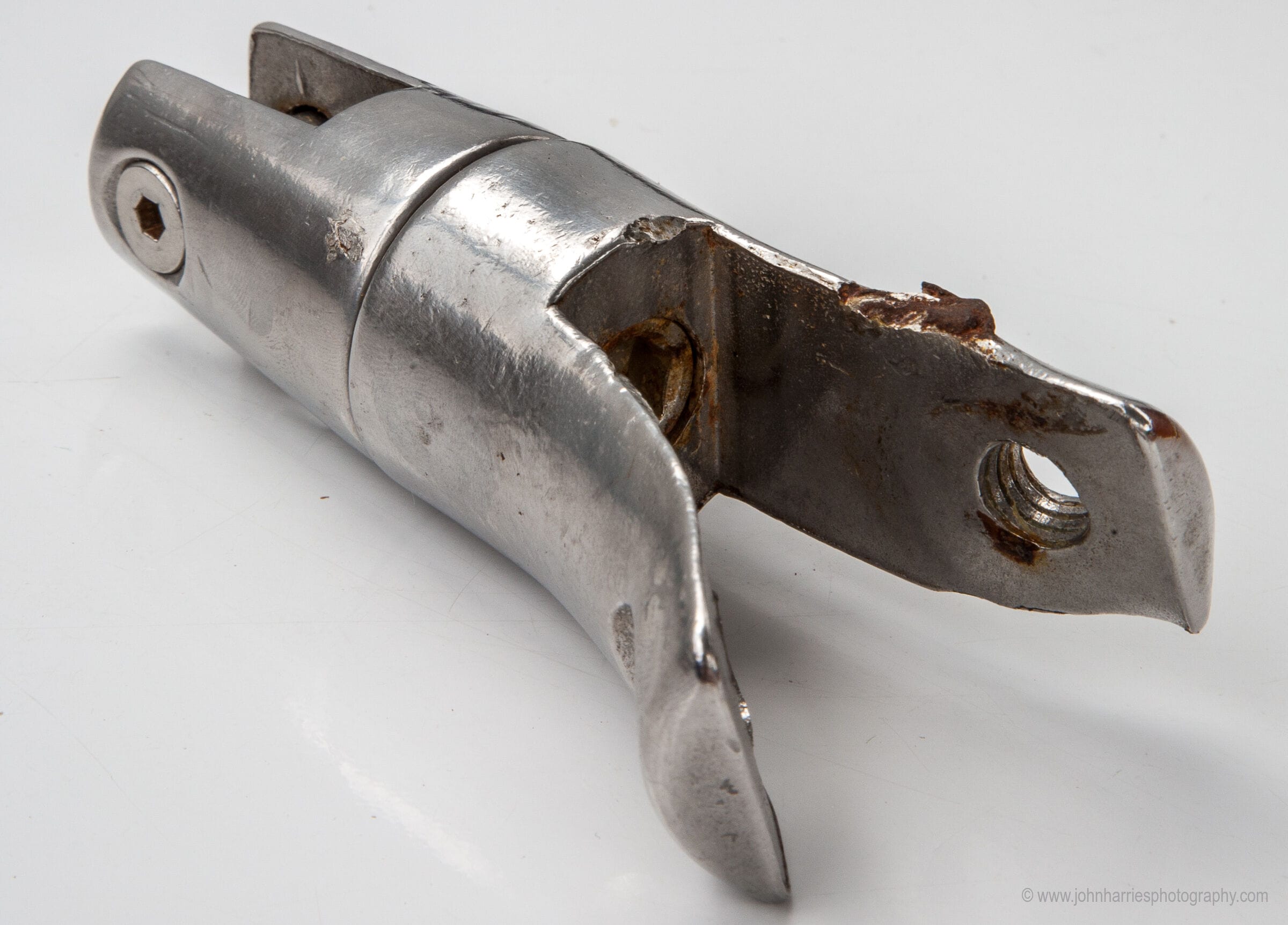
Perhaps the problem is due more to poor design rather than the swivel itself. What think you of the WASI?
A quick look around my marina revealed all boats with high test chains using standard half strength shackles. Just an observation not an excuse.
Your recommendation might be better stated as an appropriately sized high test strength shackle.
I always enjoy your thoughts and ideas. Thanks
Hi Carter,
Thanks for the comment and link.
I can’t say I like the WASI much either. While it would seem to be very strong and an improvement on the swivel that failed, it will still be subjected to the same forces and potential failure when the ball joint reaches the limit of its travel.
The bottom line is that I just can’t see a good reason to use any swivel in an anchor rode. A good quality galvanized bow shackle will always be stronger, size for size, and in addition costs a small fraction of the $200-400 that these swivels will set you back.
In over 100,000 miles of sailing including a circumnavigation and a recent trip to Greenland we have never used a swivel. I have never found a need for one and as John points out it is just one more expensive piece of equipment in the long chain of items that can fail. It won’t fail if you don’t have it. Also, if I search really hard I am sure I can find another more reliable and utilitarian item on which to spend that elusive $400.
I always thought these things looked untrustworthy, unnecessary and ridiculously overpriced. My chain gets twisted all the time, and it never causes a problem- just let it hang and straighten itself out for a few seconds before hauling the rest of it in.
An extra $300 gets you a bigger anchor…or more rode…or a better windlass…any of which would do a lot more for anchoring securely than a swivel fitting.
An interesting post but consider this; Three years back I was on the market for 200m of 1/2″ chain. I contacted a British manufacturer who claimed to make their chain in the UK, (and is a big name here). I asked for a sample of their chain that was supposed to be 100% proof tested to 4t. I had it independently tested as I am a paranoid skeptic and guess what? It yielded at 3.5t failing totally just over 4t, when its supposed minimum break was over 8t. When I told the company they just said;” Oh do you still want to place the order?”. They did not even bat an eyelid or ask to see the results; the sales assistant even admitted that they just brought it in. (And guess from which part of the world?) You need to be very careful with everything even if it meets all the specs and costs proper money.
Good to get the benefit of experience from multiple high mileage sailors, and even better to realise this means less equipment.
If exceptional circumstances should require consideration of a swivel (perhaps prevailing wind shifts, or tides, tend to rotate a vessel the same way every day), perhaps inserting the swivel a few chain links away from the anchor itself can avoid the lever arm illustrated above.
For myself, I have a faint feeling of unease with stainless steel being immersed, although we trust the manufacturers of such swivels are confident no crevice corrosion will occur in any part of the device. Apologise for thread drift, but does anyone here have an opinion on stainless chain (and stainless anchors)?
Martin
Hi Martin,
Our recommendation is no stainless steel whatsoever in the anchoring system.
Ideally, we like to see good quality high tensile chain from a recognized manufacturer, like Acco, who stamp every link with an imprint and who will provide a proof certificate.
It’s clearly a case of not knowing how the swivel should be connected to the anchor. As mentioned, there should have been a large shackle attached to the shank of the anchor; then any swivel can be attached to the shackle. But better still, is to put about six links of chain between the shackle and the swivel. This ensures a straight pull on the swivel. FWIW, this is not a swivel I would have chosen. Not all swivels are created equal!
In my case, there was no simple way to connect 3/8″ chain to a 121 lb. Rocna anchor other than to use a swivel. No shackle that would fit through the chain had even 1/2 the rated strength of the chain itself (I don’t have an oversize final link, and don’t trust a welder to put one in).
As I am well aware of the failure modes of traditional swivels as pictured above, I hunted around for something built strong enough to exceed the next weakest item in the ground tackle system.
Quickline’s Ultra Swivel fit the bill. Its design is similar to the WASI and the breaking strength of the 13mm version *at 90 degrees to the swivel axis* is 26,000 lbs. I’m comfortable that the chain would break (or the anchor would pull out) before the swivel parted, even if the latter somehow is forced to take a purely perpendicular load.
Hi Adam
I looked at the Quickline swivel by Ultra. It is made of 316 stainless. This, I understand, has much less strength than regular galvanized steel. I did not pursue this any further. Have you researched the strength of the Quickline swivel, or did you accept Ultra’s statement at face value?
Nick
John – splendid article on swivels. Like you, I was never able to see a reason to put one on an anchor rode. Thanks.
Since the WASI PowerBall and its copy by Ultra was mentioned: in addition to my response below, my opinion on these “ball-and-socket” designs is that they’re pointless.
The objective is ostensibly to alleviate the lateral loading on the swivel joint. However the more important issue is not this but rather the lateral leverage on the jaw sides when attached directly to the anchor, which both these ball designs still do!
Furthermore, the ball-and-socket allows an articulation of only 30 degrees. Hardly the 90 you might think is required. What is the point? It is a gimmick.
As to the Quickline specifically, it is produced in Turkey by the same outfit that make the “Ultra” copy of the Spade anchor (from only weak 316 stainless). Given the character of most imitators I would consider the quality suspect unless proven otherwise. There is a promo video which purports to demonstrate a supposed self-righting feature of this swivel in action, but it is really total nonsense, and the contents of their other literature does not inspire confidence.
Hi Adam,
I assume that you are using schedule 70 chain? Otherwise if G40 or BBB a high tensile shackle from Crosby will equal the SWL of the chain.
If G70, then I agree that a swivel might be better than getting a local welder to add a link of unknown strength. However the Ultra Swivel is still at risk for the type of failure shown in this post if attached directly to the anchor and a snatch load is far enough off axis that the ball joint reaches the end of its travel.
And I think the strength claimed maybe meaningless in this scenario since it was probably measured in an on axis pull test.
Maybe you could get Acco to to make you a short length of G70 with an oversize link in one end that could go between the swivel and the anchor as suggested by Paul and Martin, above.
After I closed the comments on this post, Adam wrote to us to say:
“John, I wanted to respond to a point that you made about my comments on the Quickline swivel. You suggested that the load limit that I quoted for the swivel — 26,000 lbs. — was measured axially. It was not. According to the president of QL — whose veracity you can evaluate for yourself — the swivel was tested to breaking with a 90 degree off-axis load. That was what gave me the confidence to choose his product.”
This example is much more an example of a poor product – poor design combined with inadequate materials – rather than any fundamental issue with swivels that will cause the sky to fall. The boater in question needs to seriously examine his product selection process/criteria, rather than erroneously conclude that he has proven that swivels per se are to be avoided.
Buying a cheap shackle of dubious quality from the sale bin in the chandlery is likely to prove equally disastrous.
Swivels are considered useful or even necessary by some, depending on the particular combination of anchor, bow-roller design, and anchoring habits. The general advice should be that if you don’t know you need one, you probably don’t… but to rule against them because there are some poor quality examples out there is great over-reaction.
Jaw-to-jaw swivel designs such as pictured are fundamentally flawed in the way they are designed to attach to the anchor. Do NOT use them in this manner; the failure mode is typically that pictured. They can have a length of chain installed regularly between them and the anchor, or at least a shackle. The ideal swivel design is an eye-to-jaw configuration, with a pin through the chain and a regular eye to be shackled to the anchor shank.
Regarding stainless steel in anchoring components. There is nothing wrong whatsoever in stainless used for anchor gear (with the one exception that it shouldn’t be used permanently immersed and is a no-no w.r.t. mooring set-ups for example). The problem is again one of quality. Stainless steel is very expensive – quality 316 chain costs around 4x that of stronger G40* galvanized from the same manufacturer. The price of more useful stronger G50 stainless is just ridiculous. In general stainless items should cost between 3 and 5 times the equivalent (in terms of both quality and strength) galvanized product – if not, you are getting what you pay for. The typical cause of many of the stainless steel “horror” stories is not some evil character of the metallurgy, but rather this factor in action.
*316 has roughly the same strength as mild steel, weaker than the 400 grade steel used in G40 or what Americans call high test chain, and far weaker than true high tensile 600-700 grades used in high tensile chain, high load shackles, or quality anchor shanks. John’s comments about brittleness are wide of the mark, 316 is fairly ductile with the exception of poor quality castings or very work-hardened fabrications; and the issue of laterally loading the swivel joint during recovery over the roller is not a serious matter – even a poorly designed swivel of inferior material will handle these relatively small forces without problem.
Of course the pricing discrepancies between stainless and galvanized products of comparable strength/quality means that the stainless option is one of greatly reduced value to the vast majority of people. However some small components like shackles, and indeed swivels, remain affordable and stainless brings good advantages. Just make sure the quality is good!
Hi Craig,
All good info, thanks.
One additional negative point about stainless steel. It is, I believe, very much more difficult to do high quality welds in SS. Any error in the feed of inert gas during the welding process can result in a brittle weld or one that is subject to very fast crevice corrosion.
I myself have seen a piece of SS chain where the welds corroded horribly in just a few weeks. Whereas, at least in my experience, even cheap no-name far east galvanized chain does not go that fast. (We are testing a piece out of interest on our foreshore in Nova Scotia as I write.)
So my point is that yes, as you say, there may be nothing theoretically wrong with the stainless steel for anchoring, but on a practical basis there seems little point in paying four times the price of say G40 chain to get a product with a higher potential manufacturing defect risk.
So to keep thinks simple, our recommendation at AAC remains: good quality brand name galvanized chain and shackles for anchoring. In North America we like Acco G40 chain and Crosby alloy shackles.
Of course it’s perfectly feasible to weld stainless, again it’s just a matter of quality. There was a Chicken Little piece published in a Caribbean centered magazine just recently where the author complained bitterly of a stainless steel chain failure, and screamed to high heaven about the need for everyone to learn from his tale of woe and avoid stainless or else…
His chain had failed where the weld of a link had totally vanished, probably as a result of sensitization from welding leading to what’s called inter-granular corrosion which essentially occurs because the all-important chromium in the stainless is depleted and permits subsequent rusting. The weld possibly also used the incorrect filler materials (the likely cause of such fast corrosion that you mention in your own example). Additionally welds must be properly passivated then cleaned. All of this is basic and standard and should not be an issue with any competent manufacturer. Basic rhetorical question: did the chain cost what it should have.
Near the end of the piece, it becomes clear that the author has no idea who manufactured the chain or where it came from. Ostensibly it was 316Ti, similar to 316L, but the veracity of this was not investigated.
Similarly, poor quality steel welding with pin-holing or the wrong materials can lead to problems with galvanizing and ultimate early failure. It is just a matter of having faith in the origin and quality of your gear.
Of course stainless is (or should be, as my much labored point boils down to) much more expensive, and obviously there’s little benefit to the vastly increased cost to the majority of boaters. If you can’t afford quality stainless, buying cheap junk is hardly an improvement over quality galvanized gear.
Anyway, back to the original point of the post: swivels.
I have certainly enjoyed all the different views and learned a lot from them.
Having said that, nothing has changed my view that anchor swivels are at best an expensive solution looking for a problem and at worst a dangerous potential failure point.
Never mind all the theory, I personally know two people that nearly lost their boats due to the failure of an anchor swivel. Sure we could debate for days on whether those skippers installed their swivels wrong, or used the wrong swivels.
Fact is that all the swivels I have ever seen have been installed directly onto the anchor shank and have been fork/fork designs.
Bottom line, as circumnavigator David Nutt said so well, “It won’t fail if you don’t have it”.
And on that note I think I will close the comments on this post. That’s the great thing about owning the site: you get to have the last word. 🙂
I am not impressed with the usual (boat jewelry) swivels chandleries push at recreational boaters. My windlass has trouble with twist and the chain jumps in the wildcat so I needed to find a viable swivel. I looked for swivels where commercial operators shopped. What is needed is called a swivel forerunner.
http://www.google.com/search?q=anchor+forerunner&hl=en&rls=com.microsoft:en-us:IE-SearchBox&tbm=isch&tbo=u&source=univ&sa=X&ei=XigyUf-BFIWFyQHHioCQAQ&ved=0CD8QsAQ&biw=1144&bih=607
Wow – that’s a long link. A forerunner costs a lot less and is made down to about 7/16 as the smallest. Note that attached with a Kentor link, the swivel is some distance form the ancchor, as it should be. I am buying one this winter for my new Rocna 55. I was quoted 180 bucks galvanized.
Couldn’t agree more. I almost lost my anchor through the under-cap rail bow roller when the swivel just came undone as the anchor was being lowered. Luckily, the release from the chain allowed the anchor shank to rise and jam so my $1500 Manson Supreme anchor didn’t go overboard. A shackle is to be used from now on.
Hi John,
Yikes, that was close. And imagine if it had happened one dark night. Thanks for the confirmation.
This summer I visited many marinas in Spain & Portugal. Marinas are great a chance to eyeball other boats..
The anchor swivels, as photographed above, were common wherever I went. Perhaps half of all sailboats I saw had these particular swivels on their anchor chain.
In most cases the swivel was attached directly to the anchor.
In the few cases where a shackle separated the swivel from the anchor, the shackle was usually inferior, being of significantly smaller diameter, or of stainless steel. Often there was no mousing.
Whew! What can I say?
Hi Nick,
I have made exactly the same observations while walking around mariners here in North America—scary stuff.
John ,
May have missed it in the reading : I do not see any mention of the old stand by
galvanized jaw- bow eye swivel ? They certainly appear more hardy . Have used one for a # of years . Your thoughts
Ted
Hi Ted,
I really don’t like any swivel, regardless of material. My thinking is that in most cases swivels are unnecessary and therefore adding one is just adding another point of potential failure. That said, I generally prefer galvanized fittings over stainless in an anchoring systems since they are usually both stronger and more reliable.
Also, as I said in the post, if one must use a swivel, there should be a short length of chain between the swivel and the anchor stock to prevent the kind of failure shown in the post.
John, while I can see your logic, would you make an exception for a stern anchor? A swivel in the sort of rough conditions (and laid out as you indicate) a stern anchor is typically deployed might reset that much quicker should the main anchor foul, drag or break out and/or its rode part. This is pure speculation on my part, but I can see where a stern anchor, were it forced to take the full load, would lurch about. A swivel might help a quick reset on a dark and stormy night.
Hi Marc,
I guess I really can’t see how a swivel is going to change anything in that scenario. A swivel does not have any affect on the direction of force. The key point being that even with very short scope and a chain rode (not likely with a stern anchor) that scenario is only going to impart one or two twists to the rode, which would, I think, be immaterial.
OK, thanks, John. As I said, I was just mulling scenarios inspired by the sight of my Fortress at the stern, the rode coiled down into a bucket.
Hi Marc,
Your welcome. One other suggestion: don’t coil your rode into a bucket. Better still, don’t coil it all. Instead, just feed it any old how into a bag and it will come out without a problem every time. Coil it and you will often have a huge snarl, probably when you need to most.
Back in the day we used to carefully coil our 100 meter shorefasts, and every time they would tangle. Then an old Arctic hand showed me that he kept his in old potato bags and never had a tangle.
Coiling imparts twist and twist imparts tangles.
Understood, John. The guy who sells me coffee has sacks fit for purpose. I’ve been using them to cover over the kitchen chairs, but “rode sack” works, too. It’s only in a bucket because that keeps it tidy on deck. We’re not even anchoring regularly yet, and certainly not by the stern. Good tip, though.
Hi Marc,
In addition to John’s good comment about stuffing the rode into a bag, there are a few other tricks worth knowing for how to deal with long, large diameter lines. Ballantine coils are an excellent way to make sure a line pays out correctly and what I use if I am expecting to need a line in a hurry but have the luxury of laying it out ahead of time. If you start with a coiled line and need it quickly, you can also just lay it out, loop by loop from the coil but walking the loops back towards you slowly so that it looks like a large coil lying down that has been spread out sideways a bit. I used to handle lots of very long, large lines and both of these tricks saved me many times. Whenever someone tried to cut a corner, they would end up with a ball of 400′ of line that could take 20+ minutes to untangle. I was always amazed at how many people didn’t know to throw the bitter end out of the way so that it couldn’t go through the center of the coil.
Eric
Good tips; thank you, Eric. We customarily lay out rode on deck first in loose “snake” fashion to check for kinks. It’s made possible by six-inch pipe rails to keep it there. I had to look up “Ballantine coil” and I’m glad I did. We typically Flemish coil our halyard tails, but this is a great idea for a long bit of rope rode.
I am in the process of replacing my old 8mm chain with Grade 70 8mm chain but I am having a bear of a time trying to find a bow shackle that matches or exceeds the chain strength. The chain I am buying has a WLL of 1400KG and a BL of about 7000KG. Any suggestions on an appropriate bow shackle. ? The only thing that comes close is the Wichard range of Stainless Steel HR swivels that exceed the working load of the chain but have lower breaking loads. I would like to avoid Stainless Steel if possible.
Hi Patrick,
I tackle that issue in this post:
https://www.morganscloud.com/2013/09/25/which-anchor-chain-should-we-buy/
Hi John,
I am just in the process buying a new anchor chain (I chose Aqua7 high tensile chain). I am thinking about which shakle to use. I also found high tensile shakles called Green-Pin. I am wondering if I should use following configuration: Anchor->shakle 1 (eye to anchor)->shakle 2 (eye to bolt of shakle 1) -> chain to balance the loads when anchor is swinging in tidal waters. Or is it ok. to use this configuration: Anchor -> shakle (eye to anchor and bolt to chain) ->chain.
Thank you very much, and – your books are very interesting and helpful
Best regards
Rolf
Hi Rolf,
It’s generally better to use a single shackle with the bow through the hole in the anchor and the pin though the chain. This allows the shackle to pivot to the direction of load.
One other thing. As far as I know there is really no such thing as “high-tensile” in shackles or chain. Good quality chain and shackles are graded. See this post for more: https://www.morganscloud.com/2011/05/11/things-to-know-about-anchor-chain/
I know this sounds pedantic, but the reason I bring it up is the use of the words “high tensile” can often mean that the chain is low quality and not proofed. Ditto shackles.
For more on our recommendation for shackles see this post:https://www.morganscloud.com/2007/09/01/which-anchor-shackles/
Hi John,
This is my first message here on AAC, but I’ve been an avid reader of the your articles and learned so much from so many experienced contributors these past couple of years.
One question about linking chain to anchor:
You mention that it’s better to use a single shackle as described above. In one post from 2010 named “Two Crosby 209A shackles attach high tensile chain to the shank of the SPADE anchor on aluminum sailboat Morgan’s Cloud.” I see two back-to-back shackles between the chain and the anchor shank head. Which way would you say it’s a better way for the anchor-chain link? Deciding which way to go as I finally toss my swivel where it belongs…to the trash bin!
Thanks for the insight!
Ricardo.
Hi Paulo,
The best answer to to attach the anchor with a single shackle with the pin through the first link of chain. However, this does require the anchor to have a slot type attachment point to allow the shackle body to pass through.
Being attached the way we were in the photo is a second best alternative. Given that the SPADE has a slot, that was a mistake on our part, since corrected.
Hi John,
Thanks for the reply. We have a Spade as well (thanks to all the knowlwdge I’ve read and gathered here before buying our first vessel). In 2 years never dragged an inch and only failed to set once.
Had up to F8 winds here at the Balearics 10 days ago and we were anchored on sand. Needless to say I slept like a baby. Next day Spade came out effortlessly after 48 hours of strong winds and a lot of swinging.
I’m ashamed to admit though that I’m only now getting rid of our swivel 🙁
So one shackle it is for us!
Cheers,
Ricardo.
Hi Rolf,
Further to my last. I just found that Maggi do use the words high tensile, or at least some of the dealers do. If the chain you are buying is Maggi, then I believe you are all good. I have not used Maggi chain myself, but have heard lots of good things about it, and seen to remember it did well in Practical Sailor destruction tests.
Assuming it is Maggi and you selected G70 grade, the next challenge is that, at least as far as I know, there is no shackle that will fit through the chain link and still match the strength of the chain.
More here on grade 70 chain:https://www.morganscloud.com/2013/09/25/which-anchor-chain-should-we-buy/
Hi John,
my decision in buying a chain is coming into the final steps and I have a question.
The chain will be delivered with a “high tensile” shakle from gunnebo-factory in sweden. http://www.toplicht.de/de/shop/anker-und-ketten/kette/kette-stahl-verzinkt/endglieder-fuer-die-ankerkette-aqua7
Breaking-load is 70 KN – same as the 8mm G70 maggi chain. So far so good.
I am a bit concerned about the two pins holding the bolt. I have written to gunnebo and asked if it’s reliable, but didn’t receive an answer yet.
Maybe securing the pins with loktite is advisable. What do you think?
Do you know these shakles?
Best regards
Rolf
Hi Rolf,
I have to confess to always being nervous of new (to me) bits of gear in anchor set ups. It’s just impossible to know how the law of unintended consequences may manifest.
That said, this link does seem to solve the problem without the need for a larger end link. If I were using it, I would coat the pins with red Loctite (the permeant kind) before driving them home. I would also carry at least one spare link in case I needed to remove the anchor for some reason (end for end the chain) since I don’t think I would reuse the link after driving the pins out.
Hi John,
to me it also seems more safe using loctite.
But perhaps I have another solution and perhaps this is a good hint for european sailors.
I found titan shakles which with 10 mm bolt which have a breaking load of 6250 kg coming nearly into the range of G70 chain. I hope that 10mm shakle can be fitted to 8mm chain. But I think it should work.
Manufactored in Canada ;-))
http://titanmarineproducts.com/
Best regards
Rolf
Hi John,
thank you very much for your answers.
The Aqua7-chain I am going to buy is a maggi chain.
Well, about the shakles I will have a look if I get a dealer Crosby or Acco here in Germany.
Otherwise I have chosen Green-PIN shakle but I will need that in 11 or better 13 mm to get the strength of the chain, which is a 8mm-chain. I hope that works.
Best regards
Rolf
Like John I always eschewed anchor swivels. They are a weak link. However, lately we have been anchoring for long periods of time and as the chain came aboard with lots of twist it was continuously jumping off the gypsy. So I decided to install the anchor swivel while we were in benign anchorages with the idea of removing it for voyaging.
What I noticed was that most of the photos of failed swivels showed them spread apart. Attaching a swivel directly to the anchor introduces a huge amount of side-loading. Side-loading is always a problem in equipment under tension; lack of articulation in standing rigging terminations is an example. The “fix” to attaching an anchor swivel, if you decide to use one, is to cut a length of chain (at least 4 links) to go between the anchor and the swivel.
Reading the comments above I saw links to a “kenter” and “swivel forerunner” which server the same function.
Jeff Stander
s/v Beatrix
Hi Jeff,
I agree, if one must have a swivel, that’s the way to do it.
Hi Jeff,
I’ve found this forerunner from a Dutch manufacturer:
http://akfanchorchain.com/products/chains-accessories/swivel-forerunner/
Although they call it a swivel, I think the name is a bit misleading as I don’t see it as a traditional swivel we are used to seeing.
So, I was wondering if having this forerunner with suitable D-shackles on both ends (anchor and chain) would “solve” the issue of having a swivel and at the same time avoiding possible (although rare) problems with chain twist?
Anyone has experience with this arrangement? Any real benefits to this added “complexity” to a system that should be as simple as possible?
Any thoughts John?
Cheers,
Ricardo.
Hi Paulo,
I agree that this looks like a better alternative than many swivels. That said, I still don’t see the point in adding the potential weak point given that in all my years of anchoring I have never had an appreciable problem with chain twist. Given that, to me at least, all swivels are a solution looking for a problem.
Thanks for the feedback John.
I agree with you, your solution is safer and simpler, and I find there’s a certain elegance in simplicity.
I decided to go with the following Dutch-made Greenpin:
https://eurorope.nl/sales/shackles/green-pin/standard-shackles/bow-shackles-safety-bolt-g-4163/
Our specifically is the 1.5 WLL shackle with a safety bolt and a safety factor of X 6 giving us a 9t breaking load, which is more than sufficient for our 8t plastic vessel and it’s SPADE attached to a 10mm G40 chain.
Does this seem like a decent solution? Any suggestions are appreciated!
Cheers,
Ricardo.
Hi Paulo,
I’m more used to shackles that we can wire closed, but that’s probably just habit. That said, I would definitely put red loctite on the nut in case the split pin fails.
Hi John! Still being a newbie but reading the above might I suggest the Mantus swivel. Seems to tick all boxes ecxept SS. Might also be a solution for G70 chains having size trouble. And for those doing 360’s around their anchor.
https://www.mantusmarine.com/mantus-swivel/
Hi Rob,
Thanks for the thought, and I agree that the Mantus swivel solves some of the issues in the above post. That said, I’m just not a fan of swivels since I have found them simply unnecessary, even when having spent several weeks anchored in one spot. Also, I really don’t like to see anything made of stainless steel around anchoring gear.
To add : they have the S2 swivel for 8mm G70 chain with a WLL of 4300 lbs and a safety factor of 5!
We’ve been using the Ultra Anchor swivel on our liveaboard yachts for the past eight years with excellent results, oversized swivels with oversized anchors… we sleep well at night. The Ultra swivel is actually stronger than the 12mm chain.
Hi Liam,
Each to their own. I’m still not a fan of adding the moving parts of a swivel to an anchor system. Also note that the problem with swivels is not one that is generally fixed be raw strength, so a good idea to put a short length of chain between the swivel and anchor so that the swivel is not subjected to off axes loads.
Hi John,
Our Manson 80LB (36kg) replacement, a Sarca EXEL 40kg arrived. I also got a Force 7 bow shackle for the 12mm chain, the 1/2″ model has a 16.130kg BL. Unfortunately it is too wide to run through our arm design.
I looked at all the Crosby models since you recommend but they are all too wide. Seems like I will be stuck with the Mantus 1/2″ Inox bow shackle which has a BL of 6.697kg
I just had the idea of a webbing backup, 12mm dyneema 8 wraps. What is your opinion on this? Of course I realize this should be replaced every season or so.
Could it work?
Hi Anton,
That’s an interesting and innovative idea. I can’t see a problem with it, but then again the law of unintended consequences is always lurking around boats when we try something new, so I would monitor this very carefully, at least at first.
Also, I note the shackle is not wired, but maybe you just set it up that way for the photo and you intend to wire it later. Given that the hole in the head will only take one or two turns of wire, I would also use red loctite on the threads as a backup, although I would be happier with a shackle that could take more mousing turns.
One other thought, I’m not a fan of stainless steel in the anchoring system because of it’s unpredictable tendency to crevice corrosion and embrittlement.