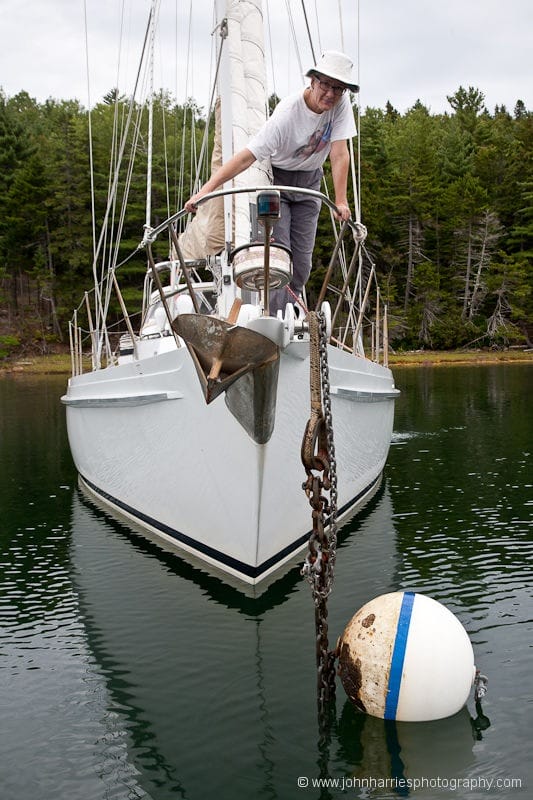
On Morgan’s Cloud we are always looking for new and better ways to minimize the chance of damage when riding out storms or hurricanes at anchor or on a mooring. And given that we have spent a lot of time in the high latitudes and further that I kept boats on moorings year round in Bermuda, where it blows like the hammers of hell in the winter, never mind a pretty good hurricane strike every year or so thrown in for good measure, we have had a lot of opportunities to experiment with gear and techniques.
Great article. I agree that the mooring line over the bow is an often neglected weak point. Anchoring for Hurricane Gloria (if I recall the name correctly) in 1985 I backed up the rope hawser with a piece of chain shackled directly to the mooring chain, led through each hawsepipe, and back to the mooring. I figured if I was going to find my (then) 32 footer ashore it would be from dragging its 500# mushroom through mud 23″ thick!
I’m curious as to what material is the blue chafing gear in your pictures. I usually use a heavy firehose, but it is sometimes difficult to work with and hard to get an eyesplice pulled through..
Hi Max,
We will do a short post on the chafe gear.
I too have read of the theory that plastic water tubing of some sort will cause an anchor or mooring line to heat to the point of melting, and I have read also of nylon line heating up. However, having anchored successfully in a couple of hurricanes, numerous gales, several parachute sea anchor sessions, and many other big blows I have never experienced either of these phenomena, and I have never seen it documented by a reliable source. My nylon rodes have clear plastic PVC tubing slid over them permanently, and I just slide this gear into place and it has perfectly protected my rodes through lots of storms. Maybe one reason is that I use fairly large diameter tubing and lines. I inspected a lot of boats that washed ashore after Hurricane Bob, and most were due to chafe exacerbated by not enough scope and indadequate lines in the first place. In most cases I would consider the chafing gear used inadequate, but on the other hand I can’t imagine being tied to a mooring with chain only during a hurricane. We had six-foot seas in Cuttyhunk harbor during Bob and the snatch loads on chain would have been horrendous.
Hi Kettlewell,
Here is some solid data on the problems with nylon.
As to having all chain to the boat in the event of the pendant failing, I still feel that a Dacron, or even Nylon pendant actually has very little spring effect due to its relatively short length. That is why we have a truly massive ground chain that provides at least some spring.
Of course it is vital, when expecting very high winds, to search out a harbour which will not be subject to any swell at all. I think that if for some reason I was caught out in an open area subject to swell it might be the one time I would consider anchoring on a very long rope rode.
The one time I was aboard the boat for a Cat 3 hurricane I was amazed to find that the chop size was very small even though the fetch was about 1/2 a mile. The water was simply blown flat
That material from Dashew is interesting, but mostly anecdotal. Any number of things could have made those lines give way where they did. Were they chafed at those spots? Caught on something as they went over the side? Who knows? Yes, I too have seen that rope companies now tout their very expensive polyester mooring lines as superior, but I’m not sure that counts as proof. Like Dashew noted in that article, one of my personal data points is a 3/8″ nylon snubber line that I used for close to 10 years on the bow of one of my boats. It became a matter of interest to me when or if the thing would ever fail. Prior to it being used as one leg of my anchor bridle on a cat it had been used as a chain snubber for a number of years on another boat. It was used in numerous gales, one hurricane, several sea anchor sessions, etc., and most of the time with absolutely no chafing gear whatsoever! The fact that it never failed made me rather confident in the strength and durability of my 5/8″ nylon anchor rode used on that same boat with vinyl tubing as chafing gear. On my mooring pendant I use enough hose to cover the entire length from the cleat to well over the bow roller. Having observed the pendant under load in some pretty severe blows I am rather amazed at how much it does stretch. If a storm is expected I always back up the main pendant with several back ups of equal strength in case one should fail.
Dear John
My mooring has no swivel. No problem. The mooring is a 6 ton concrete block buried in mud / large ship’s chain / 2″ diameter polpropylene / two floating 1″ bridles that come on board port & starboard.
You could get rid of the swivel. If you go sailing now & then, that will let the mooring unkink itself while you are away.
Or get a massively oversized stainless steel mooring, eg 1″ diameter. Massive to reduce probability of failure of the swivel. Stainless to optimize swivel function. Galvanized swivels tend to be sticky, and rust easily at the swivelling part, ie they don’t swivel well & I do not really trust them to do this. To avoid electrolysis, attach the SS swivel to SS shackles & rope, not galvanized shackles or chain. For easy inspection, keep the swivel at the top of the mooring.
Nick
Hi Nick,
Thanks very much for the solid real world data on not having a swivel. I think I’m sold on removing my mooring swivel—just one less thing to fail.
One point on your SS swivel suggestion. I think that I’m right in saying that stainless steel should never be used in an application where it is permanently immersed in salt water.
As to swivels, I suppose it depends on where you moor your boat. For many years I’ve been moored in tidal rivers, which means my boat changes direction at a minimum of twice a day, but often more times depending on the wind direction and what the current is doing. Without a swivel you could very soon wind up that chain until it is very tight. Also, I’ve anchored with more than one anchor numerous times, and I’ve noted that it almost always requires a couple of unwinding sessions per day or else the lines get seriously wound together. Even after hanging on only one anchor for a week or two in some places I note that the chain is hockled up when I pull it (no swivel on my main anchor). Murphy’s Law seems to rule, or maybe it’s the Coriolis effect! Whatever, lines and chain twist up and cause problems.
Hi Kettlewell,
Thanks for the input. I think you are right, the mooring swivel or no swivel decision is one that there is no hard answer to, it just depends where you are moored.
Ditto on the effect of anchoring without a swivel, in that we spent most of a winter two years ago anchored with just 80 feet of chain for up to a month at a time—we were working on our guide to Norway—without any hockling at all in the chain.
Like so many things in cruising, it just depends!
John and Phyllis,
Thanks for a very interesting topic.
We prepared for H Bob in Chatham, MA. with 1 1/8 three strand nylon, polyester chafe. Then hauled the boat at the last minute! Now it is time for something new
Does anyone have an opinion on the new Dyneema mooring system from N E rope. 12 strand. They claim it is horrendously strong 68,000 lb at 3/4 dia. Very light, floats and chafe resistant to boot. Looks and feels like something one might find at K Mart! Thinking of attaching a bridle of this to a 10 ” piece of 1 1/4 nylon, for stretch, or just skip the nylon? Might not need the chain.
cheers, Eric and Sue
My feeling on something like Dyneema is that it is probably a great answer to a problem that doesn’t exist. Use a big diameter nylon pendant with good chafing gear and it won’t fail. Back it up with a second pendant if you’re worried. I bet you can put together two 3-strand nylon pendants for less than one Dyneema.
Hi Eric and Sue,
I think the Dynema idea is very interesting for mooring pendants. We use spectra lines for shorefasts on “Morgan’s Cloud” and found Dynema to work very well when boat sitting Polaris in Greenland last winter.
I guess though, when all is said and done, if storm force winds are coming, I still like our chain backup to any pendant. But then I’m a belt and suspenders kind of guy.
If you do have any nylon at all in the system, make sure it is massive. I still think that this melting when cycle loading problem is real with nylon. In my years in Bermuda I saw way too many boats on the rocks with the remnants of a nylon pendant, or even two, hanging from the bow.
Dear John,
One good reason to use the Dynema line is that it is much lighter.
Those heavy bridles are tussle when day sailing. Worse when there is a bit of weather.
I have little experience on moorings in heavy weather, but have sat through a Caetgory 2 and a Cat 4 hurricane in our old 40 footer, on our CQR. We had 90 ft chain and 90 ft 3/4″ 3 strand nylon on the boat end of that.
I feel that the rope part was essential to survival. Chain gets rigid above about 50 knots, creating enormous loads.
We had a 3″ roller, about 4 ” wide. The side plates of the fitting went a couple of inches forward of the roller, and were then bent round 90 degrees on 1″ radius. I think that is the key to avoiding chafe. Simply taking the sharp edge off a stainless steel plate is not enough.
We protected the rope with a dishtowel tied around it in David (Cat 4) . No visible damage. (We were on board and checked frequently.) We still had the dishtowel when Frederick arrived, so used it again for chafe protection. It lasted a year or so as a dishtowel after that.
Hi Neil,
I think you make a really good point about the need to properly radius any edges that will chafe on rope. Most such edges, including many on our own boat, have too small a radius. Your 1″ radius sounds like a good standard.
John,
Great write up and I think I know which mooring installer you are talking about. I ran into you there a couple years ago and we had a good discussion on anchors as you were eyeing my Rocna. We discussed your frustrations with your CQR and how much you liked your steel Spade.
I would argue strongly that they have not been problem free from eliminating swivels. I suspect this was more a financial decision than one of safety. If it’s the one I am thinking about they untwist mooring chain on a regular basis after the boats twist them into a 1:1/vertical scope. Many in this field have also moved to above ball connections which are constantly wrapping the pendants in the chain. It seems like every time I go to my boat I can count boats that have sucked the ball below water from chain twist by this installer or ones that have the pendants wrapped around the chain:
http://www.pbase.com/mainecruising/image/102702039.jpg
I have also seen these same boats relocate their moorings in 25 knots or less due to the near vertical scope and the resulting sucking of the mooring out of the mud. Add 25 knots to near vertical scope and it becomes a recipe for relocation. The installer I am thinking of is also disobeying a town ordinance that mandates top swivels. This town mandate is not without good reason, tide, wind and current can spin these boats multiple times in a day and some of these boats get used infrequently so a storm could pop up before an owner even knew he/she had chain twist..
I would keep your swivel but maybe over size it to 1 1/4″.
Twisted chain can also load the chain on the long side of the link, especially long link mooring chain. This can make it more prone to load failure than pulling it in the design direction. Shackles are also are not designed to be side loaded. Chain twist is not good if a storm blows in.
I have always used grossly over-sized swivels because I recognize they are a high wear item. I use a 1″ swivel on 36′ sloop with 3/4″ top chain and USCG bottom chain that weighs about 12 pounds per foot. I also use Chafe-Pro chafe guards & Yale Polydyne Pendants (amazing pendants). I regularly see my swivel out last my top chain but both get replaced at the same time. In 37 years of mooring boats I have never experienced a swivel failure but I inspect them on a regular basis just as you guys do. This is why they should be at the ball not between the top and bottom chain. The extra $66.00 ,over the price of the 3/4″ swivel ($105.00 vs. $39.00), is cheap insurance.
One area of concern I have been observing now for many years is that of anchor chafe of the pendants in storms. I took some great photos of a pendant failure just last week and the write up and five pages of mooring photos can be seen at the link below if you are interested.:
http://www.pbase.com/mainecruising/mooring_prep
I agree on the need for a mooring swivel, but I think you can get away with no swivel in an anchor system as long as you don’t spend too much time in one place on the hook in an area with a reversing tidal flow or swirling winds that swing you around the anchor. For example, we have anchored for weeks in the Caribbean with no change in wind direction. Without a swivel once the anchor has broken loose from the bottom most of the twist in the chain will naturally come out as the anchor is hauled to the surface. Interesting point about anchors on the bow when a boat is on a mooring. In general I notice that most boats on moorings have a combination of inadequate painters, poor or no chafing gear, bad leads on the painter, and often inadequate scope to the ball. It is a wonder more boats don’t break loose!
Hi RC,
Great stuff on your site on mooring issues, thanks for the input. Also, a good point about the swivels. We too use a massively oversize one. It only looks relatively small because all the other gear around it is massive too!
One point though, we have seen two mooring swivels that have failed due to the small weld holding the nut corroding through and allowing the nut to back off. Just another reason to have swivels at the top of the system and check them really often.
Our Dynex Dux Dyneema Mooring Pendants are the best around, stronger than steel, chafe resistant, absorb shock and float! Plus our 7mm Mooring Pendant has a break strength of 16,000 lbs. The shackle, swivel or chain will break before the pendant.
Our core technology allows the Dux stretch with a soft entry with a controlled stretch and rebound.
Synthetic rope as mooring pendants and dock lines are the best thing to have for a storm or general use. They won’t get stiff or hard to use over time due to creep. They are much easier to handle due to their size.
Hope this helps anyone preparing for a storm..
7 mm is about a quarter of an inch. There is simply no play for chafe here. This is a mooring pennant.
John….I’m in the process of locating a strongpoint on the bow to act as a tie off for this type of application. A discussion that I was just having with a fellow boater in the area centered around the point loading that might occur with this type of system. Do you feel that a solid 1″ thick fiberglass deck ( I know because we just redid the foredeck and added G10 in the core in certain areas) would stand the point loading? Are you taking the load on your mooring pennant with slight slack in the safety chain or is the chain taking the load? Other pertinent information might be that the chain from mooring ball to concrete block on the bottom is 1/2″, water depth is 15′ . Boat is a Passport 40 approx weight of 28000 lbs.
Thanks for your feedback……Ernie
Hi Ernie,
First off, in our case we use the chain as a backup only, in case the pennant chafes through. In the normal course of things, it hangs slightly slack and the pennant takes the load.
As to the point loading in you situation, I’m not an engineer, so anything I tell you is based on experience and guess work. Having got that out of the way. My gut would tell me that 1″ of good quality solid glass layup should be plenty strong, as long as you use a good big backer plate to spread the load from the bolts. If it were me I would use 3/8″ aluminum for this and make it at least 6″ square and preferably bigger.
On your mooring, if you are saying that the half inch chain goes directly to the concrete block without any ground chain, I don’t like that at all. I would want to see at least 20-feet minimum of 1″ ground chain and 1-1/4″ would be better. The half inch should be fine from there up to the boat, as long as it is good quality.
Also, I really don’t like concrete blocks for moorings. See this post for why.
John..I will stand corrected. I do believe that we have some larger diameter that lays on the bottom. Will double check with our harbor master and club diver as to the exact layout.
Thanks for your input on the strong point. I will be laying in a substantial backer plate as you suggest.
When Irene came through our area this past fall, there was another lighter Hunter put on our mooring. Unfortunately, the owner paid little attention to the chafe issue and sure enough the boat made an unplanned excursion through the mooring field. The ground tackle was fine however. The lesson was once again pounded home….chafe, chafe, chafe…
As always thank you to you and Phyliss for such a terrific site. Bette and I eagerly read your posts as we ready our boat for relaunch in the spring….Ernie
Nick, we offer mooring pendants 7mm & 9mm which are small diameters. The 7mm is equal to 5/8 nylon in in breaking strenght and the 9mm is equilivent to 1″ nylon. Dyneema is very abrasion resistant but we use Dynex Dux. It has higher dyneema content than most ropes plus it’s impregnated not coated with Duracoat. It’s heat treated and prestretched, that’s why it breaking strenght is much higher for the same diameter than other dyneemas.
If you want we could add a dyneema chafe sleeve.
The core acts a snubber, as the line stretches it compresses the core. We can set the pendant up to have more or less stretch.
I’m confident that our all dyneema pendants are the best. I ‘ll make you guys a good deal on exactly what you want. The Dux is the toughest synthetic on the market.
I’ve learned more from this one article and comments in 1/2 an hour than I’d get in any one book. However, please refrain putting sales pitches for your particular products in the comments section. Take out an ad if you want but please don’t do it here. I’m a new subscriber to Attainable Adventure Cruising and don’t want these areas to get cluttered with ad-like comments. (It’s like watching TV during the political campaign season. You just end up turning the blasted thing off.) I mostly want people’s experiences and some “hard data” to go with it…but mostly the experience (field tests) is what counts and the article’s comments were filled with these. Dear Sail Safe, Inc.: Force feed me your product by taking advantage of the comments contents is a bad business strategy. You clearly misunderstand the nature of the article and the comments that go with it. It’s not just about product. It’s about common sense, technique, weather, how different pieces and processes work together (or don’t)….and mostly about sharing experience. The “opportunism” expressed by Sail Safe, Inc. means they obviously care more about sales than the integrity of the comments section or our and our vessels safety. Not that they never had my business before…but they are now and definitely on my “to avoid” list. I encourage Attainable Adventure Cruising to make efforts to prevent comments on articles such as these from turning into billboards and self serving sales pitches.
Hi Peter,
Welcome to AAC and thanks for the kind comment on the article.
Rest assured that we carefully monitor the comments and delete any that don’t add value or that are blatant attempts to use our site. Having said that, I deliberately left the Sail Safe comment since it informed us all about a new and innovative product.
Do I like the idea of Dyneema mooring pennants? No, probably not, although I’m open to being persuaded by logical argument. But I do think that censoring the comment and depriving our readers of that piece of knowledge would not have been the right thing to do in this case.
I to not think the dyneema pennant will give significant elasticity.
A few days ago we were tied up to concrete floating dock, and I put a 6 ft length of old T900 3/8″ dia, from the midships cleat to the dock. In just the 6″ waves from a breeze, Milvina (14 tos) rolled slightly and stopped with a vicous bang when the dyneema took the load. Replaced with 5/8″ nylon, neither the roll nor the stop at the end were even noticable.
I know this thread is quite old now, but seemed the most appropriate for this question.
Don Jordan strongly advocates mooring from the stern (bridle) for storms with many of the same arguments that make his series drogue so effective. Primarily the reason being stopping of violent yawning and the shock load effects of it. His theory seems faultless and is also backed up by research and empirical modelling. Nevertheless there seems to be little adoption of this practice? Has anyone tried this and/or can offer their reasoning why they don’t think it a good idea?
Hi Bruce,
I think that Jordan is absolutely right. People are often surprised to see Phyllis and I backing up wind in a tricky docking situation, but actually it works very well because the bow does not fall off—same theory.
The problem is that most boats are not equipped with really good cleats and fairleads aft to take the load and to handle chafe well. Also, being on a boat stern moored in a big blow can be unpleasant because the shelter of the dodger goes away, so the companionway must be kept closed and it is difficult to keep an eye on things.
Thanks John
Boats that already have JSD attachment chain plates like you have done could use their JSD bridal. I understand the issues with possible companionway water ingress, dodger and Bimini exposure but with an impending storm one could remove, make fast, seal etc. also I guess in fair and warm weather one might benefit from a cooling breeze blowing into the dodger. When I’ve setup my JSD chain plates I might give it a try.
Hi Bruce,
I think you are absolutely right. I have not tried it simply because our boat lies quite quietly at anchor in a big blow, particularly with the headsails taken off the curlers, as we do when expecting any really big breeze.
When you try it, please let us know how it works for you.
Hi Bruce,
I have done a decent amount of cruising aboard a boat which always anchors from the stern. In the case of this specific boat, it is definitely the way to go but the design of this boat is relatively extreme and I wouldn’t choose to anchor this way on most boats as the cons would outweigh the pros for me. Also, I believe that this topic came up in the comments to another one of the posts here but I can’t remember which one.
The best part of anchoring from the stern was that the boat was better behaved than any other boat that I have been on. Part of this is that it has a very large mast stepped quite far forward combined with almost being a double ender but we were basically motionless even in gale force conditions. The other great thing is that anchor handling is really easy because it is done right next to the helm and most boats will just back straight up into the wind.
Unfortunately, there are drawbacks to anchoring this way. The scariest one to me is that if you start dragging, the boat will take off headed downwind at high speed and give you very little time to react. In situations with current, the boat that I have done this on is very poorly behaved and “tacks” all over the place. When it gets rough, the stern doesn’t cut through the waves as well as the bow although this wasn’t that bad as the boat was almost a double ender. I am stubborn and try to always sail on or off the hook and I haven’t yet come up with a good way to do that when anchoring off the stern as you end up trying to handle sails on a run (no roller furling on this boat).
Finally, it is worth mentioning other people’s reactions. We have had the experience where people don’t realize that we are anchored. Also, it is pretty common to have someone come over and try to explain the basics of anchoring.
Eric
Hi Eric,
Thanks for fielding that one with real world experience, always the best kind.
Protecting mooring etc lines: I use old firehose. It has rubber on the inside and a tough outer sheath of artificial fibre – not sure what but it seems too hard for nylon. I get the hose from our local fire station and they are glad to get rid of it – for a small contribution to their coffee fund. It is the most abrasion-resistant sheath I have come across and is easy to fix in place – a couple of holes made with a soldering iron and some light line to fix it in place. It also makes excellent dinghy fendering when filled with a foam core eg insulating foam tubes for hot water pipes. There are probably a load of other uses – really good stuff to have in the bosun´s locker.
Hi Bill,
Fire hose is one option and fine for chain, but not one I like for rope. The reason is that any material that is waterproof stops the rope ventilating heat or being cooled by rain or spray. Recent studies have shown that many bridle and dock line failures that we used to think were from chafe are in fact due to melting of the fibbers from the friction against each other due to cycle loading.
Back before I knew this I, like many sailors, used to use plastic hose for chafe protection, but now I have gone over to tough fabric solutions like the one in this post.
Try this:
http://sail-delmarva.blogspot.com/p/chafe-gear.html
About $2.50/foot and it wears like iron. If you rig it loose so that the rope can move inside, no wear.
Hi Drew,
Looks good for lines that are set up for the long term. That said I like the Chafe-Pro solution because they can be quickly wrapped around a line the moment I notice some chafe without the need to feed the line through the chafe gear from the end.
Hi Eric,
That all sounds well thought through. We have not had a home mooring in > 15 years and I know I would set it up differently now.
We felt fortunate in hurricane Bob to be anchored upwind of the mooring field in Onset for the first first part of the blow. When the eye passed over the now upwind mooring field was pretty much empty so the danger from other boats had vanished pretty much.
The ability to splice 3 strand does make it jump out in attractiveness. I have found it (actually NE Premium) really quite resistant to chafe, but I think I am lucky to have fairly good radius-ed leads for rodes, dock lines, snubbers etc.
My best, Dick Stevenson, s/v Alchemy
Great article and comments!
This reminded me of how I end my anchor chain. I have a strong line spliced into the chain end and secured to a strong eye below. The line is the right length to come on deck and stop the chain while it is still on the anchor winch. This prevents a runaway anchor and chain, yet allows one to cut the line on deck without going into the anchor locker in an emergency. I secured a light (~1/4″) 50 foot polypropylene floating line to the end of the chain. This floating line can be used to retrieve the chain if I ever have to drop the anchor and chain, I don’t have to and may not be able to to tie on a float in an emergency.
Hi Charles,
We are rigged the same way, but without the PP floating line. I really like your addition. Much better in an emergency. I’m going to do the same.
That’s a very good idea. I have a Dacron-covered Dyneema “fuse” of line between the eye and the chain end (and a nearby breadknife) but of course the float and line are a great addition if you have to literally cut and run. And it occurs to me that if some local salvor dives on that float before you can return to do it, and finds just chain and not your expensive anchor, they may leave it be.
Our mooring in Grenada has two sand screws and chain all the way to the boat. I have seen way too many boats end up on the rocks due to a chafed mooring pendant. We have heavier chain on the sandy bottom because it seems to wear out chain that lies on the floor. The nylon snubber is attached to the chain via a shackle and a thimble splice and cleated on deck. The nylon line goes through a mooring ball and the chain around it. The chain is attached to the deck with chain stopper. We decided against a swivel since the only load rated swivel I could find was around $300(!) and I would not trust the other ones I have seen in chandleries. Tangle has not been a problem. For chain length we calculated the depth plus maximum surge experienced during a major hurricane plus a safety margin (don’t remember anymore). Once a year I dive on the mooring and look at all connections. After over two years there have not been any problems, but it is time to change the pendant as chafes where it goes through the mooring ball.
Hi Thomas,
Sounds like a good system and very similar to our storm moring in Nova Scotia, except we use huge granite boulders. I did look into sand screws but there was no one with the kit to install them in Nova Scotia and given that we have very soft mud I think the boulders are adequate. In a harder bottom I would always go for screws.
In the last photo the anchor is attached to the chain with 2 shackles, but the pin is through the anchor whereas a photo in your article on anchor swivels shows the “correct” way (although with only 1 shackle) with the pin through the chain. Which is better? Thanks
Hi Blake,
That photo was taken before I learned better. A single shackle with the pin through the chain is the best option: https://www.morganscloud.com/2019/11/11/some-thoughts-on-the-ultra-anchor-roll-bars-and-swivels/
Hi John,
I’m a tad confused. In the photo above and in the text, the safety chain is attached to mooring chain under the swivel in case the swivel breaks. But even though the tension is on the pendant, wouldn’t the safety chain cause the mooring chain to twist as if there were no swivel? I’m probably missing something obvious. Complete newbie here.
Hi Jay,
Sure, it would over time, but the safety chain is only there for the duration of a really bad storm, a day or so, so not an issue.