Question:
I received a Cris Craft 32′ cruiser/racer as a gift. This is my first boat and I’d like to sail it to France from NYC. I’m preparing it for solo sailing and would like your opinion on it’s survivability. A Sparkman& Stephens design…it has a fin keel and a lovely interior. It has been upgraded with a roller furler jib. Vetus diesel (25hp) and a steering system to replace the tiller. But I’m not certain of an Atlantic crossing with a 32′ [boat] being wise! Can you suggest what preparations I require and the best time and route to sail?
Answer:
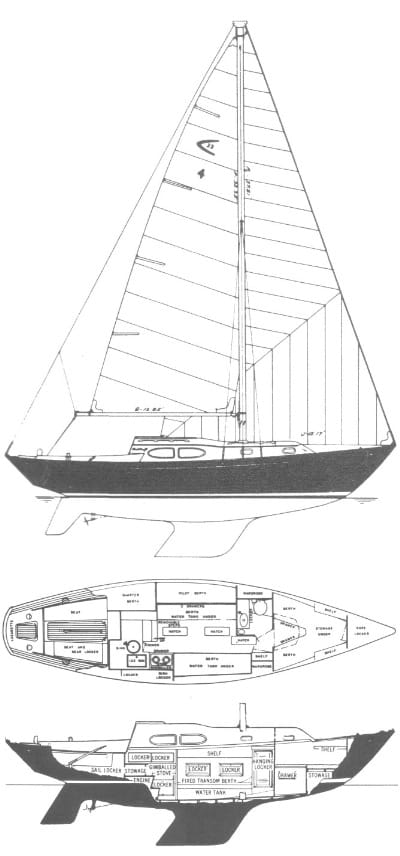
There is no intrinsic reason that a 32-foot boat can’t cross the ocean safely—many smaller boats have done it.
I really can’t give you any opinion on the Cris Craft since I have never seen one and have no information other than that available on the internet. In fact I did not even know that Cris Craft ever built sailboats.
Having said that, the hull form certainly looks good: moderate, fast and sea-kindly. S&S are good designers, but it will depend on what brief they were given by Cris Craft as to whether or not the boat was designed for an ocean crossing.
Also this is a boat that is forty or so years old, so you will want to have a really good survey done by someone that really understands the requirements of offshore voyaging before setting out. If the boat has been sailed much at all, it is likely that there will be structural work to be done. Pay particular attention to the attachment of the bulkheads, rudder, chain plates and keel as well as the mast step area.
But more important than all of that is your experience. You say that this is your first boat, so it will be really important that you get the right training and experience before setting out to cross the ocean, particularly single-handed. We recommend the British RYA Yacht Master Offshore qualification as the best way to get the right experience and training in the quickest way.
It’s not an easy qualification to get, but once you have it you will be a safe mariner and also in a position to answer your own questions about timing and route.
The other option would be a live-aboard offshore sailing course like this.
Does anyone have any information on the Cris Craft 32, or any thoughts on how the questioner can get the right experience? If so, please leave a comment.
How does this individual have even an inkling he would enjoy this undertaking enough to complete it successfully? History shows the odds of success for such an undertaking are slim to none, not particularly because of any vessel shortcomings, although that is a notable factor, but because of the skipper who doesn’t realize how shallow his or her desire to succeed with this really is, vis-a-vis the challenge of the extended isolation not to mention the challenge of becoming totally subservient to the wild and totally unpredictable ocean 24/7 for the month or so required for such a passage…The ocean can be counted on to reduce most of us to helplessness in hardly any time in much more supportive conditions than an aged pleasure cruiser under sail…Most of us would feel significantly challenged by a crewed passage from CT to St George’s (Bermuda isles) followed by the return to CT, and therefore unwilling to passage to France solo in such a vessel…Even Larry Pardey with all of his experience and knowledge prefers crew (Lynn his wife) on his passages…If he didn’t then she wouldn’t be there with him because he and a handful of others could successfully complete running in this vessel solo transatlantic to France but not without thorough and knowledgeable preparation of self and vessel including plenty of time under sail with the vessel before heading out..Cavu’s skipper in Tampa Bay
Hi Richard,
All good points. However, I think that it is important that people still be allowed to dream and to take on difficult challenges as long as they properly prepare themselves so as not to be a burden on the rescue agencies.
While few dreamers starting from the questioner’s position actually ever make the dream a reality, some do and we would not want to be the ones to discourage that.
After all, I dreamt of voyaging as a child and was fortunate enough to make my dream come true, including some single-handed voyages. I don’t really see a difference just because the questioner has started dreaming as an adult.
With all due respect to the respondents…I was quite naive in accepting the boat and thinking it would be a “breeze” to sail !! However as for personal preparation…I was a combat medic & corps of engineers officer trainee (which allows me both linear and lateral thinking)…Have spent many years in the mountains without the need of company or aid…Am a pretty good wrench and so am enabled to perform both repairs & maintenance…I have taken a nav course and am continuing my studies in meteorology & celestial nav…This post was a “reality” check and therefore I appreciate any opinion of note…Your concerns are well received and all of them have been addressed heretofore in my research…This is not a wild dream or late life adventure…I plan on keeping the boat in southern France and thought it might save shipping costs !! =P
As for solo sailing…I know it has its drawbacks…but except for resting…to me it seemed a logistical & practical alternative.
If I thought I knew what I was doing…I wouldn’t ask for help!! But I did plan on sailing it along the east coast to the Keys… before venturing across the big pond!! So any thoughts on time of year and route??
Hi William,
I am somewhat new to sailing (ASA 104 qual. on a 43 footer and J24 and small cat sailing) with a similar background to yourself from the sounds of it. Been doing whitewater/rock climbing/mountaineering/backcountry skiing for ~35yrs. so I have some combination of common sense/good luck. Would like to pursue more sailing challenges but live in Utah, have no boat and am not independently wealthy. Although a microbiologist by profession, I have also done metal work, carpentry, cabinet making, fiberglass work and am currently re-wiring my house. If you could provide info/suggestions on how to acquire an older boat, fix it up and acquire the skills necessary to venture out a little further I would sincerely appreciate it. Thanks in advance for any tidbits you would like to share.
Chris
William. Don’t listen to Richard— he is wrong. Many people with only a little experience have crossed the ocean, and safely. You’ve got a background. Just read some good sailing books, Take your boat out on some short hops— going to the keys would be a great experience. Cross over to the Bahamas. If you can sail in the shallows of the Bahamas you’ve passed your first big test. S&S are very good designers and Chris Craft wouldn’t put out a piece of shit, but having it surveyed or at least gone over by an old salt is a good idea.
The one thing that bothers me on the few Chris Craft sailboats I’ve seen in when your in the cockpit you are sitting almost deck level. If you should take a boarding wave it could be dangerous. But there are ways to take precautions at sea. If you have the urge to go and the will them fair winds my friends and don’t listen to all the people who say it can’t be done.
Hi Dannie,
I am not comfortable with any advice that encourages people to take their own boat to sea without first having made a multi-day crossing on a boat as crew with an experienced skipper. More on that here.
As the saying goes you need luck, a capable boat and experience but as long as you have at least 2 of these you will make it. There is a company called
Offshore passage opportunities that can supply you with experience and an experienced captain or crew. Check them out
It is prudent to have experience and preparation. However, let us not forget that the Smeaton’s and legends like Chay Blyth all had next to no experience before their first sailing adventures.
Hi Bruce,
That’s true, but also let’s not forget that both the Smeatons and Blyth came very close to losing their lives several times while they learned. Also the Smeatons had some very experienced mentors in the form of Peter and Anne Pye of Moonraker fame. https://en.wikipedia.org/wiki/Peter_Pye
Hi William,
Thanks for the note. One key piece of preparation that you have not mentioned is actually doing an ocean crossing on a small boat with an experienced skipper before setting out on your own. The point being that no amount of training, or other life experiences, can really prepare you for what it is like offshore in a small boat, particularly in heavy weather.
As to routing, we already cover much of that here.
My wife and I sailed around the world 1971-1975 in a 30 foot Seawind Ketch. The size of the boat is not the determining factor. It is how well the boat is built. I would agree with John that you should check and make sure all the bulkheads and chain plates, etc are in good strong shape. As for gear, you will need a windvane self steering gear. I would recommend considering the Monitor. I would also recommend a Gale Rider or a sea anchor that you could deploy in the event of a really bad storm. As for sailing skills, do as much coastal sailing as possible before you go and once out at sea remember that the first time it enters your mind whether or not you should reef; that is the time to reef. My motto is, “when in doubt, reduce sail!”
John,
I have recently read your post about sailing around the world in a 30′ ketch. I am currently sailing in the Med on board my Westerly 32′ ketch with my misses and would love some advice from you regarding ‘small’ boat prep for a three – five year circumnavigation. There are plenty of ‘you can’t do it in that’ advisers as everyone says its too small. I consider seaworthiness a more important factor. If another person in a cheap and nasty new production boat, with see through sides sneers at me, I may snap!
Sorry Scott,
Your name is most definitely not posted as John. Im going mad, surely a good sign for long distance sailing?
A comment about single-handing (I have done eight Newport to Bermuda single-handed races) when you are not changing sail, navigating or cooking and eating, you should be lying down resting or sleeping. You should look into a radar detector that is tuned to the marine radar frequencies. Or if you want to spend more money you can get a radar with a watch guard that will turn itself on every 10 minutes or so, take a couple of sweeps and sound an alarm if it sees something. But, if you go this route, you must get an external alarm hooked into your radar so it is loud enough to wake you form a sound sleep
Thanks for the great comments and suggestions, Scott.
I think I would add to that an AIS transponder. In fact, if the budget were tight I think I would buy the AIS before the radar or radar detector.
Scott,
I know this is an old thread but I was hoping to pick your brain on the Newport to Bermuda single-handed races. Is it safe to do this in a C&C 30 MK1 ? everybody I have talked to says this boat is a great boat and while she is built strong that the port lite’s may need to be beefed up the rest of the boat is strong enough to take?
I have been training for the run thew I will leave from Port Royal sound in South Carolina. the trip for me will be 825 miles. I have a fuel tank of 20 gals. that’s 40 hrs of motoring at .5 gals per hr. What size boat did you make your trips in?
Any other information you think would be helpful, I would be grateful.
Thanks, Curtis
1981 C&C 30MK1
S/V East Coast Lady
Hi Curtis,
As far as I know, the old C&C were well built boats. But that does not change the fact that a 30 is a very small boat to sail to Bermuda in.
Having said that, the real issue is that there are just way too many variables here for Scott, or anyone, to answer your question properly: condition of your particular boat, miles on her, how is she equipped and what level of survey and inspection has been done.
But none of that is as important as a question that has nothing to do with the boat. It is what’s your experience? This is going to sound harsh, but it needs to be said. The very fact that you are asking the question in this way worries me and leads me to believe that you don’t have the experience to do this trip safely, particularly single handed.
The bottom line is that when you have the necessary experience to do this in a seamanlike way, you will be able to answer the above question yourself.
This post may help.
I agree,
I have not near the experience that is required to make a trip like that. I have been in and around the Ocean from Biscayne bay to Tampa / Clearwater all my life. I know I’m not ready. It’s not me that I was questioning. It’s your professional opinion of going in the C&C30MK1. My boat has been inspected from the chainplates to the keel to the top and bottom of the SS standing rigging. All reported as good as when she was laid up.
So maybe the question should how uncomfortable is a trip like like that on a boat that has a Motion ratio of 21.7 and if I change her port lights to a thicker material and a stronger hatch cover would it be doable?
Understand that i’m just now doing my offshore over night training this spring and summer. My goat is a realistic 2018 trip.
Thank’s again for your help.
P.S we are scheduling a April trip to the BVI for a 7 Island hop. Hope to get some sailing in before then.
Any experience with the charter companies down there? ” the ones to stay away from”
Cheers. Curtis
C&C 30 Mk I
Her LOA=30′
LWL= 24′.75″
BEAM=10′
DIS=8000
HULL SPEEED=6.67
CAP RATIO=2
MOTION = 21.7
LWL TO BEAM=2.48
MOTOR SPEED 6’5
I:39
P:43
J:13.5
E:11.50
Hi Curtis,
Sounds like you are thinking about this is the right way.
I would say a trip to Bermuda in a C&C 30 Mk 1 would certainly be doable, as long as the boat is in good condition—see the post above for particular areas to be concerned about. After all, plenty of boats that small, and smaller, have done this passage.
On the other hand it will be somewhat uncomfortable and definitely a long trip in a boat that small.
But the bottom line is that discomfort is a very subjective thing. So there is is no way that I, or anyone else, can tell you that it will be too uncomfortable, or not, for you.
I would suggest that your best approach is to try some overnight passages to nowhere—set a waypoint offshore and sail to it and back, start with 35 miles out and move up to say 100—in progressively tougher conditions. Make sure you include some windward work. Once you have done that, then ask yourself how you are going to react to the same level of discomfort if it is going to last for 8-10 days. You will then have your answer.
Thank you ..valid and informative as it is…I’m curious as to whether specifics of a trans-atlantic sail are being addressed rather than general considerations…and although I have been accused of suffering from MBTB (More Ballz Than Brains) I assure you this is not an issue…Proper preparation is the key to success…but the ocean is a moving target and therefore is in need of constant correction & cognizance…Therefore any and all personal experiences are of immeasurable value…for as Einstein himself stated “imagination is more important than knowledge”…I imagine he said so…standing on the shore!!!
Jessica Watson has recently completed a solo circumnavigation and returned to Sydney to a hero’s welcome at the tender age of sixteen.
Her vessel was a 34ft S&S design of similar vintage and was chosen for its solid construction and seakindly attributes. So, if you need any endorsement of a boat’s capabilities, then this is it! Google Jessica Watson for her website and further details.
Prepare well and have a go! – you will NEVER regret doing it, but you will ALWAYS regret not doing it.
Well said Vincent. I jut loved Jessica’s story. It gives me hope. Thanks for the lead to her web site. I have no misunderstanding I know my boat is small for the trip. Its just I already own this boat and I don’t want sell her nor do I want the expense of 2 boats. I was hoping to make this the one. Thanks again for your help.
Best regards,
Curtis,
C&C 30-MK1 East Coast Lady
Port Royal,
South Carolina
moc.liamg@trub.tpc
Three things are necessary to make the passage a success:
1- Attitude- sounds like you have the independence and competence to enjoy the voyage.
2- Keep the mast up and the water out. Half the boats I step aboard have frozen seacocks, improper underwater fittings and hose, questionable standing rigging, winches that haven’t been serviced etc. From Swans & Rasseys to bargain basement models. Not yours I hope!
3- Give Hank a call at Offshore Passage Opportunities and get aboard at least one blue water delivery trip before you go.
Fair winds
Richard
Hi Vincent,
Thanks for the pointer to Watson’s site. Just to clarify, the boat she used, while from the same era and drawing board, is not the same boat as the Cris Craft 32. The S&S 34 is quite a bit larger and most, if not all, were built in England where both construction and rigging tend to be heavier and stronger than that prevailing in the USA where the Cris Craft was built. I’m not saying that this generalization applies for sure here, but William should not assume that his boat is built to the same standard as the S&S 34 without independent verification.
Hi Richard Elder,
I could not have said it better myself!
I seem to remember a photo in one of Eric Hiscock’s books of a sea damaged fiberglass coach roof (foam cored?) on what looks like a Chris-Craft. Of course he gave no I.D.
Whatever boat you take across an ocean you must be confident in its capabilities and you should (MUST!) have a full survey by a good surveyor. I would define good surveyor as one who: has considerable sea experience, is old enough to have formed mature opinions, who is willing to go over the boat WITH you in attendance and explain his findings and suggestions. He will probably be a member of one or more professional associations and will have an excellent reputation in the boating community (not necessarily the boat brokers community;-)
By all means do some practice cruises and be prepared for the times when none of it makes any sense!
Fair winds and good luck..
ED great being reminded about the photo of the Cris Craft 32 photo, Eric and Susan Hiscock’s books would be a great place for any one to start if one is thinking of long distant sailing. If all your gear looks too big you are getting it right as I recall as the weather gets worst the gear looks smaller and smaller.
Thanks again for reminding me of Eric and Susan.
Hi Ed,
Really good point on the quality of the surveyor. Thirty years ago I spent much of five years rebuilding my last boat because of structural issues that the surveyor had missed or deliberately suppressed. Some surveyors are little more than shills for the broker selling the boat.
I own a Chris Craft Cherokee 32, and I have done some offshore sailing on OTHER boats. If I were to venture offshore in my CC I would be very concerned about the large windows being punched out. My boat has always been in fresh water (and still is) so I wouldn’t be as concerned with the steel keel boats as I would be with a boat that has spent a lot of time sitting in sea water. The cabin trunk is very large and possibly a weak area in very heavy breaking seas. Once on an Island Packet 45 in the Atlantic I noticed the boat experience some damage in moderate to heavy seas. It wouldn’t be hard to imagine my CC getting the snot bubbles knocked out of it in the same seas. The CC Cherokee 32 doesn’t have balsa core anywhere but does have mild steel embedded in the laminate in areas of stress (cleats, chainplates, etc.). My boat will need some work in those areas. The primary winches that sit on stainless towers and attach to the wood combing are not nearly strong enough for Atlantic stuff. Plan on beefing up the towers somehow if you end up going offshore. I could go on but……
Hi Craig,
Great information, thank you. I will email the original questioner to make sure he sees it.
do go on…i appreciate the specificity you can add !! the areas you mentioned were also a concern to me…recently an-ex coast guard surveyer took the time to look my cc32 over…he also mentioned some of the items you mentioned…but it has a sound hull !! as for the large windows..have thicker plexi and steel straps to reinforce those areas !! and was also looking to reinforce the cabin trunk with ribbing…so looks like i’m on the right track !! how would you beef up the winch towers ?? thanks for your response !!
Hi,
I had a CC 32 for a number of years. I bought her as a semi-derelict and refitted her from the keel bolts on up – electrical, water, running rigging, steering, new ice box, cabin layout, winches, exhaust – the works. I then soloed the Maine coast for over a year.
I would say that a Cherokee is a good coastal boat with nice sailing properties who’s also well behaved on mooring. Her S&S breeding always shows through (esp vs. IOR boats)!
Craig’s points are true enough – she is not built to live on her own in the North Atlantic. The steel backing plates are a PITA but fixable. But I think the biggest limitation is load carrying limits. When you load enough gear and food aboard for such a trip you’ve seriously overloaded a Cherokee and that weight has to be carried by the rig and steering gear.
That is not to say it’s impossible, rather higher risk. A Cherokee is an old fashion sports sedan, not an RV.
Hi Jeff,
You make a REALLY good point on the danger of overloading boats. We see far too many boats, large and small, that are loaded so heavily that their design water line is well submerged. It’s a dangerous practice.
ahhh…thanks for the perspective..i should have known better than to take the brochure on face value !! seems they called it a “blue water racer”..but “…old fashioned sports car” may be more accurate !! i know the president of S&S so i’ll query him on levels of load and placement…but that is why i was looking at a solo sail…less supplies needed for one person !! i’m not obsessed with the trip..or the boat…i’ve managed to stay busy on land for long enough !! i’m not averse to risk..but i’m not a swashbuckling captain…life ain’t the movies !!!
I agree with the suggestions of doing an offshore delivery. I am a delivery Captain and a solo sailor too when I get the chance.
My first singlehanded transAtlantic was in a Tripp 30 built in 1960 and while I didn’t exactly throw a bag of sandwiches onboard and leave, it wasn’t far off it! Having said that it was an adventure and a half. I had no liferaft, went too far north and it took 31 days to get to the Azores from Norfolk. I wouldn’t have missed it for the world.
But with hindsight and a few miles behind me, there is some sense for going on an offshore trip with someone else first. I don’t actually believe it is a prerequisite by any means. I also believe that you can, as thousands do, believe me, get caught in a trap of never having the boat ‘ready’ and never having enough equipment and experience and and and….
If she is sound and you are confident that you are not kidding yourself about your own abilities, GO!. Don’t lose sight of the fact you will be traveling at a slow walking pace most of the time, keep an eye open for your boat and her gear …take plenty of books. leave the east coast late May early June, stop in the beautiful Azores and be careful you don’t get hooked on sailing or you will never stop>
oh boy simon…looks like you are exactly what i was avoiding becoming…another MBTB (see above) adventurer !! LOL… no insults intended…hindsight being perfect..what would you do different now ?? and as for kidding myself about my own abilities ?? well…40 years ago i wouldn’t have blinked an eye at such an attempt…but i’m not a fool…so i work hard to try and compensate for shortcomings…by being prepared !!
John makes a very important observation about the danger of overloading these small boats. I did exactly that and it took me from California to the Chesapeake to really realise it. The boat was significantly easier to sail after I jettisoned an awful lot of ‘stuff ‘, I could feel the difference…My boat was smaller and lighter built than the CC32, but it is something to bear in mind.
indeed it is a lesson well taken…going overboard on supplies could end you up overboard…fresh water seemed the most critical and heavy…one fellow i know pulled his motor and fuel tanks..for more water tanks !! of course a water maker is an expensive option…but i don’t want to put more into her than she is worth !! is midship the best place for ballast ?? too far forward she would plow the waves..far aft she would buck them..n’est pas ??
You want boat balanced and most of the weight in the center. Weight in the ends will increase the momentum when the boat pitches. However, when I rebuilt my Cherokee I put the house batteries under the V-berth knowing that the cp lockers and galley/ice box will get extra heavy during cruising.
The stock ice box is pretty poor and I used it as dry locker. I converted the quarter berth to a propane locker and new custom made ice box. (20lb box ice lasted over 2 weeks)
I have owned a Cherokee 32 for the past 8 years. Definitely a well founded boat. Weak points would be any steel support structures like the mast step and keel mounting structure. I agree with the concern re large aft windows. I recall seeing one that was converted to portholes of similar size to those forward (improved appearance as well). As you mentioned yours was converted to wheel steering, carefully examine the condition of the steering hardware and mounting. Bring the original tiller and hardware as back up.
The original low aspect rudder loads up and stalls quite easily when the boat is even modestly overpowered. This will make use of an autopilot challenging. I have single handed it in breeze up to 20 knots and find it quite comfortable provided that you don’t have too much sail up. I haven’t had it in seas greater than 6 ft and I am not sure I would want to. I have had a tough time making more than 65 nautical miles in a day of coastal cruising with the boat which makes for some rather harsh math for an ocean crossing.
While I also enjoy warm water sailing I am not sure I would take the southern route you describe I would go for the Maine, Canada, Greenland, Iceland, Ireland, France route. It would keep your stretches offshore to less than a week. I wouldn’t do the trip in my Cherokee…maybe in a Swan 46 with 5 talented sailing friends. 🙂
I have been sailing and racing
Thanks for your input guys…It is valuable reflection material at least…life saving info at best!! The local yacht club wants me to race it…which should aid my efficiency…however John may have a better idea so I’m keeping my eye open for a 42′ Comanche & some talented sailing friends for a Euro trip !! !!
The stainless steel winch towers could be stiffened quite a bit by putting a web or strut oriented athwartships. I have thought the same about ribs for the cabin trunk and straps for the windows. The CC32 sails great off the wind so a trip from the US over would be fun.
I want to know how it all turned out!!! About 5 years ago I bought a 48′ Chris Craft Roamer. Not a sailboat, (2) 671 Detroit diesel engines. I decided to go from Stuart Florida to the Panama canal. I changed hoses, belts and batteries. I knew the tanks had been cleaned but the boat had not left the marina for 20 years. An 85 year old marine engineer owned it and had started in monthly. The engines did start and run great. I had it hauled and the bottom inspected. I installed a gps, radar and radios. Again something I had never done. We had a350 gallon tank on the boat and we put an additional 8 fifty gallon drums on board. Their were 7 people total on board. We had purchased 2 eproms and 2 lifeboats just in case. We never even thought that we wouldn’t make it. Everyone bet against us I found out later. It was quite a trip. I thought I could do it in 2 weeks. No one told me about confused seas and waves breaking over the bow. The gulf stream was the current from Hell. The gulf stream cut my speed by over 50%. We were motoring at about 12 knots. Long story short, we did make it and it was an adventure that I wouldn’t trade for anything. Most of the crew was there for a “party cruise” so just sat around but 4 of us worked hard. A lot of sleepless and wet nights. We stayed about 50 miles off the coast of Central America. Colon, Panama was a welcome sight.