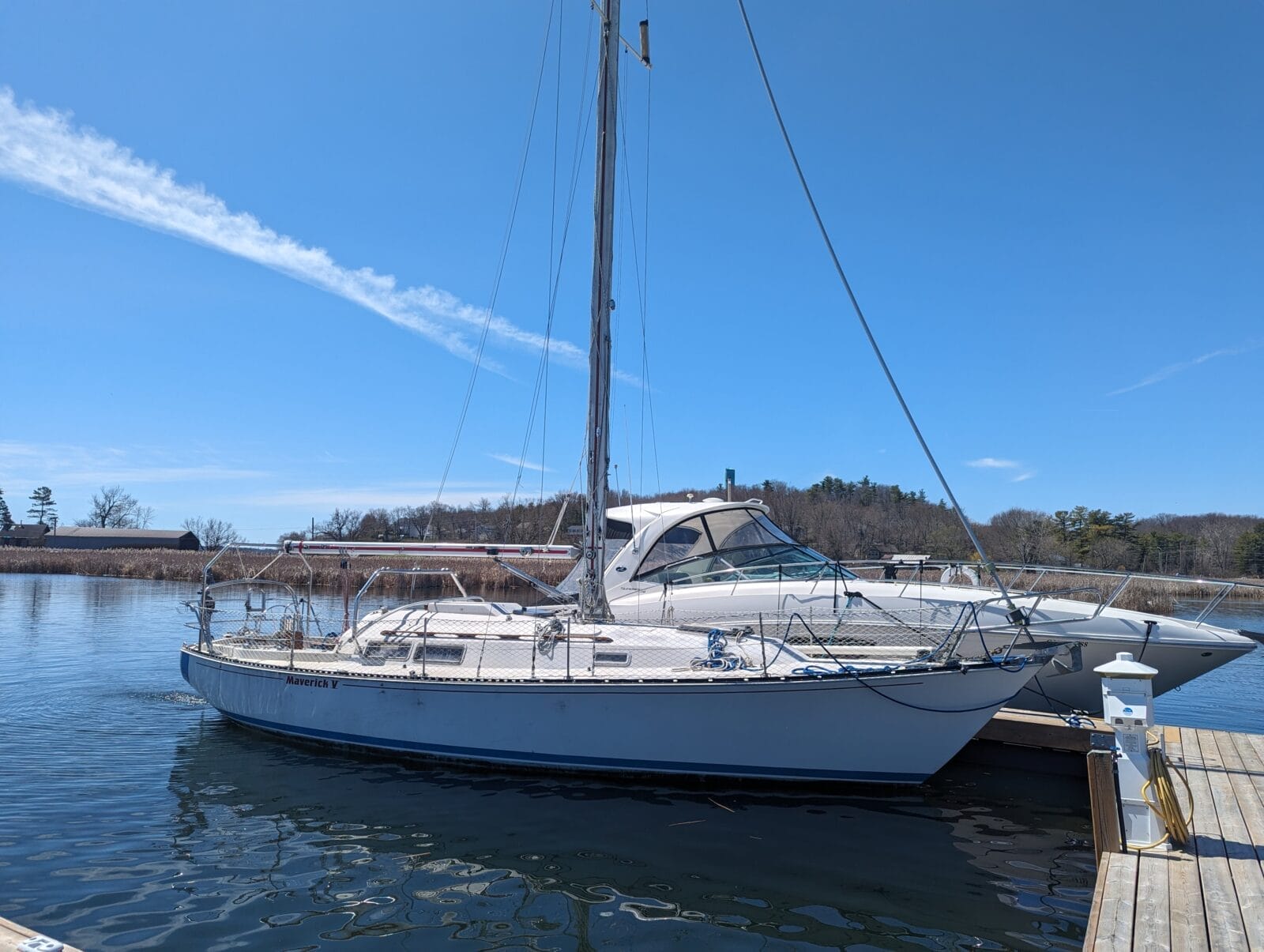
We’re now in the sixth season with our starter cruiser Maverick V, which is (so far) keeping within its budget.
And we now know that it is indeed possible for a family of four to own and operate a seaworthy coastal cruiser for:
- Under $15,000 USD to buy the boat.
- Under $15,000 USD to refit, deliver, and fix up the boat.
- Under $6,000 USD a year to insure, dock, haul, fuel, and maintain the boat.
I think—and both the insurer & surveyor agree—that, on this budget, we’ve ended up with a boat that is capable of real coastal passages to real adventure destinations. It’s of a design that is fundamentally ocean capable, but, with its current equipment and rigging, it should not go more than a hundred miles offshore.
So now the question is: What would it take to get a boat like this ready to cross an ocean safely?
Let’s take a look:
Excellent article, you’ve pointed the finger on the refit’s reality: in most cases the market would not recognize any of the work you’ve done on your boat and you’ll score a real loss once you sell it. Maybe the only choice is to find a boat where someone has made the same error and has theown a lot of money in a boat and needs to sell it.
Your best value for money, in the used boat market, is something that’s fresh off a thorough refit by an owner who intended to sail off into the sunset, and then ran into health issues and had to give it up. Sad, yes. But true.
Any given make & model of used production boat will have a spread of market values. A factor-of-two spread between the neglected worn-out ones and the well-maintained well-equipped ones is pretty normal. But no amount of refitting will bump the boat’s market value beyond the top of that range. Pouring $50k of work and parts into a $20k boat yields a $25k boat, not a $70k boat.
That’s not to say refitting is necessarily a bad idea. Only that refitting at tremendous expense, and to a standard significantly higher than the fleet average, is unlikely to be reflected in the boat’s resale or insurance valuation.
Very interesting article and I don’t disagree with a single word. However, it’s quite possible to be completely aware of the pitfalls of abandoning all financial logic and still proceeding as a ‘labour of love’ either because the boat is a real classic or you really are in love with it.
My wife calls our boat ‘The Mistress’ because it absorbs more powder, paint time and money than any legal wife could ever do and she’s quite happy for me to spend as much as is needed. She says it means I’ve no money left to spend on another woman – and she’s absolutely right.
If we obeyed financial logic, we wouldn’t own boats at all. Much of boat ownership is a question of:
It is totally OK to go into a refit saying “I love everything about this boat’s design, and I intend to keep it for a while, I just want to fix all the broken / worn out stuff at once…. and I will accept the cost.”
Where you get into trouble is when you go into a refit expecting to sell the boat after for a profit (ha!), or when you overlook fundamental issues with its design that make it less than ideal for what you’ll actually be doing, or when you get started without a proper project management plan and then it spirals out of control. Plenty of people will, effectively, give a blank cheque to a boatyard and then watch issue after issue drain their budget away with change orders and supplemental invoices.
Describing the boat as a “mistress” was a good laugh. I’ve seen a few couples where it works that way, in reasonable harmony. The most reliably successful projects, though, seem to be the ones where both / all partners contribute and share in the labour – admittedly not always possible, but certainly a significant factor in the overall success/failure rate.
Great article.
It’s important not to underestimate the ‘cost’ of your time for DIY projects.
After several frustrating and expensive mistakes, I’ve concluded that if a project requires skills, knowledge and expensive tools that I don’t have, and is likely to be dirty, boring and unpleasant, it’s better to hire it out. Assuming the professional will do a great job and do it faster than I could, it works out better to spend my time working at my job for 8 hours, than spend 8 hours doing what the professional can do in 4.
Very cogent logic here, Matt. I think you could “invest” $10,000-$15,000 into your old boat and get to “capable coastal cruiser” stage, particularly if you focused on the standing rigging and chainplate elements (plus a SOLAS raft and jacklines, AIS, etc.). But while I sailed long enough in Lake Ontario to experience some nasty stuff, it’s nothing to some of the weather action out here in Nova Scotia. That said, you could cruise from May to November (yes, judiciously) from Fundy to the tips of Newfoundland and have amazing times in a well-found and slightly modified C&C. And it would be an excellent training ground for an offshore cruiser you want to tackle in a few years.If it’s any consolation, there are a lot of vintage C&Cs and CSes out here and one sees them everywhere with bones in their teeth. So you might wish to do a very selective rehab, and then change your cruising grounds to up you and your family’s sailing skill set.
I agree, Marc – if we were planning extended coastal cruising with this boat, that would be achievable on a much tighter budget. She’s already in quite good shape for that kind of service and so it’d mostly be a matter of judiciously-added new gear.
Part of the reason we went straight to offshore passagemaking for this (highly hypothetical) article is to re-emphasize a few points made years ago in Cyclical Loading: Why Offshore Sailing Is So Hard On A Boat. This C&C 35 has easily 10 more years of Great Lakes and light coastal cruising in her before any significant work would be needed. But in open-ocean service, she’ll get that same total wear and tear after a few months. So the overhaul that’s 10+ years away on her current duty cycle becomes a “must do before departure” thing.
The other point I wanted to emphasize is the degree to which full-out refits tend to spiral out of control in both cost and time. They don’t have to, but they often do. There’s always one more piece of “nice to have” gear to add, and one more thing to fix. It’s important to keep a clear high-level perspective and to not get in over one’s head while wearing rose-coloured glasses.
Hi Matt,
As someone who has brought back to life a boat an insurance company had deemed a complete write-off after a 80% sinking, your thoughts ring true. A couple of comments:
You wrote:
I don’t have the moral right to ask the Coast Guard and other rescuers to put themselves in danger if I haven’t already done my part to ensure that the probability of needing their help is as low as possible.
It is great to see these sentiments expressed. SAR is there for bad luck and should not be called upon for poor boat preparation or poor judgement by a skipper.
And I also appreciate your recognizing in print the responsibility of a skipper who takes loved ones any distance away from the marina let alone an offshore passage.
You can determine chainplate integrity, but, for most of us, I would suggest going new. The price difference was significant when I swapped Alchemy’s CPs for new, but in no way a deal-breaker and might be partially offset when hiring a pro to determine integrity of the old. I got mine from the boat manufacturer and they arrived on my doorstep pre-drilled and they fit perfectly.
We have been on the Great Lakes for 3+ seasons now and went with a composting toilet. Not having to go into a marina for regular pump-outs is a joy: many marinas seem to put their pump outs in areas challenging for sailboats to get into and out of or on busy fuel docks where the marina would far rather be pumping fuel.
I love the reference to Stan Rogers: a musician every sailor would likely appreciate being acquainted with. (BTW, it is the 50th anniversary for the sinking of the Edmund Fitzgerald which is largely known through the song by Gordon Lightfoot: The Wreck of the Edmund Fitzgerald).
And I suspect your children would not mutiny were you to take them off for long periods: committed parents make it work and probably make it work well.
And, finally, the boat we salvaged (a LeComte Northeast 38) had, like yours, some years on her, but served us very well for 16+ years of coastal cruising with 3 children, often for a month holiday and always lots of weekends. Then, on a boisterous trip to Bermuda and back we discovered issues which we had never discovered in our years of coastal cruising. The open ocean is just far harder on a boat and revealed problems we never would have anticipated.
My best, Dick Stevenson, s/v Alchemy
I wonder if there is a minimum total cost of ownership for an ocean cruiser? If you spend $100k all-up on the C&C 35 bringing it up to offshore spec and ready for 10-yrs’ use (new sails, standing rigging, etc.), cruised for 10 years, then sold for $20k that is $8,000 per year. If you bought an A40 (theoretical but extremely optimized for low TCO) for $300k and sold for $175k after 10 yrs that’s $12,500/yr. So you’re cheaper than cheap, largely because the C&C displaces 10,500lb vs the A40’s 16,000lb. Interestingly both work out at about 78c per lb per year. Maybe that’s the target: If your spending less than $1 per lb per year you’re doing well. That is boat cost of course. Variable costs (insurance, fuel, etc.) are additional and will favour going as small as the crew will tolerate. The sails, standing rigging, and other big-ticket items will need replacing after 10 years but that is reflected in the depreciated sell-price, which has already been factored into the <$1/lb/yr TCO.
Hi Matt and all,
I have a suggestion for when chainplates are replaced:
CPs often have a lot of water around them or sluicing along the deck.
When I replaced Alchemy’s CPs, I made plinths out of ~~1/4 inch fiberglass with the cut-out matching the thru-deck cut-out. I then epoxied this plinth to the deck essentially making the deck that much higher around the CPs.
I then I used ample amounts of butyl rubber to seal the CP area where it penetrates the deck.
Top that off with a layer of butyl rubber under the stainless deck plate most boats have and around the CP where it goes thru the plate.
The plinth basically kept much of the water, standing or sluicing, from the entrance of the CPs into the boat and the butyl rubber does the rest.
I consider BR perfect for this job. It oozes into every nook and cranny and never loses its pliability: important in this area where slight movement does occur. I have 10 years on the above method and the butyl rubber is still pliable unlike most caulking which gets hard and brittle and shrinks, letting in water.
There is no indication, to date, of any need to redo any of the work.
Butyl rubber is not all the same. I purchased my BR from RC Collins at Marine How To: https://marinehowto.com/.
My best, Dick Stevenson, s/v Alchemy
In our business (which is maintaining and refitting yachts) we see this equation often. It seems if the boat is a boat you really like, and you plan to really use it for around eight years or more, then the refit may actually make sence. We assume you are going to get great joy out of sailing the boat. And we assume that buying a new or nearly new boat that is turn key is far more expensive.
One of our customers put it this way. ‘ I paid 150k then spent 150k and the boat is worth 150k. I got a quote from the builder for a brand new sister ship. It was 1.5mil. So I am enjoying a 1.5 mil boat for 300k. I will loose 150k when I sell her. If I bought the new boat I would loose about 750k when selling her. So win win.’
I think your reasoning on all the points is very good. I do think some of these jobs will take a lot more days than you think.
My first boss said when estimating a a boat project. Really get in to the details and then assume that every thing you imagine going wrong will go wrong. Now take that figure, double it, and add 50%. Wise words.
Some times it will go easy and you will get way ahead. But on the long term average he was correct. Those of us that love boats are always optimistic about what a project will take to complete. As we say, I am 4 years into a 6 week refit…
Hi Carl,
On the buy equation, I can see that. But there is a third option: Buy a relatively new, but not new, 1.5m boat for 750k (using your numbers) spend say 50K and sell her again for say 400k. Loss is 400k but no refit to manage.
I would also say that if the 1.5m boat has deteriorated enough to be bought for 150k, budgeting 150k for a professional refit is highly optimistic. My guess would be double that…and add 50% for 450k
I totally agree on your costing method, although when my projects have gone really well just doubling it worked without the 50%, but then other times when things did not go well…
One thing I know for sure, the more planning we do up front the less likely it is that we will need the added 50%.
I hesitate to post the thoughts that came to mind as I’ve read this article, so please feel free to delete my comment.
The thoughts that came to mind as I read this article, and particularly after your comment John, were “well, it’s hard to conclude that attainable adventure cruising is realistic”. Except if you’re in a very special financial situation.
For example, either the business where you earn money involves taking people on adventure cruising (like John K and the folk at 59 North), or it’s derived from it like very successfully podcasting/you-tubing about sailing, or you’ve inherited a fortune, or you had a very successful business early in your life which you sold for a few million which invested give you steady income, so a loss of 400k doesn’t bother you, etc.
I’m not saying the article is wrong in any shape or form. It just felt like a healthy reality check.
Hi Fabio,
I can certainly see how it feels that way, but keep in mind that my comment above was in relation to hiring a professional to complete the refit, because that’s what Carl brought up. With a lot of good planning and much sweat we can get offshore for about US$150,000:
https://www.morganscloud.com/category/refits/
https://www.morganscloud.com/category/boat-design-selection/she-36/
That’s not chump change, but it’s certainly within reach for those with a decent job who want it badly enough to make the sacrifices required to save that much.
And as Matt has proved, we can get out coastal cruising for $30,000 pretty easily:
https://www.morganscloud.com/category/boat-design-selection/cc-35/
There are a lot of people who are out cruising on tight budgets. A $20,000 to $50,000 boat can take you a long way. Yes, there are some compromises in size, luxury, and systems versus a new modern $500,000 boat. But those compromises are small compared to the “compromise” of not going at all.
This article is really about the jump from coastal cruising in <100NM fair weather hops – which you can do for a long time with an older, cheaper boat – to long distance passages of a thousand-plus miles in international waters. When you start crossing oceans, the wear & tear go up dramatically and the tolerance for things breaking drops dramatically. That adds cost, and it also concentrates cost – work that would have been spread out over 15 years now needs to be done all at once.
Whether new-ish or old and refitted, I have seen vanishingly few yachts that are genuinely capable of open-ocean service at a sub-$100k total cost. And it's rare to see a yacht with under $150k invested in it make landfall after a successful ocean crossing and then depart for another one.
If that's too rich, then there are a *lot* of adventures to be had with cheaper boats in less demanding passages.
Maverick V cost about as much as a middle-class used car and, if it were just Katy and I, would be quite capable of a two-year cruise down the US East Coast and Caribbean with just a bit of extra equipment and a few maintenance items. (The kids think she’s too cramped to do that as a family of 4, and they’re right.)
Hi, as someone who picked up 38’ fast cruiser built in 1986 (fin keel, cold molded, factional rig) for just over $60k thinking it would need about another $30k to fix it up, i can attest to the old boats are money pits program. Sadly if you can afford it, you are better off buying a finished production boat – even second hand. But the upfront cost is daunting. I long ago sailed past $100k of ‘finishing stuff’. I gave up with my spreadsheet! And while she is a beautiful boat its a 1986 design with a cosy interior. And still not ‘finished’. For my sins i just bought another similar boat (Tartan 37) which will need a ‘bit of work’. Its in Fiji. The upside is my 38’ yacht took us on an incredible coastal cruise up the australia east coast. The fiji boat will take us around the Fijian islands next year. But old boats consume huge amounts of money that is not so obvious at first but quickly becomes very apparent.
Hi Gordon,
I think there is another interesting idea hidden in your comment: Maybe you made a really smart choice owning two coastal cruisers in two places you want to cruise, rather than buying a much more expensive and probably bigger boat to cross the ocean between those places? I have always wondered about that idea. And nothing goes to windward like an Airbus!
It’s a valid idea. Two simple, sub $100k, 38′ coastal boats are collectively a lot easier to handle and care for than one $400k, 50′ open-ocean boat.
The question is whether you would use both of them enough to justify owning both. Where I am now, working a full-time corporate job and sailing for a few hours or days at a time, it’d be a hard sell. After retirement, though? Keeping a 30-35′ here in Kingston for our perfect 3-month summer, and then keeping another 35-40′ in the tropics or Australia on which to escape during our 5-month Canadian winter, sounds *very* appealing, as long as you can swing the cost of storing and insuring both and of flying between them twice a year.
Solid article and good analysis, having walked this path over the past 10 years. I started with a 42-year-old boat. Good Hull, Coastal cruising designed deck and salon. I reached the same conclusion that while the Cal 35 Cruiser is a decent coastal cruiser, there are inherent vulnerabilities, specifically the salon ports and high freeboard, that make it less than ocean passage safe.
I suspect that while your pricing for the various refit projects reflects current costs, your allocation of man-hours may need to be doubled. At least that has been my experience. There are the intangibles of working with an old boat that introduce project creep or redesign required to resolve issues.
That being said, there is plenty of reward received in rebuilding and sailing an old boat. It mitigates much of the financial costs. It is a project you can work on while sailing the boat. At least that has been my approach.
There’s a lot of variability in estimates of labour hours. I based these guesses on:
– me,
– in one of my productive get-it-done states,
– with my rather large collection of quality tools,
– in close proximity to several really good surveyors, riggers, and mechanics,
– at my current location where the boat is at a sheltered dock, there are on-prem cranes for hire, and literally any part you can imagine is either in stock within a 15 min drive or else will show up within three days of placing an online order.
Change any of those things and the timeframe may well expand dramatically.
Hi Matt,
Interesting thoughts. I have sometimes done the thought experiment of what I would need to change on our boat to meet my definition of mid latitude offshore capable and it is quite a significant list.
When we have looked at boats either for ourselves or to help friends, I am always amazed at the average amount of deferred maintenance I see. For example, I don’t think I have ever looked at a boat where I wouldn’t replace over half of the hoses on the boat and very few boats that I would have sailed without replacing all standing rigging. Given that hoses are a primary cause of sinking, it is amazing to me how poor condition they are usually in. Yes, replacing them can take a few days and cost over a boat buck but a few of those boats had new seacocks and old hoses so I don’t think a cost or effort argument is valid. On the topic of watertight integrity, the cockpit area and engine systems are almost never up to offshore use on production boats, both will let lots of water down below, into tanks and into engine cylinders.
A few interesting notes in the comments on time to do the projects. One thing that is hard to account for is that some people are just a whole lot faster than others. Some of it is experience, some of it is tools, some of it are work circumstances (working at home next to your shop is so much better than in a random yard and an unkown place), etc. For me, I like to put a lot of time into planning which makes the projects go a lot more quickly and without big hiccups. If I have a big unkown in a project, I try to set it up where I plan to get to a certain stage, figure out the unkowns, move onto other projects and then spend the time planning/ordering and come back and finish. Another part of this is that I tend to put much higher value on my time in the boatyard than my time project planning at home.
I like the conclusion on buying a starter boat and not trying to buy a boat for unknown and hypothetical future scenarios. I think it is extremely hard to figure out what you want in a boat until you have owned one for a while so it makes sense to use a cheaper and simpler one to figure it out. Also, boats are compromises so buying a big strong boat with dreams of offshore usage when your primary usage for the forseeable future will be light duty coastal cruising means you won’t have a boat that gets the compromise right for your usage.
Eric
Agreed on all points, Eric.
Deferred maintenance is, to some extent, normal on any vehicle (car, truck, or boat) that sees only occasional light use. I’ve never seen a boat more than a few years old that didn’t have a few pending maintenance items.
When we talk about going offshore – not coastal hops of a hundred miles, but seriously offshore – we are leaving behind the supply chain infrastructure and support network at the same moment that we’re dramatically increasing the wear and tear. Maverick V has done 25,000 miles in 50 years. She could be asked to do that same mileage again in 18 months if we start making ocean crossings.
In my opinion, that scenario calls for *all* deferred and pending items to be addressed at once, before departure. Even if they wouldn’t be needed for many more years under the current operating conditions. And that’s expensive.
Our idea of what a long term cruising boat might look like has definitely changed during our time owning this one. On-paper knowledge, however thorough, does not replace firsthand practical experience. We are certainly better placed to pick a solid, reliable, and affordable next boat now than we would have been without the “starter cruiser” experience.
This article and the comments thereon exemplify what I hugely appreciate about AAC: important topics intelligently and thoroughly addressed by authors and commentators, with civility.
You’re doing a great thing, John and Phyllis!
Craig Stephens
Hi Craig,
Thanks for the kind words, much appreciated.
Thank you for the interesting article. With your expertise and those of your contributors, it would be good to expand on how to to do coastal cruising near shore, say within 48 hours of an all-weather port, and how that may or may not differ from the theoretical optimal setup for offshore passagemaking. What information might someone need to venture out beyond inshore waters or the Intracoastal Waterway, to be prepared, have fun and be mostly comfortable? I feel like this is the biggest hurdle that faces most owners of cruising boats. For example, in the southeast US, you know that the options for boating in larger vessels are for all intents and purposes, the Intracoastal Waterway or the Atlantic Ocean. The Atlantic is a big jump from the ICW, especially when your boat is the only one in sight.
Hi Thomas,
You will find most-all of that information here at AAC in the 12 Online Books:https://www.morganscloud.com/about-online-books-2/
Of course they also contain a lot of stuff that you don’t need for coastal sailing, but it’s pretty easy to filter. For example, you clearly don’t need a JSD.
That said, the best tip I can give you is to go out their first with other people before taking your own boat, and the second would be to make sure you really know how to sail, assuming a sailboat.
Another option is to take a good practical course (not classroom). I’m a big fan of the MCA/RYA courses. Might be worth a trip to the UK. If you learn to handle the waters around the UK, the Eastern Seaboard is a doddle.
Definitely read the AAC Online Books. There’s no better resource out there.
As far as coastal vs. offshore differences in setup, I would say that the big one comes down to preparedness. If you are always going to be within 100 miles of a port, then you have more options to deal with failures. You have access to a supply chain. You can divert to refuge if something looks like it’s going to break soon.
When you’re going offshore, a week or more from port, you need to be able to handle everything that could possibly go wrong, while underway, alone. So you’re carrying more emergency gear, more spare parts, more supplies. You can’t get a replacement exhaust elbow or furler drum shipped UPS 2-Day from the warehouse while you lie alongside a pier. You need to deal with wear-and-tear items via careful inspections before you go, rather than waiting for them to fail.
If coastal cruising is like your run-of-the-mill regional airline flights, then offshore passagemaking is like an ETOPS flight. Yeah, you can technically go with whatever you’ve got and chance it – but there are widely established best practices for training, maintenance, equipment, planning, etc. to minimize the risk. They’re known to work. The insurers demand them. And almost everyone who’s serious about it follows them.
As I’m in the process of a C/D overhaul of a 49 year old 3/4 Tonner, this was an interesting, if eye opening post!
One cost not mentioned was replacing thru-hulls and seacocks. Given the vintage of the C&C it probably has bronze hardware as does mine. The replacement cost varies between $150 to $600+ ea and my boat has seven, three below the waterline.
My budget is far more modest and most of, if not all the work, will be me doing it. Also mentioned in the post was the head setup. This is one area that I’ve decided to change as I’m looking at installing a dual purpose composting/chemical head to be able to get rid of two thru-hulls, a maze of hoses and the holding tank. (Joolca GottaGo is at the top of the list but I’m open to suggestions).
But the main point about refits, or upgrades that this post highlights – is not to expect a proportional return on investment. The objective is to have a boat you feel safe in and that you are planning to keep for some time.
Hi Viv,
Not familiar with the Jooka: its footprint looks bigger and a bit bulkier, but its price is much better. I have about 3-4 seasons/~~12-15 months living with an Airhead (2 adults) and have been quite happy. I could go further but Practical Sailor has article(s) which do a far better job than I could ever do (google).
My best, Dick Stevenson, s/v Alchemy
Dick. Thanks for the suggestion. The airhead looks good although higher price. Yes the footprint of the Joolca is larger and the mounting system may not be robust enough for marine use. I’ll check out the Airhead.
Viv
Most of this C&C 35’s seacocks were already replaced with modern ones before we bought her. Seacocks are one of those things where it’s easy to go overboard with spending. You want genuine Groco BV inch-and-a-half bronze, and you’re willing to pay retail for one at a time? Yup, $600 a pop. But the equivalent part in Marelon, fully ABYC & CE compliant, is a third of that price, retail – and a lot less wholesale if you’re willing to spend some time chatting with the distributor’s inside sales rep before emailing her a 100 line file called bill_of_materials_to_quote_v7_dec2025.xlsx
Planning makes a huge difference, and lack of planning is one of the big things that drives costs out of control. I have lost count of the number of times I’ve spent $1000 of company money at same-day stocking distributors, because someone came to me needing a part NOW….. but then was able to get the same set of parts for $250 a few months later when I had sufficient lead time to run a large order through a preferred factory-direct distributor who won’t even pick up the phone for one-off orders, but is happy to arrange fat discounts as long as the order can fill at least one standard pallet.
Matt:
Yes a good point re seacock pricing. I have looked at the Marelon option and may go that route if replacing a number of the seacocks. There are a lot of contradicting opinions on using Marelon below the waterline but as you rightly point out, they (Marelon) meet the ABYC &,CE standard if installed correctly. My preference for Groco Bronze is mainly to be able to swap out like-for-like to avoid GRP repair work on the hull as some of the old seacocks are through-the-hull bolted to the flange.
But your main point is planning ahead and bulk buying. Those are probably the most important steps in restoring a boat, especially as my boat is located in a different province (NS) to where I live in NL.
Viv
Hi Viv,
Where in NL do you live? We plan on returning to its waters next season after 3+ seasons a while back. I can be reached at Alchemy128(at)gmail.com). Dick
Hi Dick.
We’re based in Corner Brook. Our boat (project) is in North Sydney at the yacht club. Hoping to get it across to Bay of Islands next year once patched up enough to get it there safely!
I’ll send you an email with contact details.
Viv
How many refits are not finished due to underestimated cost and time and how many boats that before were our pride and joy become things we no longer even want to look at let alone sail .walk around any boat yard or marina with hard standing to see the boats that are wasted waiting for the refit .sail the boat you have and enjoy the three years it would be out of the water. life happens while we plan our next big trip then move on to a boat fit for purpose remember your time is a very fineite resource and should be treat as such .
I once worked with a car customiser who had a strict rule 18 months per refurb or it never gets finished
Hi Bill,
Great wisdom. I wrote much the same, but longer: https://www.morganscloud.com/2020/02/15/a-sail-away-offshore-cruising-boat-for-less-than-us100000-its-a-lot-about-you/
Getting into an “I’m gonna tear all the old stuff apart and re-do EVERYTHING” refit is risky business. There are times when it’s the only way to bring back a boat that’s old and neglected – but it’s not easy, going in, to know whether you’re looking at savvy boat sense or utter madness.
One of our dock neighbours is a C&C that’s been owned by one couple since the late 1970s. They’ve never done a full-blown refit. They always stay on top of the regular maintenance, and pick one or two projects a year to put proper time and effort into improving. As a result, they’ve been able to enjoy almost every season for almost half a century in a reliable boat that was just right for them, that looks gorgeous, and that has a lot of cool custom features carefully designed to match their experience and requirements.
Hi Matt,
That’s the boat to buy!
John that definitely does! Boats like that are hard to find.
I looked for a year and covered many miles looking. But each one had a fault that I wasn’t up for dealing with.
Every marina visited had its sad forlorn collection of rundown boats all needing extensive work.
But the prices didn’t reflect that reality either.
I did end up with a boat that needs lots of work but was cheap and has offshore potential. Good Swedish design and European build.
Viv
The boat I bought ten years ago was from the SECOND owner who had failed to complete a refit intended to make it ready for circumnavigation. A good deal of good work was done by both men, but neither ever got to enjoy sailing the boat over the horizon. In both cases, the significant other in the relationship demanded a halt to any further expenditures, and the boat was sold.
Hi Matt and all,
Your article has got me thinking of my first trip to Bermuda on an older boat that had taken good care of my family as a coastal cruiser for years.
For 2 years I tried to anticipate every new demand an offshore passage would make on the boat and prepare for it. The force I missed was the amount of twisting that occurs in the open ocean: motion which has the bow rotating one direction and the stern the other (there is probably a term for this).
I do not know how much of this occurred on our somewhat rough passage, but it was enough to lift the toe rail ever so slightly with the twisting motion caused by open ocean conditions which had never occurred coastal cruising. This toe rail movement allowed water to sluice under the rail, find the bolts holding hull to deck with its old, now brittle and cracked with age, caulk and find its way into the boat to create misery in certain bunks and a general “what else” worry with regards to integrity.
We were now convinced we needed a different boat for our future wandering.
My best, Dick Stevenson, s/v Alchemy
Maybe there is a sweet spot between “not leaving until everything is perfect” and “these bits are old but still work and let’s see how far we get before they break and then we’ll fix them”.
When things do break on the far side of the world, where its almost impossible to get things shipped to, I wonder if it will the old bits or the perfect new ones that we will be begging customs to release the replacement parts for.
Hi Mark,
Good point. I have written much the same: https://www.morganscloud.com/2019/09/20/buying-a-cruising-boat-five-tips-for-the-half-assed-option/
I’d rather carry immersion suits than a life raft on the great lakes and coastal northern waters. They don’t require costly recertification. They are more likely to actually work when you need them. They are more likely to keep you from dying of hypothermia, and in these waters rescue will arrive in hours rather than days.
I agree. Hypothermia is THE big risk in early & late season sailing here. The rescue helicopter crews are excellent and prompt – but that’s of no use if the stranded mariners are frozen by the time they arrive.
Hi Matt, John,
Agree completely.
We left a nice protected anchorage on Isle Royale in Lake Superior last year in mid-May. It was a nice day, almost balmy and we came out and started S into open water and onto a 15+kn beam reach. All of a sudden we are putting on layers: layers upon layers. Lake Superior water temperature in the open was 40 degrees F, 4.4C, and the wind was traveling across this water getting just as cold.
Puts a whole new emphasis to staying aboard: I figure just a few minutes functionality in that cold water: not nearly time enough to get a boat turned around and get rescued.
My best, Dick Stevenson, s/v Alchemy
Ps. Jordan, I am with you on the expense of life raft re-certification.
Hi Jordan,
Sure, I like immersion suits too, but I don’t see them as a replacement for a liferaft:
https://www.morganscloud.com/category/safety/liferaft-survival-equipment/
https://www.morganscloud.com/2007/05/19/survival-suits-for-boats/
The survival suits link is broken.
Hi Jordan,
Not broken, temporarily offline while I rewrite it. You should have seen a page saying that. Your point about how good survival suits spurred me to a complete rewrite. We will republish it when I’m done, probably not long in that I did most of it yesterday.
This article really resonated with me because of the boat, a C&C 35. I bought a 1984 C&C MkIII in 2010 and owned it for many years. I LOVED that boat! It was a blast to sail. The whole boat was extremely well engineered. And a very good coastal cruising platform. Not a single leak in all the time I owned her. However, when I retired and we knew we wanted to cruise further for longer periods we had to think hard about whether this was the boat that would meet our needs going forward. A typical 1980s sailboat does not have a lot of internal volume. For example, our C&C had a 28 gal. water tank, a 20 gal fuel tank, a 10 gal holding tank, room for only two small house batteries, no refrigeration, limited storage, and so forth. And… I figured it would take a bare minimum of $50K to refit her with the kind of upgrades that the OP listed above. And that was on top of all the upgrades I’d done while I owned her. And there is the physicality needed to crawl around a smaller boat. If we were 30-40 years old maybe we could have made it work. But at 60 that wasn’t going to work for us. It was a sad day when we sold her. But we did put our money into a bit larger boat that was a better fit for our plans and have no regrets.
The point about interior space and volume is a notable one. Designers’ attitudes towards that have really changed over the years. John owns a J/109, which is almost exactly the same length and beam as my C&C 35-2. He has a full port-quarter cabin for two people with standing headroom and a door, where I have a narrow quarter berth for one whose head doubles as the navigation seat. Other nice features, like pass-through transoms with swim platforms, weren’t yet a thing when our C&C 35 was built.
Interior space sells boats. Layout sells boats. With older designs, you are consciously accepting some non-ideal layout features in exchange for lower cost – and, in some cases, comfort and seaworthiness that are hard to find in more performance-oriented modern designs.
There was an old On the Wind podcast where they were interviewing Magnus Rassy (I think) where he basically admitted that their typical customer was a couple, where the husband (typically) wanted to buy a boat and the wife didn’t.
The husband’s already sold and will say yes to whatever the wife says. But the wife doesn’t really want a sailboat. So the goal becomes to build a sailboat that appeals to a person who doesn’t like sailing!
Excellent article. I wish I had known all this ten years ago. On the other hand, I bought my starter cruiser (a 36 foot Pearson), refitted it, and went cruising. After 8,500 miles, I’m ready for a bigger boat. Whoever buys my boat will get a heck of a deal.
If you enjoyed sailing and working on that boat for ten years and 8,500 miles, then you got a pretty good deal yourself.
We don’t go cruising and exploring because it makes financial sense. We do it because it produces self-satisfaction, happiness, and a solid sense of connection to history, exploration, and the natural world, in an era where it’s all too easy to get caught up in things that do not satisfy those needs.
These articles are about sharing what we, collectively as a community, have learned about making such adventures possible while minimizing the risks of it going wrong in painfully expensive and divorce-inducing ways. I am, at the moment, very glad that Katy and I heeded that advice and went the “starter cruiser” route; there is so much that you can only learn by doing it and making a few (hopefully inexpensive) mistakes along the way.
Andrew, I’m hopefully in the market for a starter cruiser next spring/summer. Unsurprisingly, kinda depending on my SO. If you want to talk, email me at .