
I have, with a few short breaks, lived either on, or within a stone’s throw, of salt water all my life. My earliest childhood memories are of commuting by boat from a small island where we lived to a larger island called Bermuda.
I have spent the majority of the last twenty years voyaging on the ocean. Or in fact one ocean: the North Atlantic. An ocean that I feel a special and deep connection to, even though it has contrived to scare me witless on several occasions and make me both uncomfortable and/or seasick on countless others.
I feel a deep and visceral horror about the oil well blowout in the Gulf of Mexico, together with dread about the long term effects on the ocean I love and the animals that live in it.

I’m sickened when I think of the men and women of the Gulf States who have lived their lives connected to the sea, as I have, and have seen their way of life wiped out in weeks.
I wonder whether the many friends I have made in the USA, my native Bermuda, my new home in Canada, and our favourite cruising grounds of Greenland, Iceland and Norway will face the same fate when the oil from Deep Water Horizon gets picked up by the Gulf Stream, as it inevitably will, and spread far and wide.
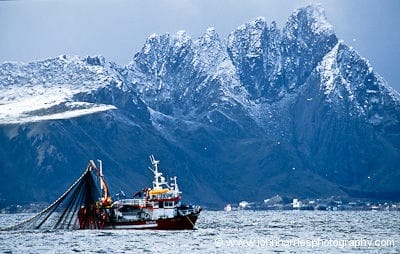
And yes, I’m angry at BP, its subcontractors, and the regulators who failed to regulate.
But you know what? Those directly connected to the blowout are not really the problem. We are. All of us that have refused to pay the real price of oil and the products derived from it. Refused by voting for politicians that promise cheap gas. Refused by not voting for politicians who want to increase the price of oil through taxation to reflect the real cost.
I’m no expert on what that real cost is, but I’m pretty sure that it is a lot closer to the US$11.00 per gallon that Norwegians pay for regular gas than what we pay here in Canada or our friends south of the border pay in the USA.
Sure, this would be a bad time to increase the price of oil products. But will there ever be a good time?
Sure $11.00 diesel would change my life and make many of the things that I love to do impossible, or at least extremely difficult.
But $11.00 gas, or $8.00 gas, or whatever the right price based on the true cost is, would spur conservation in ways that well-meaning conferences like the failed one in Copenhagen last year have no hope of doing.
The additional tax revenues would allow governments to properly regulate the oil industry and clean up after the inevitable disasters. And the additional tax money could be used to better care for those impacted by the recent financial troubles, deal with crippling deficits, and improve health care on both sides of the world’s longest undefended border.
I believe that oil products priced at treble, or perhaps even only double, what we pay now would create a spurt of technical innovation in energy saving and alternative generation technologies that would dwarf the achievements of the Apollo program, and finally free us from the tyranny of an oil based economy.
I for one am going to vote for politicians that understand the real price of oil. If you love the ocean, I implore you to do the same.
I will also support electoral reform in Canada and particularly a change to proportional representation. A voting system that I am convinced is much of why the majority of countries that use it have more rational oil product pricing than we do in North America since it promotes cooperation between political parties, not confrontation, and gives smaller parties, who typically support rational but politically difficult strategies first, a greater voice.
We will now return to our regular programming.
Not far from our anchorage in The Whitsundays the State Government is wooing the big players to develop coal-seam gas…with little or no regard for the side-effects…it’s all about getting the biggest bang for the smallest of bucks…Hey, I suppose that’s what the Gulf Oil Spill is all about…eh! DV PS: We hope your angst extends to all forms of nuclear energy too!
Thank you John for this intellectually honest and brave piece; you’re not contentious, you are right on.
Most people don’t want to take personal responsibility for their addiction to cheap oil (whether it is unrealistically low petrol or diesel prices, or more insidiously, that $19 sweater at Wal-Mart which also depends on cheap oil for its cheap price). Since they will not do so (are we biologically evolved not to take personal responsibility for the long term?), we can use a little behavioral help.
While I live in New Hampshire (Live Free or Die), I am (and most entrepreneur business owners I know like me are) with you on the solution: the US gov’t and other gov’ts should implement a thoughtful policy decision that they will seek and maintain a $200 per barrel price. They should tax the oil revenues such that the pump price reflects that. When that is done, there will be some temporary disruption, but we will all quickly adapt.
More importantly, when that is done, you will see a miracle of entrepreneurship—suddenly, capital will flow to new energy technology, secure in the knowledge that that technology is competing with a steady $200 per barrel price (which more accurately reflects the “true” cost which you are getting at in your piece). Within a very few years, we will have solar, wind, fuel cell, and as yet unidentified new technologies rapidly substituted for fossil fuel. [Parenthetically, for the last twenty five years, I have watched oil prices go up, then new capital flows into new energy technology, gets a start, but then, wham, oil prices go down—largely manipulated by traders, not reflecting true demand—the energy investments don’t work with lower oil prices, and the new technology gets no traction.]
Oil (and coal) are falsely viewed as cheap by consumers (and their elected politicians). This is an uneducated view, supported by the 24 hour news/entertainment media. So in my judgment, the change we are talking about simply won’t happen without an appropriate (and courageous) intervention of government policy—establishing and maintaining a realistically high price.
I am metaphysically oriented to the positive and cannot remember a time when I advocated for government intervention in anything but interstate highways. But here is a place where we in the private sector need some help.
Best,
Pete Worrell
S/V PATIENCE
I can only speak as a citizen of the United States. Raising the taxes on oil would be like raising the allowance given to an irresponsible child in the expectations that they would become responsible because of it. Life doesn’t work that way. Higher taxes paid in Sweden as an example do a great deal of good, because the money goes to a responsible government that is a reflection of a responsible people. We in the United States are not financially responsible as a people, which is reflected in our government, laws, and wars. Some of us may hope to change, but throwing money at us won’t make us better money managers. It will only waste money. Please wait until we have earned the right.
You have been shown a large oil spill and your attention has been focused on the disaster and the millions being spent to solve the problem. Ever wonder why we are so effective at some things and so ineffective at others? Think about how the commodities markets operate in this case. Your attention is being focused on the millions being spent to address the problem and the loss in stock value to BP shareholders. Your attention is not being focused on the hundreds of millions being made in the commodities markets betting against a solution. You are simply sitting in the audience at a magic act experiencing misdirection. A trick though should only last so long, so a solution will arrive when another disaster somewhere else in the world occurs. That is the benefit of global warming. There is no real scientific debate going on, that is only misdirection. Global warming provides an endless amount of opportunities to do well in the commodities markets. The BP disaster is simply a bonus.
Ever wonder why government funded education programs continue to fail generation after generation in the United States? Education opens minds, changes priorities, and affects policies. Want the world to change? Vote for people and policies that positively affect education. If that happens, we will all be able to enjoy the oceans that are so dear to our hearts.
I could not agree more – our cultures of consumption have infantlized us in ways we fail to understand. We have been trained to expect more and more for less and less, certainly less personal sacrifice. And like you, the ocean is my primary external metaphor, and I see the disaster in the Gulf of Mexico as self-inflicted. Hence the self examination.
To that end, may I suggest that each of us consider lowering our impact on the environment by buying and upgrading a used boat next time rather than spending the large sums needed for the latest new craft?
While I don’t disagree with this in theory, my experience from as far back as I can remember tells me little if any of the premium pricing you propose will find its way to the desired results, especially if it’s in the form of increased taxes…instead it will be siphoned into other causes perceived to be more urgent not the least of which will be the pockets of greedy executives and politicians with their hands in the till…We need look only to the U.S. social security system and the medicare system for corroboration of this…the social security till has only i.o.u.’s for its capital basis as the actual income is continually siphoned off to the general fund which is now the real source for social security distributions not to mention the costs for administering all of these complicated transactions and tracking the essentially worthless i.o.u.’s; and then medicare is infamous for its vulnerability to chronic fraud and graft…So in the final analysis let’s leave gas pricing the way it is and continue what work is still being done to reduce our needs for petroleum…Lastly I enjoy relating to my now-adult offspring and anybody else willing to listen that I vividly recall when gasoline was priced per gallon at $0.20 for years before it started to climb slowly at first in the late 1950s to the $0.25 range to the $0.35 range in the late 60s…from there it has been rising steadily although lately at a more 50s-60s pace but who knows how much longer this will be the case? Richard in Tampa Bay and Cavu’s skipper
Good-on-ya for taking on such a significant topic. Makes your blog that much more appealing. Keep it going.
Doug & Dale
http://www.nytimes.com/2010/06/17/world/africa/17nigeria.html
Thanks to all for all the great comments.
I have to admit that I pressed the post key on this piece with more than a little trepidation about what the reaction might be. But it seems that I need not have worried in that AAC readers have a higher level of environmental responsibility as well as respect for the opinions of others than is generally the case on the internet. I wonder if this goes with an interest in offshore voyaging?
David V:
Although I’m certainly no expert, I wonder if nuclear does not hold the only hope of getting off our oil habit. This video of Bill Gates talking of new technologies makes the important point that to make a real difference we need to take carbon emissions to zero, and quickly. Something no amount of wind or solar power can do: http://www.youtube.com/watch?v=JaF-fq2Zn7I
Pete Worrell:
Setting a minimum oil price and making up the difference in taxation is a really interesting idea—simple and elegant. I would worry that the producers of, and speculators in, oil might be encouraged to raise the price before taxation if there was not some system in place to preserve the competitive aspect so important to efficient business.
Dana and Richard:
Not being American, I would not presume to comment on your country’s political responsibility as regards the use of the funds raised from increased oil taxation. However, as a resident of Canada, I can’t say that we are much better—the oil sands come to mind. That is why I suggested that we in Canada need to embrace a change to our outmoded and divisive political system as a first step toward a sensible energy policy.
Anonymous:
Thanks for the link. How horrible to think that what is a massive and unprecedented spill to us is just the way it is every year in many other countries.
Both fibreglass and aluminum pleasure yachts take massive amounts of oil and/or energy to build and repair and operate…even the sails and carbon fibre masts are made from oil. It’s a bit much for their owners to go on about saving oil and energy, especially when they’re increasingly voyaging into the Arctic and wintering over huddled by oil stoves!
A Canadian would convert Norway’s fuel prices to (depending on the US exchange rate) $CAD14.55 per CAD gallon, or $CAD3.20 per litre, not $US11.00 per US gallon. In Vancouver we’re paying $CAD1.20 per litre (we already have a transit tax, and now a new carbon tax on fuel which was bitterly fought by the US dominated boating industry)…but it’s not a problem since anyone who wants to can go across the line to the US to save lots of money buying cheaper US gas at less than 1 $CAD per litre (subsidized by US taxpayers!), the same way you took your boat from Nova Scotia to the US for a new engine to save money by avoiding paying Canadian taxes and tariffs.
Hi Robert,
Just to clarify, we replaced the engine at Billings in the USA because we have been doing our work there for 15 years (way before I became a Canadian resident), not to avoid taxes. In fact, on returning to Canada we declared the engine and paid both HST and duty on it. The duty because it was built in the UK outside NAFTA.
Nice one bro, for stirring it up on a fun subject. Just to add to the fun; are you aware of how much the world’s mass food industries are wed to oil? (Also, aren’t GM food technologies dependent on pesticides that have oil derived components (genuine question, I’m not sure)?)
But in any event, we have three converging resource disasters coming to a head in the next thirty years – oil, water and between them, food. While underneath them all, is the big problem no-one likes talking about – population. So, while I wouldn’t advocate the immediate hike in oil prices you have suggested, we have to start doing something now. Perhaps an escalator on fuel taxes (yearly increases like we had in the UK up to 2007) and an internationally agreed start on taxing shipping and aviation fuels would be good places to begin.
Quite right. We are all to blame and a tripling of fuel costs would cause a change, even if we have to pay more for shipping of goods etc. We MUST do something and since we’re all responsible, we will just have to swallow the extra costs.
On a personal note I would like to see an end to those ridiculous Motorboats that burn tons of fuel an hour taking a few fat lazy people from one beach restaurant to another but then I am in St Tropez there is a hideous concentration of stink boats here.
Hi Benjy,
Thanks very much for the support and I have to say that I find the motor boats that measure their consumption in gallons/mile pretty hard to take too.
I hate when I find blogs like this—there are so many ways to comment on this and only so much time. And I’m several months late.
Right, we HAVE to do something now, not in 10 years. In fact the ‘ecological, or environmental cliff’ may already be upon us. Anyone who watches TV, or the internet, or reads a paper has to realize that something strange is happening. Tornadoes in December and January? Snow in places that haven’t seen it in multiple decades, or ever before? And the flooding all over the world? Torrential rain reports are more common now than I ever remember. Wake the politicians UP!
Yes, there are people, even scientists that will poo-poo the obvious, but Flat Earthers are here to stay, you can not change them or their ideas. We must deal with the situations at hand with the intellectuals and hope that there is time for us to respond.
Perhaps we can get some relief from the oil cartels by using a commodity that is in great abundance in Canada and the US—Natural Gas. No it won’t work in aircraft, or boats either—practically. But it would work just fine in most other transportation modes; rail, trucking, buses, and autos. We have to convert the existing coal fired power plants to Nat Gas. We have the capability to put the transportation infrastructure in place almost immediately (in nuclear terms). Besides creating jobs, jobs, jobs, the impact would mean cleaner air in just a few years. At the present rate of use, there is at least one to two hundred years of proven reserves on the books, on the hard with proven extraction methods. Why not actually double that rate through gov. subsidies in the power and transportation industries? I would gladly convert my vehicles. Electric cars, plugged into a coal base power system (using 5 to 10 times the energy to build then they will save), won’t work.
Will that fix it? No, just a drop in the ocean, but it would be a start, and we need a start. Wind and solar and tidal power could also add to the program, but these things must be done in earnest…now, not politicized for the next 10 years. I live near Cook Inlet where the tides are 20 and 30 FEET. There is just now some talk of using tidal flow for a power experiment. Experiment? The Dutch have been using it for years, this place is nuts!
One thing about a carbon foot-print…it’s harder than hell to get out of the carpet!
Hi Dale,
Great comment, thanks. And really good points about the benefits of natural gas use against coal and the general silliness of building electric cars with their highly toxic, high carbon footprint, batteries and then charging them with electricity from coal. Right up there with making ethanol by burning diesel!
I like this blog – I think because it gets contributions from people who are up close and personal with the effects of all this, rather than being desk-jocs like myself – nonetheless, on the Gas front, are you aware, over there, that natural gas can be stored as liquid and used as a direct fuel for both land and sea vehicles? Here in Europe it is in fast growing use.
Hi James,
Thanks for the kind words on the site.
I agree, we could use liquefied natural gas a lot more than we do. Unfortunately it has not proved practical for boats to date because it requires a great deal more volume, when measured against diesel, for a given amount of energy.
In fact it was tried for cooking on boats in place of propane some years ago but fell out of favor due to the difficulty and expense of filling cylinders as well as the above reason.
I would just like to add that the most important way to reduce our footprint is simply to consume less. I know it seems obvious but this really is the easiest and most sensible option. It’s not a cure all but it is something that we can all do right NOW.
It’s always, electric this, biofuel this, hydrogen, wind power etc but no one ever states the obvious. JUST USE AND BUY LESS!!!!!
Turn lights off, share a car journey to work. Don’t replace your car so often. Use a bike more. Don’t throw food out, re heat it and eat it the next day. The list of ways to do this is endless.
Remember that the powers that be want you to consume and consume until there’s no planet left. It doesn’t have to be like this.
On a positive note I am delighted to see that more and more people are realising the urgency of this matter. Whether this extreme weather is due to human activity is not the point. We owe it to future generations and the extraordinary and frankly amazing biodiversity on this planet to take care of it regardless.
I’m delighted that these desperately important issues seem to be snow balling. Things are really happening.
It’s very exciting!
Well, during the Jimmy Carter days, conservation was the in thing. In fact, if we had implemented his plan for automotive standards the mileage for US cars would be much higher today and would probably be using the rails like they should be used. But the two headed political monster switched again and the good ideas of course were thrown out.
Hi Benjy,
I would certainly agree on the conservation “just use less” theme. However, I still think that a realistic price is the way to attain that goal for oil products. Human nature being what it is, most of us will tend to use too much as long as oil is cheap.
Oil is definitely too cheap. Diesel is cheaper than water (sold in drinking bottles) at my local fuel station.
I felt pained by Hess’ statement:
“It’s a bit much for (boat) owners to go on about saving oil and energy, especially when they’re increasingly voyaging into the Arctic and wintering over huddled by oil stoves!”
There are renewable answers of course: For propulsion whale oil would burn fine in a normally aspirated low-compression internal combustion engine; and to keep warm (in the Antarctic if not the Arctic) we could burn penguins. Yes, penguins burn. The old whalers used to throw them on the fire to keep the blubber melting pots going.
😉