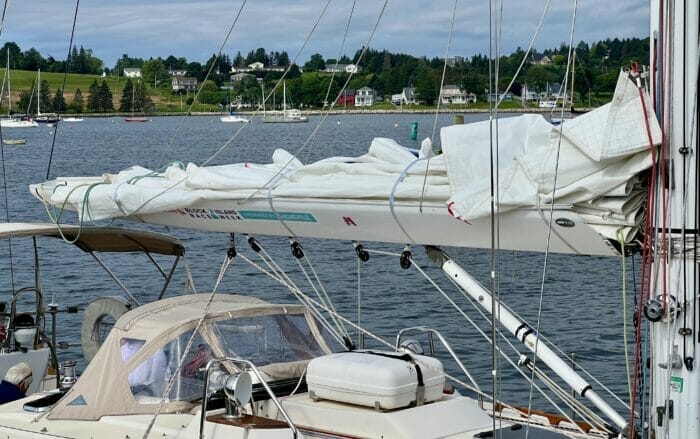
Pocket Boom, V Boom, Park Avenue Boom, it doesn’t much matter what we call them, these booms are a great idea that should be adopted by a lot more sailors than do.
A great way to simplify sail handling, and make it easy to put on the sail cover, but without the complexity, weight, performance loss, and, yes, dangers of in-mast or in-boom furling systems, and way cheaper, too.
If you are considering an automated mainsail system, do yourself a favour and think long and hard before you pull the trigger and blow a wad of cash.
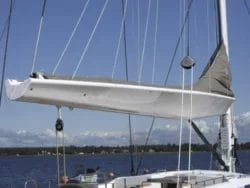
Instead, fix the slab-reefing system on your boat properly—a good 80% of the slab systems I see are poorly designed and set up—and, then, if you want to take it to the next level, buy a V Boom.
This one from Offshore Spars looks like a nice implementation. I’m guessing it’s a derivative of the brilliantly designed V Booms that Hall Spars used to make.
I wanted one of these in the worst way, but after we got done replacing our cracked aluminum mast, there was no money left.
More on how to decide between in-mast, in-boom, and slab reefing. Yes, there are situations when one of the first two options makes sense…but not that many.
And if you think in-boom systems are easier to use, watch this:
I have seen a similar idea but the shape fabricated from tube along the boom.
Hi Alastair,
That’s an interesting idea that it might be possible to retrofit. I have also seen outriggers and racks fabricated out of SS tube, but don’t like that much because of how much they would injure someone they hit, even lightly.
see comment above.
I wouldn’t use stainless.
Concerning injury, not sure it matters much what part of the boom hits you – the consequences are horrid no matter what – whether your neck gets broken by the boom, or the brain gets banged up makes very little difference – the outcome is the same
Hi George,
I disagree. In fact I don’t like adding any protrusions to the boom. My thinking is that a boom injury is not always catastrophic—could even just be falling into it, or a light brush in a tack—so my thinking is that adding stuff sticking out is upping the injury potential.
Hi John,
I guess it depends on the circumstances. We ended up setting the boom well above head height for that reason.
However if you consider the striking surface of the boom in the picture at the very top, I don’t think it is any different from that of a 25 or 30 mm pipe. So, if blunting the blow is the objective, perhaps neither should be used and we should stick to the regular shape.
Hi George,
The pic at the very top is, as I wrote in the post, in my view, far less than ideal. Instead look at the carbon boom from Offshore.
I find the idea of V shaped booms or booms with protrusions to be an unnecessary expense/complication, and possibly dangerous in the case of protrusions. A swinging boom has so much inertia that even a pretty innocuous looking bump on the head can have us seeing stars. I’d hate to think of all that inertia getting transferred to a skull via a small surface area rather than spread out over several square inches where a flat sided boom makes contact.
My current boat has a Profurl behind the mast furler that Ive learned to like a lot but my previous boat had slab reefing and a lazy jack setup that made things SO easy, just flake the sail into them, wrap 4 or 5 sail ties around the sail to hold it in place over the boom, lead the lazy jacks forward along the boom and under the reefing hooks to hold them in place and tension them using cam cleat mounted on each side of mast. Then throw your simple, one piece, continuous sail cover over it and secure it in place. So simple and fast that there’s no reason to think of it as a task to avoid. When it’s time to remove sail cover, start at the back and roll or fold it forward so when it’s time to put it back on you can fasten the front part around mast and then unroll it, pull top of sail cover taut and secure to end of boom, then just walk forward along boom tying or clipping bottom of sail cover together. Done.
Hi Jeff,
I agree on the protrusions and that slab with lazyjacks works well. That said, V books are great, in my view, although far from re quirked.
One difference, I don’t like taking the lazyjacks forward and devised a system that makes that step unnecessary: https://www.morganscloud.com/2013/09/03/lazyjacksmainsail-handling-made-easy/
Of course that requires zippers in the sail cover, but on balance I prefer that trade off.
In addition to the advantages in controlling the sail on top of the boom, there might also been an aerodynamic advantage in that the wider boom acts as an end plate for the main sail reducing pressure spill over from the windward side.
Apparently very important in some cases (Americas Cup etc. where the deck acts as a big endplate), but for a cruising boat maybe mostly a small added bonus.
Hi Svein,
That’s another point in favour, although with today’s loose footed mains there is probably room, depending on how tight the outhaul is and the shape of the foot, for the air to cross sides. Anyway, as you say, not a big deal for a cruiser.
Hi John
we priced this out in aluminium, it was more than the boom itself and I was not enamored by the look (though you can sleep up there when its really hot and the sail isn’t up. Also it reduces how far you can let out the sheet before the boom hits the shroud
Our solution was to have three bars each on the boom spaced so none would hit the shroud. These are kind of three dimensional – with a support in the center, so nothing will bend. Good old triangles …
The lazyjacks go to the outside of the bars.
Same benefits, cheaper, lighter, no problems.
Hi George,
I still think that a Carbon V boom is the ultimate option. I talked to Hall Spars about this and they had looked at the loads carefully and determined that it was difficult to do a V boom elegantly in aluminium. Perhaps that’s what you ran into.
Also, I have never seen a boat where the boom gets even close to the shroud before the sail starts to chafe unacceptably on the shrouds and spreaders, so I can’t see the V boom being the limiter for letting the sail out.
And finally, I have seen outriggers and at least to me they are both ugly and pose more danger of hurting someone than a smooth boom.
you can do much more, shapewise, with carbon than with aluminium (which was the option we considered – Sparcraft France) and they look quite good on large yachts, IMO. We didn’t bother carbon for the boom because the weight penalty of an alu boom is much less than that of an alu mast.
point taken.
concerning ugliness etc. we decided this on the basis of drawings and it looked ok to us – ugly did not come to mind, but that’s in the eyes of the beholder. to us the benefits were bigger, light weight and doing the job. I commented concerning the danger above, but we may agree to disagree on that one.
I am not in a position to replace the boom on my Bristol 35.5 but I had a stainless catchment fabricated that helps immensely. My lazy jacks attached directly to it. It serves as a great hand hold when reefing. As the sail is loose footed and the sheeting is mid boom it also strengthens the boom. https://lh3.googleusercontent.com/pw/AIL4fc8VHOq6pAAeQLnz7Gztr4SWP_0LLnRvalMIrFM_bBHwCTfrob_RZLdSLOpEKVY0eyQEgDwJn2GjlCSpcEnn3hN68nSQsnitIGU29jJy0U8bOmRDfqxZQToz2bY0QzTU7kcMaxoGgP6H8AuVxzwilQi0VCkgm6Zm1VhDZZy4VGUYtTQ9loMN2CKYh1qzqS1MnEq_hKEVa51V04oWNvv6tyyBo0HrGLmTSxN8entTL-5OwINUGgGGjV4IKXS8JIOZwSfqyAsWV33-VvK6NY-WUuEaJqbFYet3eeXgEDR3Lf7W7o4mJ7XYXDeJUBKkq-MTlRMP5YWjxTCm_1JZ7WcEVPEonSWsD3phVUZKYvIeieRdquyW5WLmxz1aj68Vrklx1Hw6zImr49O-F5qa-_dVBphWiNaM01XVHve9xuwTnwk0VRiKdRmgNmypwE81PTQF3Hu8An3LH5nnsZdwcY1yEMLAS2xbl021kZklX6OHLZIt6PGJcNqE-fGhLVcaxxd_g3ter8aw_R4JbOmEZcZKxpyFNbECxTPlupVFMk7HXPqDlMroMW-Rd3rrFsBr_7m25eZcTomcTFDdMsKTesaftt3fyP4emSuNh8csfjamTbXwX39v8npM8K_WgsHimTSiwNEb-H9iJ-SDEXJrH9NVbk77Dp46RuspPUy6HNqRC3Y5a4Z4DPek1dnYCwm4ywWA-YwSInmd5DH99QDoAoohk_ySat7_snFWdrgb3FPHxWbFVRYSpIKJjd_txEQ_-fEQEIt_qoimrym1OOyzKW0FdO_mmCrJ55AScdmKgZAg-hCh4Lt7uuk5STGd3OYSKE03l3jQlDlEaR_U4TByJTC4i0ALebfJA-52wchw4bi25gN0z-B7jPhQpjT8LURJZtwXWXHEcSlJ1WCuIW1czkH_FFI=w523-h649-s-no?authuser=0
Hi David,
Good to hear from you again. However, the links you provided are not accessible. That said, you can now upload a photo to the comments here: https://www.morganscloud.com/2013/11/10/aac-comment-guide-lines/
Having sailed with V-Booms, I don’t like them. I find they obscure the foot of the sail when reefing. The boats I have sailed with V-Booms the reef clew disappears about 8 inches before it is set. Often resulting in a sloppy reef, or worse we have had a reefing line wrap on an oddly folded flake, and because we couldn’t see it, the reefing line sawed threw the sail. I find Stack Packs have the same basic problem since know one ever rolls them down tight against the boom.
Hi Carl,
That’s interesting and something I had not thought of, particularly given that I don’t like stackpacks for the same reason. That said often the answer to a reef line that chafes through is to change to Dacron sheathed Dyneema:https://www.morganscloud.com/2017/12/09/running-rigging-recommendations-part-1/
In this case the reef chafe did not come from sawing with stretch but because maybe 20 feet of reef line was pulled across an unfortunate fold under tension.
The V boom blocking the view will not be quite as bad if reefing from the mast because you can look down the boom from the Gooseneck. But with single line systems taking over the problem is compounded. And when you hear the pundits explain it, you start to think “of coarse staying in the cockpit is always better.” Thanks for being a consistent voice of reason.
Hi Carl,
Yes, I agree, I think a lot of my love for the V boom idea is because I’m also a reefing at the mast guy. As you point out, maybe not such a great idea for reefing from the cockpit, because of the visibility problem.
i have a carbon v boom, and very happy with it. but here is my problem, i want bigger reefs on my boat, but the reefing penants are attached to the boom with a padeye on top of the boom, located exactly under the clew. it works great with the reefs as designed, but i cant fly a sail with bigger reefs because it seems impossible to fit new padeyes on the boom because they need a backing “block” inside of the boom… which is not accessible. Any idea how i could do this? it’s a x-yachts, my actual mainsail is as drawn originally. 2 reefs but still a huge sail with the 2nd reef… which is fine most of the time until it isn’t…
Hi Nikolaas,
That one has me stumped too, particularly since with carbon spars we have to be really careful not to stress them in ways that the designer did not plan for.
That said, a really good carbon composite tech could maybe cut a hole in the boom and install a new third padeye and then repair the hole, but I would not do that without design supervision from the company that made the boom. So first step, check in with them.
The only other solution I can think of is a storm trysail to set when the second reef gets too much, but that probably means adding a track to the mast, and that’s not easy either. Still having a storm trysail is great: https://www.morganscloud.com/2013/06/01/lee-shores/
More here on reef sizes and relationship to a trysail: https://www.morganscloud.com/2025/02/16/reefs-how-many-and-how-deep/
Thanks for your input. Your staysail setup on your previous boat looks bomb proof! Nordic masts, the manufacturer of my boom no longer exists, and southern spars that took them over has no records. So that path seems difficult. An idea I had was to make a 3 small grooves in the boom, top, left and right and fit a strong Velcro webbing through it. But anyway nobody wants to work on the boom without ok from maker so it’s a loophole…
Hi Nikolaas,
That’s such a pain. I get so sick of hearing about companies that buy smaller ones, but don’t bother to keep records to properly serve the legacy customers.
I also would not put any groves in the boom because of the dangers of stress concentrations: https://www.morganscloud.com/2022/02/06/12-cruising-boat-maintenance-tips/ (#7)
How about the trysail idea?
yes it’s annoying. i don’t see where i can add a trysail track on my mast. and again im sure it will need reinforcements where the bolts are, its also carbon from “nordic masts”. not sure yet what i will do. i was also thinking of buying a new boom but that seems like throwing money out of the window.
Nikolaas,
A thought is to find a rigger used to working with carbon spars. Our rigger is an experienced sailor in his own right (offshore racer) with deep practical experience and entirely used to one-off projects like yours. Whereas most spar manufacturers would likely see your project as an annoyance?
I also find they are amazing at fixing things that to me seem impossible to reach with their secret rigger “tricks”. So for instance, could they create a port in the end of the boom to add reinforcing pads under? Pretty sure they would have a way to reach. Good luck.
I think you are right, thanks for the tips. now the boat is in italy, where you find good craftmanship but they are very risk averse…
Hi Nikolaas,
Frustrating indeed. Thoughts:
thanks john, let me dig deeper into it