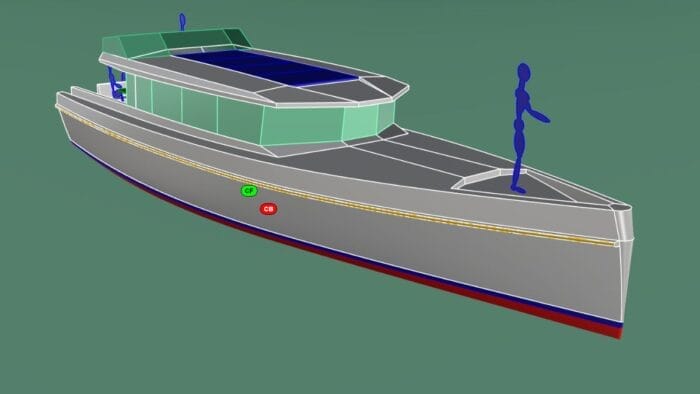
A few years ago I got interested in offshore motorboats and, more specifically, improvements in the generally horribly inefficient trawler yachts available.
I wrote a bunch of articles and Matt and I dug deep into the then newly designed Artnautica LRC58, to the point that I was noodling around with the designer Dennis Harjamaa to come up with an expedition variant.
My hope was that this focus would result in an efficient and seaworthy long distance motorboat, a bit like those being built under the supervision of our friends Steve and Linda Dashew, but without the eye-popping price tag—if you have to ask, you can’t afford it. And, indeed, several 58s were built, the first two by AAC members who heard about the boat here1.
But, unfortunately, as seems to be the trend in our world, what the market wanted was bigger, more expensive, and more complicated versions of the Artnautica 58, and of course Dennis obliged…and I lost interest.
But I just got an email communicating that Dennis is just starting the process of designing a smaller Artnautica LRC49. And he is looking for input on the boat.
Here are some brief preliminary thoughts on the boat:
Thanks for sharing. I could see something like this in our future once the kids truly move on and we decide to slow down even more from our current semi displacement Sargo. I’ve been following the Delos 2.0 build closely as I’m interested in aluminum constructed boats.
I filled out the survey as well. Excited to add some input. I agree that two cabins is too much for that boat and the mission I would have for it. I think it could be the perfect couple’s boat with one cabin, galley up in the pilothouse, and use the aft cabin space for storage, systems and engine access. I agree with your point on no electric propulsion stuff… not ready for prime time yet. Keep the design simple and easy to maintain by the owner with mechanical diesels, etc.
I would want a “get home engine” (wing engine or twins (2 small Betas?), and an exterior helm station for nice weather days and ease of piloting in harbors.
Also, I think it should keep the benefits of the other LRC boats including long-range ocean crossing ability, self-righting, and unpainted aluminum.
Hi Kevin,
I agree, the boat is just too small to have guests for more than a couple of nights, at least for me, and in that case they can sleep in the salon. One thing we learned over 30 years of living aboard is you get far fewer guests than you think you will and therefore giving over a lot of room to guest accommodations is not usually a goods thing.
I fall into the 2 cabin camp. We like having guests and do not like them sleeping in the salon. Even when it’s just me and another guy doing a transit. Maybe it’s the crowd I sail with, but it seems I am always off shore with delivery crew sleeping on top of each other.
I am glad to see a “scaled down FPB”. I work on alot of trawlers and most are uncomfortable at sea and not very efficient. I was excited when Deefoot built a 50. But alas only one was built and the original owner deleted the second cabin opting for a King sized berth in the bow. Nice in port, but not a single seaberth onboard.
Hi Carl,
Sure, if you really want guests, but given the size of the boat (small) I personally would prefer they did not stay long. It’s not just having bunks, in a boat this size, but rather that they and their gear will be constantly underfoot. We used to have four in the M&R 56 from time to time, but she was over twice the size of this boat and even so things got crowded.
The problem is not having a second cabin for guests, it is that the forward cabin is unusable while traveling offshore. if you have to beat even against moderate waves, you will not be able to sleep there. The boat is designed for a cople with occasional guests. Let’s think about it: if you want guests even while going transoceanic, you need a second cabin and a convertible dinette like on a sailing boat. Otherwise guest only when you are onshore, and the dinette in any case, for the owners while in the ocean. Foreard cabins are not useful, they just work in mediterranean in july and august, or other similar places. I am italian and i raced in the Giraglia many times: with mistral you don’t sleep forward, i can ensure you.
I agree with your forward cabin statement. I would prefer a 49 blue water catamaran design, better space utilization. Twin engines and the speed to get away from fast moving weather events that are the hallmark of climate change.
There are two aluminum options in that size range. One is a sailing cat and the other a motoring cat:
Interesting options. I have always been concerned about the righting ability of cats so I prefer the Arnautica self-righting design.
Hi Kevin,
I actually don’t worry about capsize on power cats. Wind induced capsize is much more of a problem on cats, and there is a good argument that a well designed cat is more resistant to wave capsize than a mono. More on the science here: https://www.morganscloud.com/2025/06/03/catamaran-trimaran-or-monohull-capsize-risk/
Hi Bruce,
I like power cats too, but that’s not really an apples to apples comparison. A 49′ power cat, particularly the way people trick out cats would be a huge boat probably costing two to three times more than this boat. A better comparison would be say a 35′ power cat.
There is also another issue with power cats that often gets over looked: short range. The issue is that to maintain good performance a cat must be kept light, but for long range, we need lots of fuel, but that slows the cat down and makes her sluggish more than it does a mono.
This is why Steve and Linda Dashew, who started off as cat people, changed to long thin monos: load carrying and fuel range. (I had some long chats with Steve about this some years ago.)
All that said, for shorter range work, I would also think a lot about a power cat.
Hi Piero,
I think most here agree with you. The trend with masters staterooms in the bow is in my mind not smart. (I can think of some other descriptive words too…)
However. in this case and many others, the stateroom can be significantly further aft. When on the ocean, there should be several suitable bunks in the deck house. Since this boat is probably meant for 2 people most of the time, that’s a good solution.
A very small percentage of time on the boat is crossing oceans. Even with circumnavigations on sailboats, at least 90% of the time is at anchor or in harbours. Even an ocean capable motorboat will most likely spend far less time that way, and pick its weather windows carefully. Then fwd cabins are no problem.
Hi Stein,
I agree. In fact, as I said above, I prefer to stay out of my living cabin at sea.
Hi Piero,
I don’t see that as a problem. At sea the off watch can sleep on the settees and in harbour the forward cabin is out of the way and a great owners spot that will be much nicer to live in than something crammed under the cockpit.
Steve and Linda Dashew always designed their boats that way: harbour owner’s cabin forward and sleep amidships at sea. Even on the M&R 56 where we had nice aft cabin because the boat is twice as big as this one, the off watch slept in the salon at sea: https://www.morganscloud.com/2011/03/20/the-perfect-seaberth-2/
In fact I would hate to be using my owners cabin at sea when I’m often less than clean, and salty, although that won’t happen as much on this boat.
Hi John,
I’ll never buy a motorboat. If I can’t sail, a motorboat cannot possibly replace it. “Motorboats are cars that fell into the water and, sadly, didn’t sink.” 🙂 Still, I understand that I’m not representative of the average person, in more respects than this one, and thinking about design is always interesting, so:
Assuming that this boat is intended for extended cruising for one couple, I think that one should double down on what that means: The deck house is the salon, galley and cockpit in one, by opening windows. Thus no aft cockpit, just a small aft deck with a dinghy garage and storage. If the customers insist on outside steering, make it possible to open the fwd part of the deck house more. Steering from the stern is dysfunctional, perhaps apart from while docking. A boat shouldn’t be designed primarily for docking…
Since the floor of the deck house is elevated, there’s a lot of space underneath it. Much of it will be used for engine(s) and tech, but far from all. If all the flooring in the deck house is made of very big hinged hatches, access below is excellent and the perfect workshop is available. With an ongoing project, no need to tidy up at the end of the day. Just close the hatches and all is ready for normal life. This way, the space under the floor, and deck house itself, can be kept low, as headroom isn’t needed.
Going down forwards from the deck house, should be primarily the master stateroom, in full width, and most of the available space forwards. The bow could perhaps be storage? In the transition between deck house and master stateroom, should be the single good bathroom and simple cabin(s) for guests.
The bunk(s) should extend under the deck house. No luxury. The owners want visitors, as sharing with family and friends is one of the best experiences of cruising, but they also want the guests to leave in reasonable time. It’s a visit, not a cheap cruise. I think two units of this type could fit, at either hull side, but one is enough.
A requirement for a nice experience is available privacy for all aboard. Owners want to be good hosts and to impress their guests, which is only good, but if the size and style of cabins is an important factor in this, something important is wrong.
Hi Stein,
Take another look at the actual volume of this boat. I worked with Dennis on alternatives for the LRC 58 and we had hell to a get decent guest accommodations into that (gave up). This is only a 9-10 ton boat (much smaller) so there really is not the room for some of the things you are suggesting. That said, there is some storage forward of the owners stateroom.
You can see where Dennis and I ended up in this article: https://www.morganscloud.com/2016/12/17/the-artnautica-lrc-58-adventure-edition-offshore-motorboat/
All that said, I agree, I would make the cockpit even smaller, but would definitely want outside steering for docking. A key rule Dennis has is no side doors, just too dangerous for downflood, and I agree. So that makes close quarters manouvouring not practical without outside steering.
I think it would be great to see an Adventure Edition version of the boat similar to the LRC58 work you did. However, as you said the trend is bigger and bigger boats…I think there is still a market for a boat under 50 feet. Nordhavn sold a lot of the 41’s so maybe there is a market for this boat. Especially if they could keep the price lower than a new Nordhavn I would see people wanting one (ocean crossing, self-righting, in aluminum).
Hi Kevin,
I agree, there is a place for this boat and she could easily be changed in the same way we did the LRC58 without adding much, cost to be even more seaworthy.
I think a key variable will be the price they can bring her in at. If she start creeping toward a million it’s going to be a hard sale against say the N41.
The biggest problem is explaining that the boat is actually smaller than say the N41, a lot smaller, so adjusting peoples expectations about what they can realistically have in the boat. By the way, I like the N41 way better than most of their boats, but she would be even better (for me anyway) at say 46 ft without increasing displacement.
As a former sailor and now owner of a LRC 58 hull 4, I can relate to Stein comment about “motorboats are cars that fell into the water” I continue to deal with the emotional trauma and loss of
identity of being a sailor on a motorboat. But while my mind wants to sail, my
body is telling me it’s just too risky…. but I still want the thrill of
arriving in a new county, meeting lovely people, and enjoying a beautiful
anchorage. Maybe us AAC members who are considering converting to MV should
form a therapy group!!!!!!!!!
Hi Brian,
Great to have your first hand input as an LRC 58 owner. Nothing could be more valuable to the discussion. And I totally hear you on the trade off here. As I aged, I made the call to stay sailing but a smaller boat and not go far, but I totally understand your approach because I miss the very things you point out.
This is very interesting. He should come to Trawlerfest and talk to potential buyers to gauge interest and desirable features.
On the outside steering – remote control technology like Dockmate is trustworthy and gives complete control. It’s all that’s needed for docking. Don’t complicate systems for something that will be used for such a small percentage of operational hours.
If the designer is really interested in getting this model launched, I’d be happy to get him in front of an audience at Trawlerfest, you may contact me directly if that’s something he wants to pursue.
You continue to provide a great service to the cruising community by bringing pieces like this to all of us. Thank you!
Hi Bob,
Dockmate is an interesting idea. That said, the idea of no direct connected control does make me a bit nervous particularly since we would likely be a long way from the main controls if anything went wrong. I would also want to be at the outside steering station and able to look around without glass in my way when in confined waters and low visibility.
The marketing people at Artnuatica are members here so I’m sure they have read your kind offer, and thanks for the kind words.
John,
This is fun to see. I like the Artnautica design and think it would be a perfect design to split its time between the Pacific Northwest and our home waters in Southern California. Having switched from sail to steam with our very simple single diesel lobster style cruisers, I’d like transitioning to an Artnautica design to simply slow down and be more fuel efficient without giving up much livability.
A year or so ago, I tried to undertake the construction of a very similar design with Phil Lambert who was the builder of the Outbound 46 sailboats. Phil’s 46’s were well constructed and thoughtfully designed. He is great to work with.
Phil wanted to build a 46 Nigel Iren’s designed power boat that would be similar the proposed Artnautica 49. Phil owns “hull zero” already. See:
https://cruisingodyssey.com/2023/08/28/new-rangeboat-46-made-for-efficient-cruising/
Anyway, I was signed up to build hull number 1 in Turkey but Phil and I got cold feet when the Turkish Builder only wanted to proceed if there 3 initial orders, and I was the only taker. It was a bit risky for everyone involved to invest in tooling if there was not a batch of orders. My wife and I have commissioned 5 prior builds (1 in Taiwan, 4 in Maine) and were pretty comfortable with how it would likely play out, but all those builds already had existing hull molds, and two had top molds as well.
The lay-out we designed was a stretch version of our existing 39 x 15 Calvin Beal Lobster cruiser. I would enjoy getting feedback on our design but I am not sure how to upload the lay-out and side profile images. There was a forward queen, and a lower mid-hallway single (think pilot berth to side of hull) and an aft double (think “sleeping only” quarter berth). The goal was to have private spaces for sleeping at opposite ends of the boat, and separate seaworthy sleeping quarters when it was time for 2 or 3 buddies to do a delivery cruise. It is galley-up, and small dinghy would get pulled into cockpit. A super simple equipment list was specified, no gen-set, lots of solar, single diesel and possible electric 48V wing pod.
If you want to see our design, feel free to email me at
Here’s a link to out existing lobster style (again, very simple boat) which has some of the features we want to incorporate into our next undertaking.
https://downeastboatforum.com/threads/38-calvin-in-california-%E2%80%9Csteady%E2%80%9D.43282/
Happy new year, Glen
Hi Glen,
Yes, Phil and I had quite a lengthy correspondence about the boat you were considering. I liked the boat a lot and was sad when it did not get off the ground. Phil told me he just could not get enough people to understand the lower speed, lower fuel burn, no condo, idea, but he loves the boat.
You can upload jpeg images to a comment: https://www.morganscloud.com/2013/11/10/aac-comment-guide-lines/
If you’re not sailing then what’s the point? If you move to a motor boat you’ll soon discover inland cruising. Have a look at a map of European Inland Waterways and you’ll see what I mean. So- outside steering, and ditch the inside helm because you’ll be docking constantly, (but remember that’s way better than motoring at sea, especially if you are are coming from a sailing background. I hate motoring at sea). Two cabins, you’ll be inundated with guests. You will soon learn how to manage them though. Bicycles help. Plus a second cabin makes great storage. And two toilets- you’ll need that when you get old, even without guests. Stowable inflatable with 10hp engine that will tow you out of trouble; davits for coastal, river and lake passages. If you want a garage buy a house. And remember, yachts make way better motor boats than motor boats do.
Hi Mark,
Sure, I can see all that for a canal purposed motorboat, but that’s not what the Artnauticas are purposed for. That said, Artnauticas have done quite a bit of canal cruising (most built in the Netherlands) and seem to do that relatively well while still being offshore boats, so a good compromise, I think. Horses for courses.
And yes, generally I agree that some sailboats are very good offshore motorboats, I used to own one. That said, we can do even better if we take the mast and keel off but keep some of the concepts: https://www.morganscloud.com/2013/07/19/a-sailors-motorboat/
My wife and I took our new to use LRC 58 through the Swedish Gotta Canal last season (58 locks). Before leaving I installed a outside steering station with thruster controls. To my surprise it was much easier to run the boat inside and I abandoned the outside station. Only time I use it is in perfect weather, and I want wind in my face and reminisce of my sailing days. Same goes with docking … with two people and headphones, and a working bow and stern thrusters, I don’t feel the least desire to use my second helm … very surprising
Hi Brian,
That’s interesting and I get it, now you have explained it, as long as there are thrusters. I was, like you, equally surprised! Still, based on my history with the M&R 56 I think I would pass on the thrusters in favour of the magic spring because of the drag, complication, and expense of thrusters. This is also one of the reasons I like the idea of twins, which, with a bit of practice, come close to equaling thrusters in close quarters. All that said, these decisions are very personal and the cool thing is that the LRC platform, and aluminium construction, allows each of us to have the boat we want.
Without some
form of stabilization, I don’t think this design can really be consider
offshore capable. I would suggest designing
the hull to be able to install a gyro or fins (if you don’t want to use it the
canals) and have paravanes as a backup…. like I do on my LRC58 hull 4 (which I
can retrieve without touching the “fish”)
Hi Brian,
I agree totally. Can you expand a bit on how your fish work, and particularly retrieval. I love the simplicity of “birds” as we call them here in Atlantic Canada. Nothing like seeing a fishing boat in a nasty sea steaming along pretty much rock steady to convince a person of the utility. That said, I’m also thinking that gyros have changed everything, and might now be the best bet. Any thoughts on that?
Gyroscopic stabilizers are amazingly capable…. at a price. A 9 ton, 49 foot boat would call for a Seakeeper 3 ($40,300) or Seakeeper 4 ($47,400). To that price you must add installation and an extra 80 to 100 amps of 12 V electrical generation capacity.
I doubt that I will ever again design an open-water motorboat without a suitable location and structure to fit one of these. But I completely understand the logic of any owner/builder who decides that the cost is disproportionate to the benefit and therefore builds the boat without the gyro.
Regarding the electric propulsion issue…. The only usage-profile that an electric motor option would make sense to me is in the canals… less than 40 NM per day, flat water, 4-5 knots max, and charging at a marina most nights. Given the draft (both water and air and beam) of these boats (not with a Nordhavn), this is not out of the question. Although probably does not make sense financially, I am considering installing an easily removable electric 15 KW outboard engine, on my LRC58…. But not until we finish our cruise to Norway, Iceland and the British Isles … and maybe then .. in two years… solid-state batteries will be affordable, and also I can use it as my get home engine and get rid of my current get home 35 hp sail drive which only pushes the boat 3 knots.
Hi Brian,
I agree on electric. Interesting about the get home. I dug deep into this whole get home issue and in the end came down in favour of twins, which surprised the hell out of me, but even so that solution has issues too. No clear right or wrong and very usage dependant. Three articles here: https://www.morganscloud.com/2017/05/02/get-home-backup-for-offshore-motorboats-part-1/
On a smaller boat like the LRC 49 I think small Beta twins could be a great choice. Especially if that means no bow and stern thrusters. Although with limited opening windows I wonder if Air Conditioning would be a must… then maybe a generator with a PTO for get home capability would be better…
It is easy to fall down the rabbit-hole of over-engineered hybrid systems.
I think the sweet spot is right where the Beta / Hybrid Marine factory integrated line has landed. They are adding motor-generator units, belt driven, on the output side of the transmission of what is otherwise a totally ordinary diesel drivetrain. (I am pretty sure they are using the Motenergy ME1304 which is a fine choice for this, and program it for up to 10 kW electric power from batteries to prop / 5 kW electric power from engine to DC bus.) They are much more efficient, and I think more reliable, than trying to get 5 kW continuous from a belt-driven alternator….. an important consideration as you pile on lots of house loads, a lithium battery bank, and maybe a gyro stabilizer which will draw 1 kW on its own. They can putter around silently with the diesel off for short distances. If the electric drive fails, it keeps running as a totally ordinary mechanical diesel.
That, in twin 30 hp or single 50 hp configuration, would be quite a sensible choice for this boat if the owner was expecting high house loads, wanted fast battery charging, or wanted the ability to poke around silently without fumes.
Happy New Year, John and Crew!
Please take a look at the GlobeMaster designs by Dutch naval architect Willem Nieland. There are now four GM50s on the water, and he has completed the design of a 45. Another interesting design by Jason Dickey, NZ, is the Pacific 62.
I am curious about your thoughts. I will meet Willem in Amsterdam in two weeks.
Stay afloat,
Robert