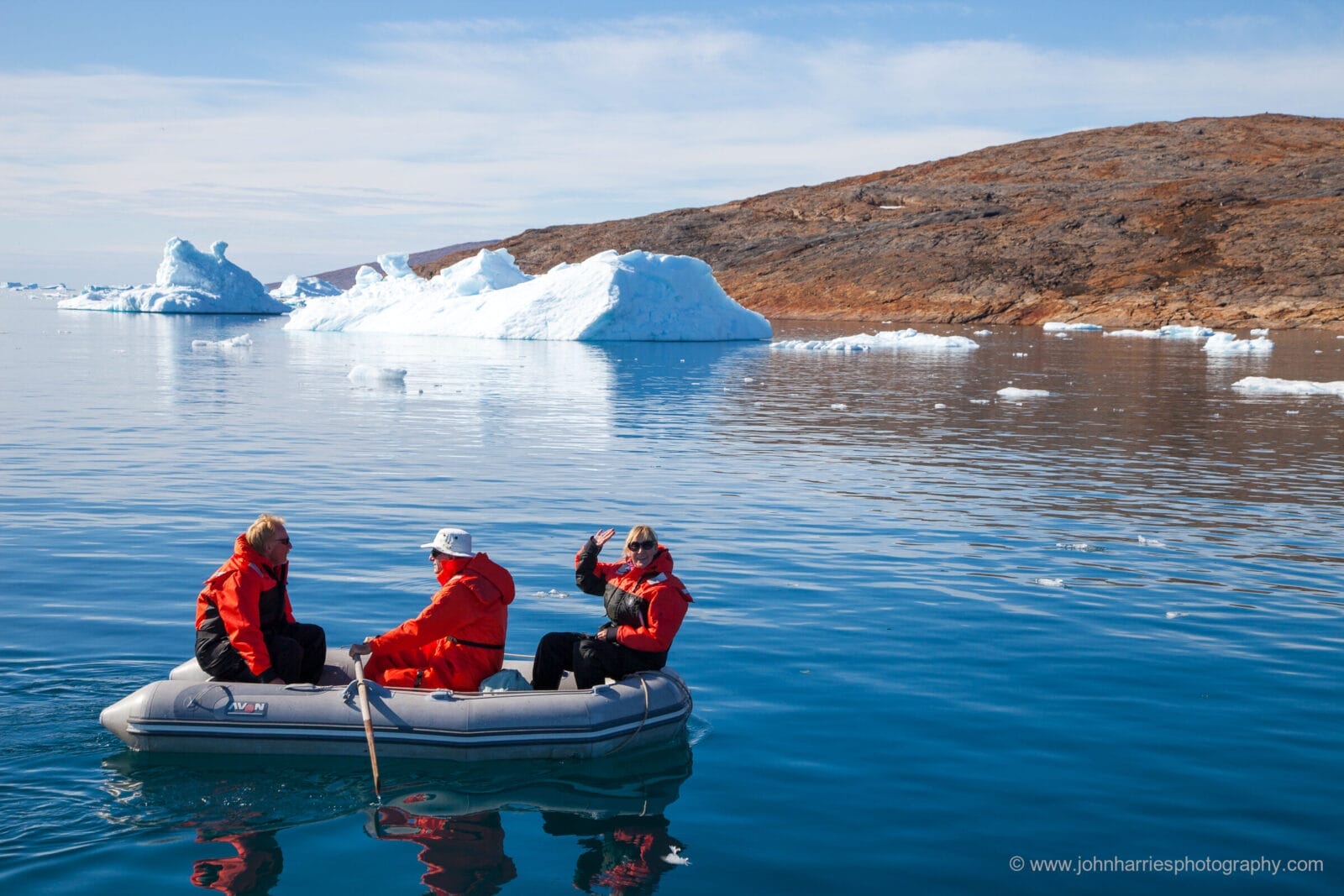
Taking a scientist and her partner ashore in Greenland. An hour after this shot was taken the wind was gusting over 50 knots and the temperature had plummeted. We can never be sure what’s coming in the north, so good gear and preparation are vital.
Survival and exposure suits have very different, although partly overlapping, functions. Here’s my thinking on which we should carry depending on the type of cruising we are planning.
Login to continue reading (scroll down). Paid membership required:
We have mustang exposure suits in momentum. Easy to get into, with excellent thermal insulation and flotation. They are so comfortable many crew kept them in during off watches even to the point of sleeping in them- sort of like wearing a good sleeping bag
In the waters from Faroes to above the arctic circle in Iceland they were excellent even in rain and freezing wind chill temperatures
Our best and most useful cold weather kit because ease of use and comfortable
Paul Kanev
S/V momentum
Peter Greathead
January 8, 2026 10:27 am
Several years ago on my circumnavigation, we had a swim stop in the Indian Ocean near the Seychelles. We were in the water for upwards of 30 minutes, until a black-tip shark interrupted the fun. When I got out, myself and several others were shivering uncontrollably, an early hypothermia symptom. The ocean is a huge heat sink and unless the water is the same temperature, or better than your blood, you are going to lose heat, and eventually hypothermia will set in.
Good point. I’m from Bermuda and even there in the summer in 30℃ water you can get cold if you stay in long enough.
Mark Wild
January 8, 2026 10:34 am
I put my boat into Lake Michigan in April each spring. Water temps 30-40 degrees f. I started sailing solo last year and realized that if I went off the boat my chances of survival were low to nil. I looked at the options listed above (as well as the previous discussions on AAC and PS) and ended up buying an NRS Extreme SAR dry suit. I wear two insulating layers inside it and a pair of oversize sea boots over the attached booties. Also two PLBs attached (406 and AIS). I can move around the boat and work easily in the suit. It’s comfortable and dry but John is correct that the latex neck gasket is necessarily tight and a little uncomfortable. You get used to it. I did a 300 mile solo race last summer and lived in the suit for two days. When I went below to nap I’d unzip the chest zip. But then I don’t have any heat in my boat so it’s pretty cool inside. I’m finding this a reasonable compromise for the coastal cruising I’m doing. By mid June, the water and air temps are generally warm enough that I don’t need the suit so I bag it up. Next summer I’ll be cruising Lake Superior. The dry suit should get plenty of use in those always cold waters.
Brian Russell
January 8, 2026 10:40 am
About 5 years ago, I bought two used Mustang survival suits on Ebay. They were shipped from India, where there is lots of shipbreaking.IIRC, they were under US100 each and completely serviceable.
There must be thousands out there from ships that were broken up. One suggestion. I would take them into a commercial safety outfit for certification. they will almost certainly pass, but in so doing you have removed any potential liability issue, and if they don’t, it’s just as well to know.
Assume they came from Alang. You can get a surprising amount of big ship stuff coming out of there that got left on ships getting broken up. I kinda want to buy a fiber optic gyrocompass and see if I can get it working.
Last edited 12 hours ago by Jordan Bettis
Bill Harvey
January 8, 2026 10:53 am
Dry suits also come in neoprene with very durable neoprene neck ,wrist seals boots and dry gloves with front entry zips downside as expensive if not more than other options but very flexible
Use mine while diving in the north sea from ribs and fresh water lakes with water temp 2c
Carry it on the boat great for prop clearing and cleaning
Bill Harvey
January 8, 2026 11:02 am
Lose heat 25 times faster in water than in air biggest loss is through the head
Bill the largest heat loss is not through the head, a popular claim, but it is wrong. The head accounts for about 10% of heat loss, but it feels as if there is much more heat loss because it is a particularly sensitive area. The original claim came from an experiment from immersion in arctic waters, wearing a survival suit that had no hood. Actual heat loss amount is proportional to body area. Hence, the torso when immersed has the highest heat loss, which is why the body restricts blood flow to extremities to try and keep the torso warm. However, if wearing a survival suit or other foul weather clothing, keeping the head insulated is absolutely essential to reduce the time until hypothermia sets in, or increase survival time.
Thanks for the fill on that. I was a bit uncomfortable with that assertion, but was not sure enough to clarify it. That said, your point about proper head cover is well made too. This is one of my objections to relying on a drysuit in an abandon situation: no insulated purpose built hood.
Jordan Bettis
January 8, 2026 1:21 pm
I have a mustang drysuit. It is easy to don and doff you just have to do it in the right order. You can also get a fleece liner that they sale for added insulation.
The gaskets you.. get used to.. I’m used to wearing PPE doing various projects. Not always comfortable. You get used to it. Dunno what to say.
Also sure definitely inspect it for damage. Mine has an outer nylon shell that is very durable.
One big advantage to it, is that you can wear it in less cold weather. When single-handing on the great lakes I wear it during the night. I also keep a PLB in the shoulder pocket.
For ventilation you can just leave the front zipper open. Obviously this will impair watertightness, but if you’re working heavily or get hot walking around onshore, just unzip it. I’ve also pulled the top off onshore and tied the arms around my waist.
The drysuit is more comfortable (temperature wise) to wear in warmer weather than an exposure suit, and it also is more capable of keeping you alive in cold water. And if it does leak, and you’re in a cold environment and therefore have the liner, possibly wool base layers etc, inside the suit, then the suit basically “degrades gracefully” to an exposure suit as it fills with water.
Alan Miegel
January 8, 2026 1:42 pm
Can’t say I agree with you on all drysuits. Cheap ones maybe but I own a trilaminate, front zipper dry suit with cuff protectors, suspenders and dry gloves. Crushed neoprene ones are very similar. They are easily opened to vent/dry out after exertion as it has suspenders inside and a front zipper that is easily opened/closed even with 7mm neoprene gloves or mits. You can pop it over you rhead and have you head, nack and shoulders exposed. It’s very flexible and with light weight thermal undergarments you can stay for hours in the water and never get cold. At deck level after donning there is about 35lbs floatation in it. Even if you vent off the air in the suit you would still need maybe 15lbs to sink it. I’ve also worm gumby suits and don’t see any difference between the two as far as floating face down. I can say I worked as a professional diver for sometimes 12 hours in a trilam drysuit and found it cofrtable and much better than a survival suit would be.
Eric Klem
January 8, 2026 1:57 pm
Hi John,
Totally agree on the importance of survival suits in anything but really warm water. I have always thought that getting in a survival suit is more important than getting in the liferaft in these waters. The problem of course is that donning is tough and there is an incentive to wait as you can’t do much in them so I like the solution you used of the Ice Commander.
The courses I have been involved with require you to be able to don the suit in under a minute. This is remarkably hard and takes more than little practice. It can also be interesting to try to do it in something like a small hard dinghy to simulate the boat moving all around, it is another level harder even. I do recommend also just jumping in the water and floating around with it on. It can be really fun and you learn a lot but make sure you have an easy way to get back out of the water.
I don’t have a lot of experience with exposure suits mainly because I haven’t liked them all that much when I have used them. For a tall guy, the one I used to have pulled hard between the shoulders and groin which was uncomfortable. Also, I found the fact that they are not waterproof annoying so I often just reached for my foulies. Note that my experience with them is on boats with large crews so drying out of stuff like this is very problematic and is part of the reason why Grundens or equivalent foulies are liked so much.
Thanks for reinforcing the importance of practice. You are so right! The first time I tried it without training it was a total cluster… and 1 minute is a high bar to clear.
I also agree that if I was faced with situation where I could either get into my survival suit, or a life raft, I would probably choose the survival suit, at least in cold water.
I’ve taken the survival school courses twice (I have commercial tickets) and the first time, they made us throw our unzipped suits in the pool and then don them in the water. That’s a challenge!
I can’t even imagine how hard that was! Hope there was a lifeguard present.
John Harries
Author
January 8, 2026 3:36 pm
Hi All,
As I expected several people are extolling the benefits of dry suits. That’s fine if you are comparing to foul weather gear or working exposure suits. As I say in the foot note that’s a matter of taste. No argument if you prefer dry suits to either of those alternatives.
However, I stick by my assertion that dry suits are not a substitute for survival suits. And that includes the heavy duty neoprene ones which I own an example of and have used several times in near freezing water, so I have relevant experience.
A huge amount of research by survival experts has gone into survival suits in the commercial world and they have saved countless lives in some of the worst situations and conditions imaginable. Us recreational mariners second guessing that makes no sense.
I think we’re mostly comparing drysuits to exposure suits. Agree that they’re not a substitute for gumby suits.
OTOH, putting a gumby suit on is akin to getting in the liferaft in that you can’t keep working to save the boat with it on. Doffing is essentially giving up on the boat and trusting your fate to rescue.
We have mustang exposure suits in momentum. Easy to get into, with excellent thermal insulation and flotation. They are so comfortable many crew kept them in during off watches even to the point of sleeping in them- sort of like wearing a good sleeping bag
In the waters from Faroes to above the arctic circle in Iceland they were excellent even in rain and freezing wind chill temperatures
Our best and most useful cold weather kit because ease of use and comfortable
Paul Kanev
S/V momentum
Several years ago on my circumnavigation, we had a swim stop in the Indian Ocean near the Seychelles. We were in the water for upwards of 30 minutes, until a black-tip shark interrupted the fun. When I got out, myself and several others were shivering uncontrollably, an early hypothermia symptom. The ocean is a huge heat sink and unless the water is the same temperature, or better than your blood, you are going to lose heat, and eventually hypothermia will set in.
Hi Peter,
Good point. I’m from Bermuda and even there in the summer in 30℃ water you can get cold if you stay in long enough.
I put my boat into Lake Michigan in April each spring. Water temps 30-40 degrees f. I started sailing solo last year and realized that if I went off the boat my chances of survival were low to nil. I looked at the options listed above (as well as the previous discussions on AAC and PS) and ended up buying an NRS Extreme SAR dry suit. I wear two insulating layers inside it and a pair of oversize sea boots over the attached booties. Also two PLBs attached (406 and AIS). I can move around the boat and work easily in the suit. It’s comfortable and dry but John is correct that the latex neck gasket is necessarily tight and a little uncomfortable. You get used to it. I did a 300 mile solo race last summer and lived in the suit for two days. When I went below to nap I’d unzip the chest zip. But then I don’t have any heat in my boat so it’s pretty cool inside. I’m finding this a reasonable compromise for the coastal cruising I’m doing. By mid June, the water and air temps are generally warm enough that I don’t need the suit so I bag it up. Next summer I’ll be cruising Lake Superior. The dry suit should get plenty of use in those always cold waters.
About 5 years ago, I bought two used Mustang survival suits on Ebay. They were shipped from India, where there is lots of shipbreaking.IIRC, they were under US100 each and completely serviceable.
Hi Brian,
What a deal and a great idea.
There must be thousands out there from ships that were broken up. One suggestion. I would take them into a commercial safety outfit for certification. they will almost certainly pass, but in so doing you have removed any potential liability issue, and if they don’t, it’s just as well to know.
Assume they came from Alang. You can get a surprising amount of big ship stuff coming out of there that got left on ships getting broken up. I kinda want to buy a fiber optic gyrocompass and see if I can get it working.
Dry suits also come in neoprene with very durable neoprene neck ,wrist seals boots and dry gloves with front entry zips downside as expensive if not more than other options but very flexible
Use mine while diving in the north sea from ribs and fresh water lakes with water temp 2c
Carry it on the boat great for prop clearing and cleaning
Lose heat 25 times faster in water than in air biggest loss is through the head
Bill the largest heat loss is not through the head, a popular claim, but it is wrong. The head accounts for about 10% of heat loss, but it feels as if there is much more heat loss because it is a particularly sensitive area. The original claim came from an experiment from immersion in arctic waters, wearing a survival suit that had no hood. Actual heat loss amount is proportional to body area. Hence, the torso when immersed has the highest heat loss, which is why the body restricts blood flow to extremities to try and keep the torso warm. However, if wearing a survival suit or other foul weather clothing, keeping the head insulated is absolutely essential to reduce the time until hypothermia sets in, or increase survival time.
Hi Alastair,
Thanks for the fill on that. I was a bit uncomfortable with that assertion, but was not sure enough to clarify it. That said, your point about proper head cover is well made too. This is one of my objections to relying on a drysuit in an abandon situation: no insulated purpose built hood.
I have a mustang drysuit. It is easy to don and doff you just have to do it in the right order. You can also get a fleece liner that they sale for added insulation.
The gaskets you.. get used to.. I’m used to wearing PPE doing various projects. Not always comfortable. You get used to it. Dunno what to say.
Also sure definitely inspect it for damage. Mine has an outer nylon shell that is very durable.
One big advantage to it, is that you can wear it in less cold weather. When single-handing on the great lakes I wear it during the night. I also keep a PLB in the shoulder pocket.
For ventilation you can just leave the front zipper open. Obviously this will impair watertightness, but if you’re working heavily or get hot walking around onshore, just unzip it. I’ve also pulled the top off onshore and tied the arms around my waist.
The drysuit is more comfortable (temperature wise) to wear in warmer weather than an exposure suit, and it also is more capable of keeping you alive in cold water. And if it does leak, and you’re in a cold environment and therefore have the liner, possibly wool base layers etc, inside the suit, then the suit basically “degrades gracefully” to an exposure suit as it fills with water.
Can’t say I agree with you on all drysuits. Cheap ones maybe but I own a trilaminate, front zipper dry suit with cuff protectors, suspenders and dry gloves. Crushed neoprene ones are very similar. They are easily opened to vent/dry out after exertion as it has suspenders inside and a front zipper that is easily opened/closed even with 7mm neoprene gloves or mits. You can pop it over you rhead and have you head, nack and shoulders exposed. It’s very flexible and with light weight thermal undergarments you can stay for hours in the water and never get cold. At deck level after donning there is about 35lbs floatation in it. Even if you vent off the air in the suit you would still need maybe 15lbs to sink it. I’ve also worm gumby suits and don’t see any difference between the two as far as floating face down. I can say I worked as a professional diver for sometimes 12 hours in a trilam drysuit and found it cofrtable and much better than a survival suit would be.
Hi John,
Totally agree on the importance of survival suits in anything but really warm water. I have always thought that getting in a survival suit is more important than getting in the liferaft in these waters. The problem of course is that donning is tough and there is an incentive to wait as you can’t do much in them so I like the solution you used of the Ice Commander.
The courses I have been involved with require you to be able to don the suit in under a minute. This is remarkably hard and takes more than little practice. It can also be interesting to try to do it in something like a small hard dinghy to simulate the boat moving all around, it is another level harder even. I do recommend also just jumping in the water and floating around with it on. It can be really fun and you learn a lot but make sure you have an easy way to get back out of the water.
I don’t have a lot of experience with exposure suits mainly because I haven’t liked them all that much when I have used them. For a tall guy, the one I used to have pulled hard between the shoulders and groin which was uncomfortable. Also, I found the fact that they are not waterproof annoying so I often just reached for my foulies. Note that my experience with them is on boats with large crews so drying out of stuff like this is very problematic and is part of the reason why Grundens or equivalent foulies are liked so much.
Eric
Hi eric,
Thanks for reinforcing the importance of practice. You are so right! The first time I tried it without training it was a total cluster… and 1 minute is a high bar to clear.
I also agree that if I was faced with situation where I could either get into my survival suit, or a life raft, I would probably choose the survival suit, at least in cold water.
I’ve taken the survival school courses twice (I have commercial tickets) and the first time, they made us throw our unzipped suits in the pool and then don them in the water. That’s a challenge!
Hi Peter,
I can’t even imagine how hard that was! Hope there was a lifeguard present.
Hi All,
As I expected several people are extolling the benefits of dry suits. That’s fine if you are comparing to foul weather gear or working exposure suits. As I say in the foot note that’s a matter of taste. No argument if you prefer dry suits to either of those alternatives.
However, I stick by my assertion that dry suits are not a substitute for survival suits. And that includes the heavy duty neoprene ones which I own an example of and have used several times in near freezing water, so I have relevant experience.
A huge amount of research by survival experts has gone into survival suits in the commercial world and they have saved countless lives in some of the worst situations and conditions imaginable. Us recreational mariners second guessing that makes no sense.
I think we’re mostly comparing drysuits to exposure suits. Agree that they’re not a substitute for gumby suits.
OTOH, putting a gumby suit on is akin to getting in the liferaft in that you can’t keep working to save the boat with it on. Doffing is essentially giving up on the boat and trusting your fate to rescue.
Hi Jordan,
I agree, and think that’s a good way to look at the issues in an abandon ship situation.
That said, did you mean donning, rather than doffing? If so I can change it for you.