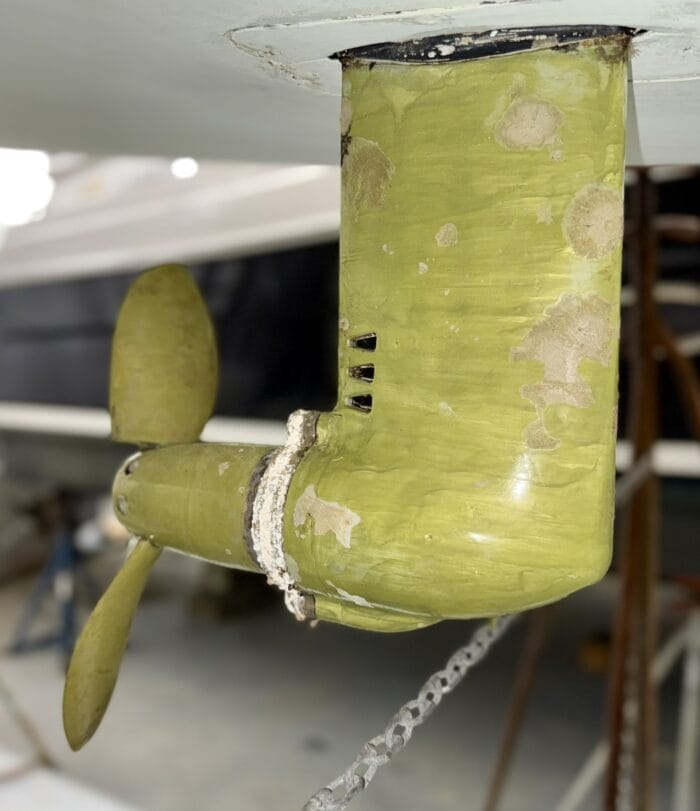
When we bought our J/109 we had the prop and saildrive leg coated with PropSpeed® by the boatyard we store at.
It has now been three years with six-month sailing seasons since then and the coating is still doing well. The photo above shows the amount of fouling when the boat came out of the water this year after six months, and the little bit of light shell came off with a scotch pad and very little work.
That said, there are some small areas of coating failure but close inspection shows that there are places where the applicator did not get a quite even coating thickness.
Prop Speed success depends on prep and application. The use environment water is also a factor. Mine was yard applied ( who knows how.). It lasted three seasons in the mid Chesapeake Bay but the condition wasn’t nearly as clean looking as your picture. I tried Rustoleum galvanized (93% zinc) this year and had a good result for the cost of $18. I removed the prop speed with paint stripper,then sanded the PYI clean,sprayed three coats and done. A lot cheaper and not hard to DIY. But those of you with saildrives suffer unique neurosis. Mike Pitzer
Did you use a primer? We tried the same on our shaft drives / props and it mostly sloughed off within a week.
No primer. I just took it down to clean brass with three M on a wheel. Then wiped it with alcohol before spraying three coats.
Hi John,
The following hack comes with a caveat – I haven’t been able to do an accurate test between PropSpeed and DIYSpeed but have had promising results on our MaxProp to fix PropSpeed areas that were damaged. At some point (when I retire) I will do a full prop coat from base metal as a trial.
Prepare the bronze surface with a fine rotary wire brush on a drill. You want the tiny scratches on the surface to create adhesion. Then wipe clean with thinners. Then apply an etch primer all over (I use the International Paints one). Your prep is now done.
Now squeeze a good amount of 100% PURE silicone sealant from its tube into a disposable mixing cup, enough to cover your prop / sail drive size.
Then add a good splash of epoxy thinners to this cup, but don’t overdo it. Now take a wooden mixing stick (I use Norski ones) and start mixing. Keep mixing for a few minutes. Now swear at whoever told you about this hack, as the silicone remains stubbornly unaffected. Keep stirring.
Look in the cup as you keep stirring, laughing that this isn’t going to work and magically the silicone combines with the thinners and becomes the consistency of paint – just like PropSpeed. Add more thinners and stir in, if DIYSpeed is too thick.
Hint: If it hasn’t worked, keep stirring.
You need to brush this paint on in one application, so quickly mix a second batch and apply a second coat before the first one dries, just like PropSpeed – you can read their application instructions.
Epoxy thinner? I’ve worked with West System Epoxy a fair amount and haven’t run into any thinners except maybe denatured alcohol which we used to clean up tools afterwards. Perhaps you are referring to “un-thickened” epoxy added to the 100% silicone. Since I have West system epoxy and all the pumps needed, I’m intrigued by this hacks potential cost savings compared to PropSpeed.
Hi John, International (AkzoNobel) Thinner No.7 Epoxy Thinner. Label on tin says… “Formulated specifically to be used to reduce the viscosity and aid application when applying International two pack epoxy materials.”
Interesting DIY solution – please come back and post when you have any data whether it works! I can’t stomach the cost of propspeed and have reasonably good results with the Hempel product, though boat only in brackish water right now.
I have done similar for years. I make sure the 100% silicone caulk I buy has instructions for using in an aquarium because some don’t. I thin the caulk with Coleman stove fuel to a brushable consistency. I have applied it over clean lightly roughed bronze both with and without a couple coats of Rustoleum spray galvanizing. Unless nicked or scraped it seems to be good for a year.
Be careful about applying too much. I have. It changed the shape of the trailing edge of the propeller blades causing the prop to sing. It would sing when motoring at a good clip. Several faulty diagnoses lead to a couple of weeks in the yard replacing the prop shaft, realigning the engine, filling and redrilling the bolt holes in the engine beds, and replacing the cutless bearing (2X) before saying it must be the propeller. It was. Google “singing propeller”.
The usual auto parts stores stock a low viscosity silicone material in tubes that is used to seal the leaks in windshield seals. It needs no thinning. I started off using it.
Sherwin Williams makes both one and two component anti-graffiti siloxane paints as do others.
My saildrive is now twenty years old and going strong. I have the Volvo MD2030 with the Volvo SD paired to it. Previous owner of my Pretorien changed out the previous Volvo for the newer 2030.
Three years ago, I sanded the saildrive down to bare aluminum, primed and repainted. Top coat is the same as the bottom paint which is Pettit Hydracoat eco. I need to dive the boat on the morning (Raritan Bay) about every three weeks to remove silt. I had reserves when buying the boat with a saildrive but I am now enjoying the pros of the saildrive. Dry bilge, efficient operation (better prop angle) super smooth operation, smaller footprint engine compartment. I did try a competitor to Prop Speed and applied it myself with poor results.
Looks great John. I love my sail drive with a flexofold two blade prop. I have to negotiate a marina and two locks every time I leave my home port of Swansea. When I bought the Winner 9.50 with its Yanmar engine and leg, the original coat had long gone, so I cleaned up the aluminium leg and applied 6 coats of International interprotect (their 2 pack primer) and then Trilux. This has been fine in the Bristol Channel and in Swansea marina with its unusual sub tropical worm infestation. But sadly the new international water base propeller antifoul has been useless. It wouldn’t even mix properly and phone calls plus emails got no answer from the usually helpful tech guys at international? I don’t want to keep abrading the beautiful prop more and more as it’s not just an adhesion issue given the growth. So my leg is well protected but it’s back to an annual polish of the prop blades. The polymer hub is fine with normal antifoul.
The Yanmar SD25 sail drive housing on our Dragonfly 32 was coated with an epoxy primer and then had Interlux Baltoplate anti-fouling applied to it. It’s been two years and it is holding up quite well. We have a two blade Flex-O-Fold prop with the plastic composite housing and it has no coating on it. We did use Prop-Speed on the folding prop blades and it is still marginally holding up. Our boat lives mostly in a fresh to slighly brackish water environment (Lake Pontchartrain) so the typical fouling we see is slime (hardly ever a barnacle). However, at least 3-4 times a year we cruise off the lake into saltwater environments (i.e. the Gulf of Mexico) and barnacles will form unless I clean the unpainted surfaces every 3-4 days. We recently returned from a 3 week cruise and before we left, I coated these same surfaces with Lanacote anti-fouling grease to limit barnacle development. I need to dive on the boat to see how it worked.
Propspeed was developed in New Zealand about 25 years ago. The New Zealand boating community has more experience with it than anyone else and long ago came to the conclusion that it is the best option available, to the extent that it is not a matter for discussion. Iron Bark is currently in New Zealand, hauled out for a refit. Every vessel in the boatyard other than two foreign vessels uses Propspeed – sailboats, powerboats, commercial barges, workboats.
I have used Propspeed whenever I could get it for the past 15 years. It is superior to anything else that I have come across. As an example, since it was last applied 15 months ago, Iron Bark has sailed and motored about 1500 miles in coastal waters and sailed 16,000 miles offshore (a trip from New Zealand to Alaska and back). On arrival back in New Zealand the propeller had 2 small barnacles on it, with about 10 more on the propeller boss and shaft. The paint film was intact except for the blade tips where it was abraded away by chopping through weed mats. Water temperatures varied from 8°C to about 32°C and she has traversed about 95° of latitude (37°S to 58°N) with ample opportunity for fouling of all types. The prop may have been clean but the hull was quite foul with gooseneck barnacles acquired in deep water and triangular barnacles (Balanus trigonus) from coastal waters in New Zealand and Alaska.
The cost of Propspeed in New Zealand is modest compared to the prices John is paying. By getting together with another boat to share a 500cc pack, its cost professionally applied to two 18” three-blade props is NZ$360 – about NZ$180 (US$100) each if you clean the prop yourself. This suggests that North American prices have plenty of room to fall.
Hi Trevor,
How great to hear from you! Not long ago Phyllis and I were wondering how you were doing and how the new boat was working out. Obviously the answer is very well, given your recent voyages!
Thanks for the fill on Propspeed. You clearly know way more than I do, so very useful.