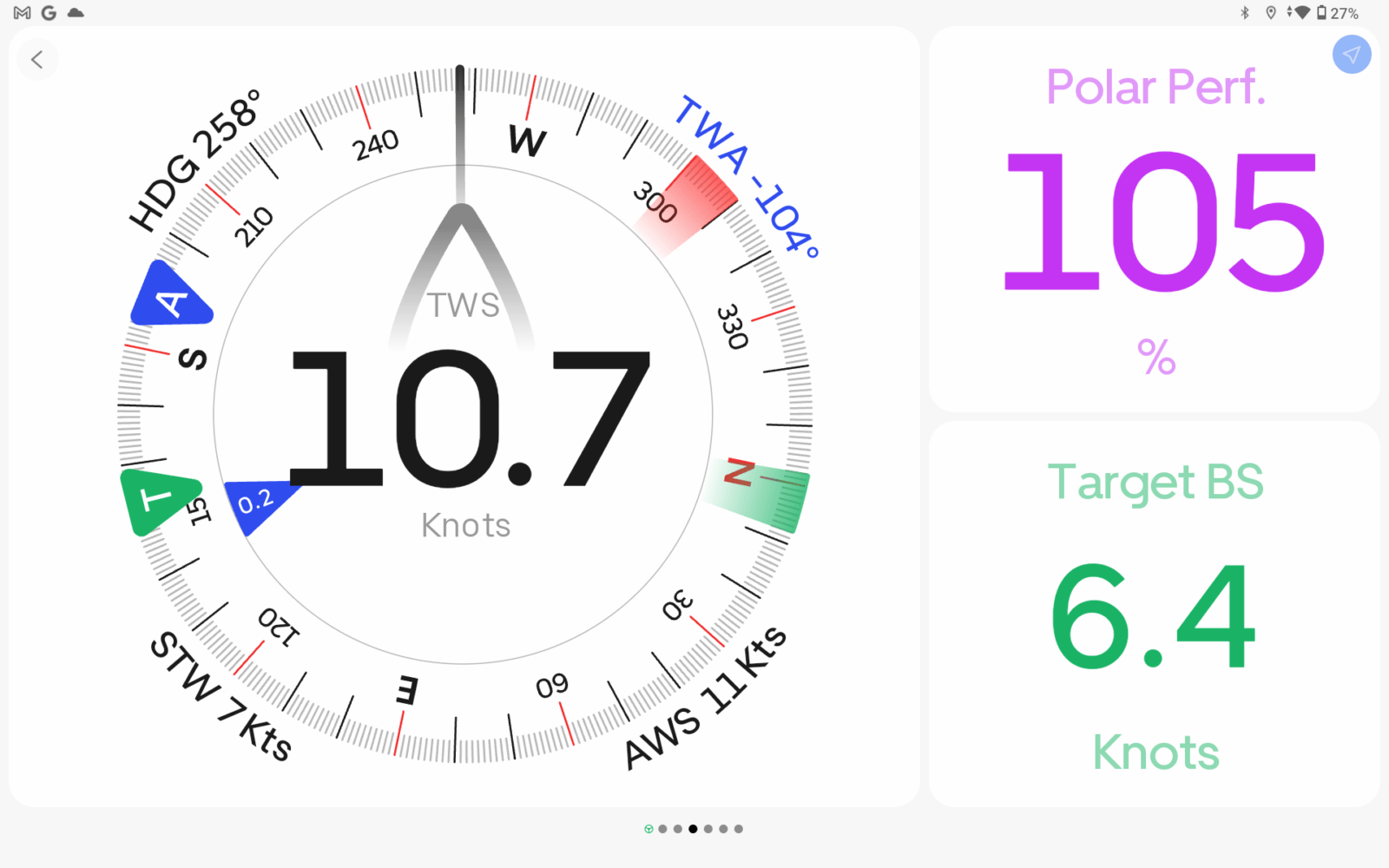
A sailing screen showing performance against polars.
In Part 2 we got the Orca Core all set up, and hinted at the many things it can do. Now let’s dig deeper so each of us can decide if Core is worth US$595 to us.
Login to continue reading (scroll down). Paid membership required:
Don’t mean to keep harping on this but what works/doesn’t work without the subscription? Do all the sailing stuff still work without charts? Do you get to keep the charts that are downloaded or are they deleted? Or is the whole system bricked?
Also, what if Orca goes out of business? Do you have $3k of junk?
I don’t like my Raymarine stuff but at least it will continue to work until it physically breaks.
Sure, if Orca go out of business some of the Core features would stop working, such as remote read out, and the Orca App would not be able to download any more charts, so replacement would be a smart move, but the loss here is $595 (Core) not $3000, given that the sensors can be used with other systems and the Orca Display is a Android tablet that could be used with other apps. Given the relatively small amount of money in play, that’s not something that worries me.
The other thing is that I would always replace orphaned hardware fairly quickly after the company went out of business so the way I look at it the same applies to most any system and most are a lot more expensive than Orca.
There is replacement risk in everything. For example if the folks behind Open CPN went away and stopped upgrading the software and supplying charts the software would eventually become unusable as operating systems are upgraded and so you would be faced with buying say TimeZero and charts for more than Core. And one day your PC will likely get to the point it can’t run the latest version of Windows, or at least not well, and so will need replacing. Or at some point Panasonic will probably stop supporting/repairing your particular PC so all it will take is one key switch to break, and you will need to replace it at ~$3000.
Not saying any of that is likely, but it’s not any less likely than Orca going out of business and no one taking over from them.
Point being that tech moves on and hardware replacement risk is just part of owning this stuff. No electronics system is replacement risk free,
Well I disagree with “throwing it out if the manufacturer is out of business.” If I did that I’d throw out half my tools and sailing hardware.
I don’t have to upgrade Windows (or even use it) if I don’t want to. I’m not reliant on Panasonic because Dell and Getac sell the same product (fully ruggedized 2 in 1). OpenCPN is a community, if the current maintainers step down there are other people.
Even considering traditional equipment, my Raymarine came with the boat. Raymarine has no idea that I use their equipment. There are no OTA updates and no remote kill switch.
That being said I looked up Orca’s subscription policy and it is (currently!) surprisingly good. The charts you download apparently stay in the device forever, they claim there’s no remote delete, and they say that none of the on-the-boat device functionality is tied to an account or subscription.
Each of us can claim lower risks of replacement for whatever our favourite tech is and that gets hugely complicated, so there is no clear right. That said, I have been around PCs since CP/M and hardware replacement due to changes in tech or companies going out of business have been a fact of life all that time. And I have also found that predicting what will need replacing is very hard. Point being that to say a given tech has no risk of replacement is just not supported by history.
Also, I did not say you were reliant on Panasonic. What I said was that one day there will be no service on your PC and if it fails you will have to replace it for around 5 times the cost of a Core.
Added to that, these days we have to worry about security, so not updating Windows, or any other operating system, is a high risk strategy that I don’t recommend.
The other thing to think about is that the fact that Orca charge a subscription could also reduce the risk of problems going forward. Not only because they have regular and predictable income but also because recurring revenue is now the holy grail in the software business. So there is a credible argument that if Orca did have trouble, it would be easy for them to find a company to sell to who would carry on.
In summary, replacement risk is complicated.
Does any of this make Orca better than your solution? Of course not, to say that would be silly. And anyway, I’m a huge fan of PC based navigation. But equally to keep dumping on Orca in this way does not make a lot of sense to me either.
Jeremy Stoltz
November 21, 2025 11:35 am
I purchased an Orca Core two years ago when I added AIS because I didn’t have an autopilot or heading sensor on the boat. The core is comparable to a B&G’s Precision-9 even if you didn’t use any Orca software since the data is sent over NMEA 2k.
I may have an older plan but I never purchased a subscription and most of the Orca features described in the article work without a subscription. The biggest limitation is no offline charts and limited logs.
Broadcasting NMEA 0183 sentences via WiFi has been a feature request since the beginning so not sure if they are willing to add it.
I use Orca as my primary navigation but since the current data doesn’t exist in my area I still subscribe to Navionics Boating. If the charting was comparable to most other offerings I would subscribe to Orca but it currently is missing info.
When you say that the Core is comparable to the Precision 9, have you tried both providing heading and attitude to an autopilot and/or target plotting on a radar, both in waves.
Point being that just because both output the same data, that does not necessarily make them equal. A lot depends on the speed and quality of said data.
I haven’t compared the two. The core is probably redundant on a lot of other boats since they already have a similar device already installed which could be used to compare the data.
I have a fairly simple boat at the moment with no below deck autopilot or radar. When adding AIS I compared features between the core and something similar to a Precision 9. The core seemed to be comparable feature wise and more flexible. Plus I liked what Orca was trying to do and wanted to support them and try it for myself.
Great, thanks for the fill. I’m with you on what Orca is doing. Reminds me of my time in the early days of the PC business going up against mini computers that cost ten times more built by companies who did not treat their customers well.
Kevin Dreese
November 21, 2025 2:54 pm
John. Great stuff as always. By the way… not that you are looking for more work but I thought an awesome book opportunity would be a soup to nuts compilation of your J-109 refit. Having all the articles in one place would not only be like a master’s guide to not just refitting a J-109 but also useful for anyone.
I may write a bit more about our J/109 refit, but I don’t think I will make a book out of it. First off I have already written a lot about it, but by subject (electrical, electronic, rigging etc), which I think is a more useful clarification. The other thing is that while the 109 is a great retirement boat for us, it’s not really a cruising boat, particularly offshore, so such a book would be of very limited appeal to our members.
Richard Ritchie
November 21, 2025 3:00 pm
It might be exciting technology but what about current alternatives?
You have scraped around for benefits and tried to show what Orca could do if they develop further.
But in doing so you talk of things that are actually available already now.
I am particularly thinking of your need for availability of ALL NMEA data on TCP/IP or UDP.
Just buy one of the Yacht Devices bridges. They have a fantastic flexibility, are cheap and even I made it work out of the box (and I do not do IT interfacing). Now I have all data available everywhere, combined, distributed and filtered as I want, across NMEA0183 and 2000 and Seatalk, on Wifi if needed for ipad, etc. Ready for you to do your interfacing work to any display device in however way you want.
So I suggest that a large part of your needs can already be done without expense.
The biggest killer for me from following up on your recommendations is the chart disply: I would not want their cartography compared to any I am using. It appears too pastel and hard to read.
Sure there are alternatives, perhaps better alternatives. That’s the whole point of a real review: to define a product so that we can all make good decisions, not to get into arguments about best. I even make clear in the summary that Orca might not be best, and it certainly won’t be best for everyone, which I say too.
And I mention many other products in all three parts. I’m also very clear that if we already have the NMEA data from other devices, as I do, (B&G plotter) there is not a lot of navigational benefit to Orca Core.
But it does other things that Yacht Devices don’t do for such a low cost. For example the yacht devices fluxgate costs nearly as much as the whole Core. Add in GPS with NMEA and you are at close to double the cost of Core. And then you need the NMEA to Wifi box for several hundred more. With the three you are at better than double Core. On the other hand, you also have a more open system, so that’s a win for YD. I also make clear that I think Orca should open the system more. Many trade offs. And that’s what a good review does, expose trade offs and hopefully encourage companies to make their products better.
I got interested and dug a bit deeper into YD and I’m pretty sure they are only doing very simple true wind without any of the sophisticated corrections that Orca do (see article).
If I’m right, that’s a huge Orca benefit since really good true wind is required for good off wind autopilot performance in waves. This kind of thing is why in depth reviews are so time consuming…and valuable.
Thanks, John. Agreed.
And I was unclear.
I was only suggesting there were other ways to add simply something you were missing, given all that one might already have on board. I was not suggesting playing Lego to make up all the Orca core functions: that would be very costly.
Appreciate the very thorough feedback and sorry to have troubled you.
No worries, it was interesting digging into Yacht Devices more. Very cool company.
Mark Baumgartner
November 21, 2025 3:15 pm
I have had the Core2 since it came out and overall I like it very much for most of the reasons you’ve set out. I also find that their overall screen aesthetic and chart views are very user friendly and intuitive. Except for areas where chart choice dictated another application (not uncommon in the Caribbean, Bahamas, and East Coast US), the Orca was my application of choice.
To round out the discussion here are a few cautionary things I have noted:
No Alarms. Particularly no AIS collision alerts. This is pretty critical and basic and I hope they add it soon – Vesper does this very well with configurable options. In my opinion the revised anchor watch is nearly useless. Sure, it seems neat to draw on the chart around your boat, but with no good scale reference it makes it hard to use in practice. I much prefer the Vesper style of place anchor and set radius (though assymetrical would be a nice addition). And again, the alarm is near useless as it has no remote notification (text or email) and it won’t alarm unless the app is open and active on your phone/tablet (yes, if you are remote and have the phone on and app open it will alert you that the boat’s moved out of the anchor watch area, but that’s not practical). Other applications can send a text and you can check boat position/status by text – even without a full internet connection.
The AIS ignores/filters out some transmissions. While approaching the Chesapeake Bay at night my Vesper picked up a Fishing Device Buoy transmitting AIS, but the Orca didn’t display it at all. MarineTraffic also showed the transmission so something on Orca was filtering it out. I notified Orca but have heard nothing back.
Radar. This might be limited to the Navico Halo+ and B&G plotters but once Orca connects to the Radar, the B&G plotter will report Radar not found until you reboot the Plotter (and don’t reconnect Orca). This seems to be a fairly common issue with B&G and the workaround for OpenCpn is to have Opencpn use Radar B, and the B&G plotter use Radar A (the Halo+ has 2 radars). The Orca doesn’t appear to allow selection of one or the other radar so to switch back you need to disconnect the Orca and reboot. Pretty clunky.
Despite those limitations, which I hope get addressed at some point. There are many benefits to the Orca and overall it works well.
Thanks for those points. Very useful. I will be covering more in part 4 and will reference your comment then. To be fair, when sitting the anchor alarm you can use the measure tool to give scale when drawing the alarm zone. That said, I can certainly see why you like the drop and set radius functionality. Me too.
And thanks for the heads up on the radar, I had not yet run into that. Adds to my thinking that the radar option is really not useful, as stated above.
Last edited 26 days ago by John Harries
Garth Paine
November 21, 2025 11:56 pm
Hi John,
I have been using Orca for a few years now and love it on the west coast of the USA. I am looking at a global race and wondered if I could use Orca for that, but found that the available charts are actually quite limited to more heavily populated areas (unless I am missing something), so it could not be a primary nav tool for a circumnavigation. Even charts for Mexico are nonexistent. I just wanted to point this out as you mention global charts. Cheers, Garth
Yes, I have mentioned chart availability several times and will dig deeper in Part 4.
Fabio Luis De Paoli
November 22, 2025 11:23 am
I like the way you do your analyses always pointing out there is no perfect solution and each should evaluate if it’s the right fit for them, even if you inject your opinion from your experience, which is valuable. Thank you for that.
Orca sure seems like an attractive product suite that can disrupt the market.
However, similar to what others commented, I fear it follows the trend of modern smart devices by requiring an account to setup, and a subscription model – which is reasonable for getting updated charts.
The first key discomfort I would have is what happens if Orca goes kaput with their app being sunset. One important side effect is you’d never be able to reset the Core and reconfigure it. Most people won’t want to rush and replace for something else if the Core works well That risk of losing functionality doesn’t happen with traditional hardware. So, to me, it is a key disadvantage of Orca. Good thing is it is easy to fix by enabling setup through direct Wifi with no Orca account, which I hope Orca implements in a future firmware release. 🙂
The second key discomfort is the subscription model of today won’t necessarily be the same of tomorrow. Ha. Orca Core requiring an account and talking to the internet means Orca could change their licensing terms in the future so you require a subscription for the key or best Orca Core functionalities to work. Has happened before with non-nautical Smart Devices, can happen here. Again, easy to fix, and if Orca believes they have a superior product that stands on its own ground without having to lock users in, as apparently they do believe, it would be wise for them to remove mandatory Orca account need and make that crystal clear in their marketing and licensing.
If these Smart Device similarities are removed, I see even greater potential to take over the market for what Core provides and as a side effect entice more Core customers to try/buy the Display and Charging Mount.
Yeah John sees the subscription as a company trying to build a “sustainable business” but I’ve been in this industry for almost 20 years and I can smell this type of business model from a mile away.
The model is to use the hardware as a loss-leader to get the subscription. The subscription is important because it’s ARR (Annual Reoccurring Revenue) — a key metric for silicon valley.
The ultimate goal is to sell the business to private equity with a valuation based on DDDDD# of subscribers with $XXM ARR. The PE firm will then fire all the development resources and squeeze the customers till their eyes pop.
They could prove me wrong by decoupling the hardware from the subscription, for instance, by making OTA updates opt-in and allowing people to install their own charts if they don’t want to use the subscription charts.
I’ve got even more experience than you in software development, as well as inside experience with Silicon Valley business shenanigans, so I won’t say that what you have outlined is an impossible evolution for Orca; but it is also not inevitable. A lot depends on the people running the company, which does operate well outside of Silicon Valley — and maybe also outside of the Bay Area’s business models and practices. Negative customer outcomes are not the only possibilities for subscription software models.
Frankly, I don’t see a PE acquisition as the most likely negative evolution of Orca. What I would see as more likely if the company’s officers are opportunistic cynics and/or if the company runs into financial pressures is that an established vendor would buy out Orca, accompanied by lots of press releases about how EstablishedVendor will now integrate Orca’s technology with their own, bringing it to a larger market while continuing to support Orca users, etc. Shortly thereafter, almost all of Orca’s technology and work will effectively disappear and Orca employees will be looking for new jobs since EstablishedVendor has accomplished their goal of eliminating a competitive threat from an emerging product that already did some things better. I’ve seen significant amounts of my own work disappear down that hole.
But, again, it is impossible to know from outside the company and outside its officers’ minds exactly how Orca will evolve.
Yeah definitely a possibility. The reason why I went with PE as the most likely outcome is that
1) The market is currently pretty competitive with several major navigation equipment manufacturers (Garmin, Raymarine, Simrad, Furuno) plus other interconnected vendors in more specific verticals (Standard Horizion, icom, etc). It doesn’t seem like there’s a dominant player where you’re going to drink their milkshake until they pay for you to disappear.
2) The interlocked subscription/hardware play just feels like a business designed to produce durable ARR being the value prop for a buyer who wants to extract maximum value from that revenue stream.
That being said I never really understood the Garmin/Active Captian acquisition except perhaps there were people at Garmin wanting to do a rollup and starting with the cheap stuff.
Regardless, I’m so skeptical of this upstart because it feels to me like a business that’s being built to sell. Maybe it’s not. Again if they want to prove me wrong they could do so by decoupling the hardware and subscription products.
There already is considerable decoupling between the hardware and the software/service subscription — enough so that I’m seriously evaluating whether at least the Display hardware is a good buy on its own even without any subscription. It is at least competitive with other tablets being marketed to boaters. And even if one were to go all in and buy the Core and then the Orca company disappears, a $599 not-quite-a-brick is not an enormous expense in most yachting budgets. Orca is still an early adopter’s gamble at this point, but it isn’t an enormous one.
1) The display isn’t usable as a chart plotter without an account since the free tier only has access to “online charts” (does this mean you also need a net connection?)
2) You can not bring your own charts, you have to use theirs.
Since the display comes with the first year free, and they say they don’t delete offline charts I guess you could download the charts for all the areas you want to go while the subscription is active and then let it expire.
It’s still an Android tablet, so other software can be run — it’s not exclusively an Orca software platform. The Orca Display 2 looks to be a good option to run any Android navigation software, which is why I’m so interested in what John will discover when running the TZ iBoat for Android beta. I’m basically evaluating it as a generic Android tablet with built-in GNSS and inductive charging that also includes instrument and autopilot control software.
Thanks I wasn’t aware that you could use it as a standard Android tablet, although in that case there may be other options that fit your needs. For instance, the Samsung Galaxy Tab Active5 has everything you list except inductive charging (but it does have hot-swappable batteries)
The Active 5 is also only a little more than half the brightness and I’m not sure the screen is as well optimized for dark glasses and use with gloved hands, as the Orca Display. And to me hot swap batteries are not near as good as an elegant mount and induction charging either. And the Galaxy uses pogo pins for charging which both Mark and I are pretty sure will not stand up well to salt water.
On the bright side for the Galaxy, the water resistance rating is higher.
Interesting comment about Galaxy Active Tab and gloves – I thought the pen that comes with the Galaxy Active was a bit of a gimmick until I tried using it and found that it is a fantastic thing with gloves.
Good to hear, but I guess I would prefer not to have to keep track of a pen in an open and wet cockpit. August over at 59 North shared that the Orca Display is really good with gloves on, so that would be my preferred option.
I agree, all this speculation, is just that, speculation. We can’t know what’s going to happen, or what the Orca principles are thinking, so my thinking is that this stuff is a waste of time that can be better spent deciding whether or not Orca (or any other tech) meets our individual needs.
I also think that this knee jerk hate of subscriptions is ill advised. In many cases subscriptions allow companies to be more customer focused rather than constantly figuring out ways to make their existing hardware obsolete, including stopping support prematurely, so they can sell us something new, like the plotter companies often do: https://www.morganscloud.com/jhhtips/garmin-cut-vesper-users-loose/
My other thought is that there are a lot of suggestions here that will make it a lot more difficult for Orca to reach profitability and stay there. I think that’s misguided too since I would much rather get my products from a profitable company, than one that’s struggling.
And as you point out further down, we are talking about just $595 in play here.
I guess I can see your discomforts, but I don’t share them. My thinking is that whenever we buy anything we are making a gamble on the company, subscription or not.
Sure we can keep orphaned hardware or software for a while, but eventually problems arise and replacement becomes the seamanlike option.
And after all, given that Orca Display is generic we only have $595 in play.
Another thing to consider is that having lived in Norway for over two years I can tell you that the culture, both socially and and in business, is much less predatory than we are used to in North America. Is that a guarantee of good behaviour? Of course not, but it is worth taking into account. Also my interactions with Orca have given me a very good feeling about the culture.
As I’m Norwegian, I can confirm what you say, John.
I don’t personally know the people behind Orca, even though I have spoken to some of them at a previous METS. They could get tempted by a big number and sell out, of course, as anyone could, no matter what strategy was chosen.
However, these guys started up as enthusiasts. Orca is their baby. A deal that makes it perish will get a lot of resistance, no matter what nationality. The typical Norwegian lives in close contact with nature, with independence and pride in self reliance as the ultimate metric. A money dude from Silicon Valley trying to buy Orca might face an unexpected personality test. The demand is: “Just be normal!” Which the Silicon Valley money rep cannot avoid failing.
The classic Norwegian might quickly think: “Who do you think you are? Is this weakling really trying to push me? OK. Just f off!” They will often not say any of that out loud, and rather either smile, be polite and move away, or just look down and grumble a bit. This means, communication has irreversibly ended.
Sounds a bit weird, perhaps, but even though Norway is rich and technologically and socially advanced, it’s also been on the edge of the world for many thousand years. We’re still partially outsiders with a “little brother” complex, strangely mixed with self confidence. Morality, pride and such from the old days are still alive. That’s mostly nice, but occasionally also not.
The only reason Norway is (technically) not a member of the EU, is this exact mechanism. I may paint a slightly comical picture, but it’s actually more real than one would think. I now live in Amsterdam. It’s sometimes easier to see this stuff from the outside. So now you understand all Norwegians perfectly. 😀 Anyway, I doubt if Orca will be a victim of big money, but who knows.
Don’t mean to keep harping on this but what works/doesn’t work without the subscription? Do all the sailing stuff still work without charts? Do you get to keep the charts that are downloaded or are they deleted? Or is the whole system bricked?
Also, what if Orca goes out of business? Do you have $3k of junk?
I don’t like my Raymarine stuff but at least it will continue to work until it physically breaks.
Hi Jordan,
Sure, if Orca go out of business some of the Core features would stop working, such as remote read out, and the Orca App would not be able to download any more charts, so replacement would be a smart move, but the loss here is $595 (Core) not $3000, given that the sensors can be used with other systems and the Orca Display is a Android tablet that could be used with other apps. Given the relatively small amount of money in play, that’s not something that worries me.
The other thing is that I would always replace orphaned hardware fairly quickly after the company went out of business so the way I look at it the same applies to most any system and most are a lot more expensive than Orca.
There is replacement risk in everything. For example if the folks behind Open CPN went away and stopped upgrading the software and supplying charts the software would eventually become unusable as operating systems are upgraded and so you would be faced with buying say TimeZero and charts for more than Core. And one day your PC will likely get to the point it can’t run the latest version of Windows, or at least not well, and so will need replacing. Or at some point Panasonic will probably stop supporting/repairing your particular PC so all it will take is one key switch to break, and you will need to replace it at ~$3000.
Not saying any of that is likely, but it’s not any less likely than Orca going out of business and no one taking over from them.
Point being that tech moves on and hardware replacement risk is just part of owning this stuff. No electronics system is replacement risk free,
Well I disagree with “throwing it out if the manufacturer is out of business.” If I did that I’d throw out half my tools and sailing hardware.
I don’t have to upgrade Windows (or even use it) if I don’t want to. I’m not reliant on Panasonic because Dell and Getac sell the same product (fully ruggedized 2 in 1). OpenCPN is a community, if the current maintainers step down there are other people.
Even considering traditional equipment, my Raymarine came with the boat. Raymarine has no idea that I use their equipment. There are no OTA updates and no remote kill switch.
That being said I looked up Orca’s subscription policy and it is (currently!) surprisingly good. The charts you download apparently stay in the device forever, they claim there’s no remote delete, and they say that none of the on-the-boat device functionality is tied to an account or subscription.
Hi Jordan,
Each of us can claim lower risks of replacement for whatever our favourite tech is and that gets hugely complicated, so there is no clear right. That said, I have been around PCs since CP/M and hardware replacement due to changes in tech or companies going out of business have been a fact of life all that time. And I have also found that predicting what will need replacing is very hard. Point being that to say a given tech has no risk of replacement is just not supported by history.
Also, I did not say you were reliant on Panasonic. What I said was that one day there will be no service on your PC and if it fails you will have to replace it for around 5 times the cost of a Core.
Added to that, these days we have to worry about security, so not updating Windows, or any other operating system, is a high risk strategy that I don’t recommend.
The other thing to think about is that the fact that Orca charge a subscription could also reduce the risk of problems going forward. Not only because they have regular and predictable income but also because recurring revenue is now the holy grail in the software business. So there is a credible argument that if Orca did have trouble, it would be easy for them to find a company to sell to who would carry on.
In summary, replacement risk is complicated.
Does any of this make Orca better than your solution? Of course not, to say that would be silly. And anyway, I’m a huge fan of PC based navigation. But equally to keep dumping on Orca in this way does not make a lot of sense to me either.
I purchased an Orca Core two years ago when I added AIS because I didn’t have an autopilot or heading sensor on the boat. The core is comparable to a B&G’s Precision-9 even if you didn’t use any Orca software since the data is sent over NMEA 2k.
I may have an older plan but I never purchased a subscription and most of the Orca features described in the article work without a subscription. The biggest limitation is no offline charts and limited logs.
Broadcasting NMEA 0183 sentences via WiFi has been a feature request since the beginning so not sure if they are willing to add it.
I use Orca as my primary navigation but since the current data doesn’t exist in my area I still subscribe to Navionics Boating. If the charting was comparable to most other offerings I would subscribe to Orca but it currently is missing info.
Hi Jeremy,
Thanks for the report, much appreciated.
When you say that the Core is comparable to the Precision 9, have you tried both providing heading and attitude to an autopilot and/or target plotting on a radar, both in waves.
Point being that just because both output the same data, that does not necessarily make them equal. A lot depends on the speed and quality of said data.
Hi John,
I haven’t compared the two. The core is probably redundant on a lot of other boats since they already have a similar device already installed which could be used to compare the data.
I have a fairly simple boat at the moment with no below deck autopilot or radar. When adding AIS I compared features between the core and something similar to a Precision 9. The core seemed to be comparable feature wise and more flexible. Plus I liked what Orca was trying to do and wanted to support them and try it for myself.
Hi Jeremy,
Great, thanks for the fill. I’m with you on what Orca is doing. Reminds me of my time in the early days of the PC business going up against mini computers that cost ten times more built by companies who did not treat their customers well.
John. Great stuff as always. By the way… not that you are looking for more work but I thought an awesome book opportunity would be a soup to nuts compilation of your J-109 refit. Having all the articles in one place would not only be like a master’s guide to not just refitting a J-109 but also useful for anyone.
Hi Kevin,
Thanks for the kind words.
I may write a bit more about our J/109 refit, but I don’t think I will make a book out of it. First off I have already written a lot about it, but by subject (electrical, electronic, rigging etc), which I think is a more useful clarification. The other thing is that while the 109 is a great retirement boat for us, it’s not really a cruising boat, particularly offshore, so such a book would be of very limited appeal to our members.
It might be exciting technology but what about current alternatives?
You have scraped around for benefits and tried to show what Orca could do if they develop further.
But in doing so you talk of things that are actually available already now.
I am particularly thinking of your need for availability of ALL NMEA data on TCP/IP or UDP.
Just buy one of the Yacht Devices bridges. They have a fantastic flexibility, are cheap and even I made it work out of the box (and I do not do IT interfacing). Now I have all data available everywhere, combined, distributed and filtered as I want, across NMEA0183 and 2000 and Seatalk, on Wifi if needed for ipad, etc. Ready for you to do your interfacing work to any display device in however way you want.
So I suggest that a large part of your needs can already be done without expense.
The biggest killer for me from following up on your recommendations is the chart disply: I would not want their cartography compared to any I am using. It appears too pastel and hard to read.
Hi Richard,
Sure there are alternatives, perhaps better alternatives. That’s the whole point of a real review: to define a product so that we can all make good decisions, not to get into arguments about best. I even make clear in the summary that Orca might not be best, and it certainly won’t be best for everyone, which I say too.
And I mention many other products in all three parts. I’m also very clear that if we already have the NMEA data from other devices, as I do, (B&G plotter) there is not a lot of navigational benefit to Orca Core.
But it does other things that Yacht Devices don’t do for such a low cost. For example the yacht devices fluxgate costs nearly as much as the whole Core. Add in GPS with NMEA and you are at close to double the cost of Core. And then you need the NMEA to Wifi box for several hundred more. With the three you are at better than double Core. On the other hand, you also have a more open system, so that’s a win for YD. I also make clear that I think Orca should open the system more. Many trade offs. And that’s what a good review does, expose trade offs and hopefully encourage companies to make their products better.
Don’t get me wrong, I like Yacht Devices and think they make great stuff at good prices, but this is about Orca, not Yacht Devices, which I have already written about, a bit: https://www.morganscloud.com/jhhtips/engine-temperature-gauge-hack/
As to the chart display, I agree and covered that in detail in part 1: https://www.morganscloud.com/2025/10/28/orca-navigation-system-review-part-1-architecture-and-display/
Hi Richard,
I got interested and dug a bit deeper into YD and I’m pretty sure they are only doing very simple true wind without any of the sophisticated corrections that Orca do (see article).
If I’m right, that’s a huge Orca benefit since really good true wind is required for good off wind autopilot performance in waves. This kind of thing is why in depth reviews are so time consuming…and valuable.
Thanks, John. Agreed.
And I was unclear.
I was only suggesting there were other ways to add simply something you were missing, given all that one might already have on board. I was not suggesting playing Lego to make up all the Orca core functions: that would be very costly.
Appreciate the very thorough feedback and sorry to have troubled you.
Hi Richard,
No worries, it was interesting digging into Yacht Devices more. Very cool company.
I have had the Core2 since it came out and overall I like it very much for most of the reasons you’ve set out. I also find that their overall screen aesthetic and chart views are very user friendly and intuitive. Except for areas where chart choice dictated another application (not uncommon in the Caribbean, Bahamas, and East Coast US), the Orca was my application of choice.
To round out the discussion here are a few cautionary things I have noted:
Despite those limitations, which I hope get addressed at some point. There are many benefits to the Orca and overall it works well.
Hi Mark,
Thanks for those points. Very useful. I will be covering more in part 4 and will reference your comment then. To be fair, when sitting the anchor alarm you can use the measure tool to give scale when drawing the alarm zone. That said, I can certainly see why you like the drop and set radius functionality. Me too.
And thanks for the heads up on the radar, I had not yet run into that. Adds to my thinking that the radar option is really not useful, as stated above.
Hi John,
I have been using Orca for a few years now and love it on the west coast of the USA. I am looking at a global race and wondered if I could use Orca for that, but found that the available charts are actually quite limited to more heavily populated areas (unless I am missing something), so it could not be a primary nav tool for a circumnavigation. Even charts for Mexico are nonexistent. I just wanted to point this out as you mention global charts. Cheers, Garth
Hi Garth,
Yes, I have mentioned chart availability several times and will dig deeper in Part 4.
I like the way you do your analyses always pointing out there is no perfect solution and each should evaluate if it’s the right fit for them, even if you inject your opinion from your experience, which is valuable. Thank you for that.
Orca sure seems like an attractive product suite that can disrupt the market.
However, similar to what others commented, I fear it follows the trend of modern smart devices by requiring an account to setup, and a subscription model – which is reasonable for getting updated charts.
The first key discomfort I would have is what happens if Orca goes kaput with their app being sunset. One important side effect is you’d never be able to reset the Core and reconfigure it. Most people won’t want to rush and replace for something else if the Core works well That risk of losing functionality doesn’t happen with traditional hardware. So, to me, it is a key disadvantage of Orca. Good thing is it is easy to fix by enabling setup through direct Wifi with no Orca account, which I hope Orca implements in a future firmware release. 🙂
The second key discomfort is the subscription model of today won’t necessarily be the same of tomorrow. Ha. Orca Core requiring an account and talking to the internet means Orca could change their licensing terms in the future so you require a subscription for the key or best Orca Core functionalities to work. Has happened before with non-nautical Smart Devices, can happen here. Again, easy to fix, and if Orca believes they have a superior product that stands on its own ground without having to lock users in, as apparently they do believe, it would be wise for them to remove mandatory Orca account need and make that crystal clear in their marketing and licensing.
If these Smart Device similarities are removed, I see even greater potential to take over the market for what Core provides and as a side effect entice more Core customers to try/buy the Display and Charging Mount.
Keep up the great work John!
Yeah John sees the subscription as a company trying to build a “sustainable business” but I’ve been in this industry for almost 20 years and I can smell this type of business model from a mile away.
The model is to use the hardware as a loss-leader to get the subscription. The subscription is important because it’s ARR (Annual Reoccurring Revenue) — a key metric for silicon valley.
The ultimate goal is to sell the business to private equity with a valuation based on DDDDD# of subscribers with $XXM ARR. The PE firm will then fire all the development resources and squeeze the customers till their eyes pop.
They could prove me wrong by decoupling the hardware from the subscription, for instance, by making OTA updates opt-in and allowing people to install their own charts if they don’t want to use the subscription charts.
I’ve got even more experience than you in software development, as well as inside experience with Silicon Valley business shenanigans, so I won’t say that what you have outlined is an impossible evolution for Orca; but it is also not inevitable. A lot depends on the people running the company, which does operate well outside of Silicon Valley — and maybe also outside of the Bay Area’s business models and practices. Negative customer outcomes are not the only possibilities for subscription software models.
Frankly, I don’t see a PE acquisition as the most likely negative evolution of Orca. What I would see as more likely if the company’s officers are opportunistic cynics and/or if the company runs into financial pressures is that an established vendor would buy out Orca, accompanied by lots of press releases about how EstablishedVendor will now integrate Orca’s technology with their own, bringing it to a larger market while continuing to support Orca users, etc. Shortly thereafter, almost all of Orca’s technology and work will effectively disappear and Orca employees will be looking for new jobs since EstablishedVendor has accomplished their goal of eliminating a competitive threat from an emerging product that already did some things better. I’ve seen significant amounts of my own work disappear down that hole.
But, again, it is impossible to know from outside the company and outside its officers’ minds exactly how Orca will evolve.
Yeah definitely a possibility. The reason why I went with PE as the most likely outcome is that
1) The market is currently pretty competitive with several major navigation equipment manufacturers (Garmin, Raymarine, Simrad, Furuno) plus other interconnected vendors in more specific verticals (Standard Horizion, icom, etc). It doesn’t seem like there’s a dominant player where you’re going to drink their milkshake until they pay for you to disappear.
2) The interlocked subscription/hardware play just feels like a business designed to produce durable ARR being the value prop for a buyer who wants to extract maximum value from that revenue stream.
That being said I never really understood the Garmin/Active Captian acquisition except perhaps there were people at Garmin wanting to do a rollup and starting with the cheap stuff.
Regardless, I’m so skeptical of this upstart because it feels to me like a business that’s being built to sell. Maybe it’s not. Again if they want to prove me wrong they could do so by decoupling the hardware and subscription products.
There already is considerable decoupling between the hardware and the software/service subscription — enough so that I’m seriously evaluating whether at least the Display hardware is a good buy on its own even without any subscription. It is at least competitive with other tablets being marketed to boaters. And even if one were to go all in and buy the Core and then the Orca company disappears, a $599 not-quite-a-brick is not an enormous expense in most yachting budgets. Orca is still an early adopter’s gamble at this point, but it isn’t an enormous one.
From what I understand here:
https://help.getorca.com/en/articles/6541858-subscription-prices-and-functionality
1) The display isn’t usable as a chart plotter without an account since the free tier only has access to “online charts” (does this mean you also need a net connection?)
2) You can not bring your own charts, you have to use theirs.
Since the display comes with the first year free, and they say they don’t delete offline charts I guess you could download the charts for all the areas you want to go while the subscription is active and then let it expire.
It’s still an Android tablet, so other software can be run — it’s not exclusively an Orca software platform. The Orca Display 2 looks to be a good option to run any Android navigation software, which is why I’m so interested in what John will discover when running the TZ iBoat for Android beta. I’m basically evaluating it as a generic Android tablet with built-in GNSS and inductive charging that also includes instrument and autopilot control software.
Hi Mark,
Exactly!
Thanks I wasn’t aware that you could use it as a standard Android tablet, although in that case there may be other options that fit your needs. For instance, the Samsung Galaxy Tab Active5 has everything you list except inductive charging (but it does have hot-swappable batteries)
Hi Jordan,
The Active 5 is also only a little more than half the brightness and I’m not sure the screen is as well optimized for dark glasses and use with gloved hands, as the Orca Display. And to me hot swap batteries are not near as good as an elegant mount and induction charging either. And the Galaxy uses pogo pins for charging which both Mark and I are pretty sure will not stand up well to salt water.
On the bright side for the Galaxy, the water resistance rating is higher.
It’s all trade offs.
Interesting comment about Galaxy Active Tab and gloves – I thought the pen that comes with the Galaxy Active was a bit of a gimmick until I tried using it and found that it is a fantastic thing with gloves.
Hi Nick,
Good to hear, but I guess I would prefer not to have to keep track of a pen in an open and wet cockpit. August over at 59 North shared that the Orca Display is really good with gloves on, so that would be my preferred option.
Hi Mark,
I agree, all this speculation, is just that, speculation. We can’t know what’s going to happen, or what the Orca principles are thinking, so my thinking is that this stuff is a waste of time that can be better spent deciding whether or not Orca (or any other tech) meets our individual needs.
I also think that this knee jerk hate of subscriptions is ill advised. In many cases subscriptions allow companies to be more customer focused rather than constantly figuring out ways to make their existing hardware obsolete, including stopping support prematurely, so they can sell us something new, like the plotter companies often do: https://www.morganscloud.com/jhhtips/garmin-cut-vesper-users-loose/
My other thought is that there are a lot of suggestions here that will make it a lot more difficult for Orca to reach profitability and stay there. I think that’s misguided too since I would much rather get my products from a profitable company, than one that’s struggling.
And as you point out further down, we are talking about just $595 in play here.
So true …
Hi Fabio,
Thanks for the kind words.
I guess I can see your discomforts, but I don’t share them. My thinking is that whenever we buy anything we are making a gamble on the company, subscription or not.
Sure we can keep orphaned hardware or software for a while, but eventually problems arise and replacement becomes the seamanlike option.
And after all, given that Orca Display is generic we only have $595 in play.
Hi Fabio, Jordan and Mark,
Another thing to consider is that having lived in Norway for over two years I can tell you that the culture, both socially and and in business, is much less predatory than we are used to in North America. Is that a guarantee of good behaviour? Of course not, but it is worth taking into account. Also my interactions with Orca have given me a very good feeling about the culture.
Hi John, (and Fabio, Jordan, Mark),
As I’m Norwegian, I can confirm what you say, John.
I don’t personally know the people behind Orca, even though I have spoken to some of them at a previous METS. They could get tempted by a big number and sell out, of course, as anyone could, no matter what strategy was chosen.
However, these guys started up as enthusiasts. Orca is their baby. A deal that makes it perish will get a lot of resistance, no matter what nationality. The typical Norwegian lives in close contact with nature, with independence and pride in self reliance as the ultimate metric. A money dude from Silicon Valley trying to buy Orca might face an unexpected personality test. The demand is: “Just be normal!” Which the Silicon Valley money rep cannot avoid failing.
The classic Norwegian might quickly think: “Who do you think you are? Is this weakling really trying to push me? OK. Just f off!” They will often not say any of that out loud, and rather either smile, be polite and move away, or just look down and grumble a bit. This means, communication has irreversibly ended.
Sounds a bit weird, perhaps, but even though Norway is rich and technologically and socially advanced, it’s also been on the edge of the world for many thousand years. We’re still partially outsiders with a “little brother” complex, strangely mixed with self confidence. Morality, pride and such from the old days are still alive. That’s mostly nice, but occasionally also not.
The only reason Norway is (technically) not a member of the EU, is this exact mechanism. I may paint a slightly comical picture, but it’s actually more real than one would think. I now live in Amsterdam. It’s sometimes easier to see this stuff from the outside. So now you understand all Norwegians perfectly. 😀 Anyway, I doubt if Orca will be a victim of big money, but who knows.
Hi Stein,
A very good and fun analysis of why and how Norwegians are different. Thanks.