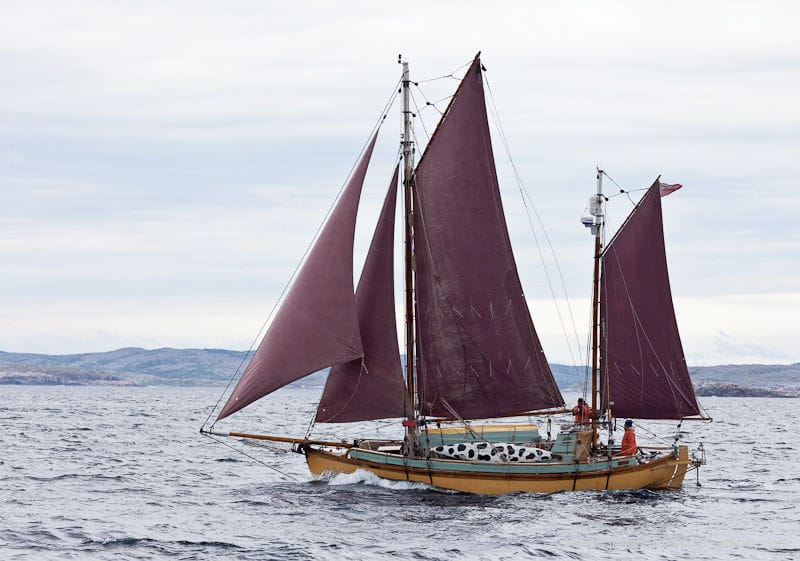
Question [edited for brevity]: I was perusing the boats for sale on the web and came across a number of ferro-cement hulled boats and I was wondering what you thought of that material in general for use in a cruising boat. Is it ever a good idea or is it a matter of manufacturer and current condition? Since I haven’t heard of any companies using it these days I thought it might be an indication that it was an experiment that didn’t show a lot of promise.
Answer: We have no experience with ferro-cement boats, other than hearing that they do not handle abrasion well. But we do know Mick and Bee who have been sailing their gaff-rigged ferro-cement sailboat Hannah for many years, though we’ve never asked them for their thoughts on ferro-cement.
Does anyone out there have personal first-hand experience with ferro-cement boats, or good and qualified engineering information (no hearsay, please)? If so, please leave a comment.
First-hand experience?
Not much, apart from helping out a concrete canoe team now and then.
General engineering information?
If the designer understands the material, there’s nothing fundamentally wrong with ferro-cement from an engineering standpoint. It can be more than strong enough if designed and built correctly.
Ferro’s main weakness is that the manufacturing process is very much dependent on the skill of the workers and the culture of the company. It is very difficult to tell whether you’re looking at a ferro hull built of quality materials by skilled staff, or one built of chicken wire and cheap mortar by whomever happened to be in the unemployment line that day.
A few dead giveaways are an unfair hull and excessive variations in the surface texture, which would indicate that the cement work was done by unskilled labour instead of by properly trained plasterers. In the absence of such obvious bad signs, you need a very careful survey by someone who specializes in ferro construction; I doubt the average surveyor sees enough of them to know exactly what to look for.
Hi Matt
I’d agree with your comments and observations on ferro, especially the point about fairness giving away a poor plastering job. Many years ago in Sausalito there was a stretch of rough ground with a row of horribly deformed ferro monstrosities, known locally as the Boulevard of broken dreams.
Ferro can be good, especially if the right design is selected, where the inherent weight penalty isn’t an issue, like the Colin Archer replicas (like Hannah) built by a builder who did it right (like Mick the Brick who built Hannah).
There are some weaknesses – poor resistance to impact, being one although this is less of an issue with a proper internal armature (and not just chicken wire) is used.
And I’m told that in many countries there is now a reluctance to insure ferro boats. Maybe this is down to poorly maintained or badly built boats frightening the insurers – I don’t know.
Ferro was very popular in Australia and NZ, especially the Hartley designs. They even offered a relatively light design (for ferro) called the RORC 39. In the UK Windboats of Wroxham built many of Peter Ibold’s Endurance range, and these are still highly valued, real heavy displacement cruisers.
Best wishes
Colin
Note to self: Do not play nautical knowledge games with Colin, and especially not for money.
There goes another potential source of income….
Best wishes
Colin
To answer a few of the issues you raise.
Bonding new cement can be done by applying a coating of PVA glue to the old cement, allowing to dry and then applying new cement. Quikrete also offer their own version of this procedure.
Large, dry repairs to the keel can be done with an epoxy mortar, Portland cement, silicon sand and epoxy added to mortar slump consistency.
Chlorinated Rubber Paint – absolutely! I’d completely forgotten about that…I think next time I have something I need to research I’ll ask you first – so much quicker than googling through pages of stuff.
And lastly whilst it wasn’t something you made a comment on I would say that re-sale values are low but so are purchase prices so I certainly don’t see that as an issue.
Hi Mick
Thanks very much for the info on bonding new cement. PVA glue, of course – amazing stuff.
I’d agree on the sale/re-sale issue, and ferro can certainly get you out there cruising if your budget is tight, as you guys and Hannah can prove.
Best wishes
Colin
The short answer is yes they do make good cruising boats. Particularly if you are, like us, of the impecunious strand. You get a lot of boat for your $ or £ in our case. Hannah was 8 years old when we bought her and included all we needed to head off. 51,000 miles later, all in the North Atlantic, much of it in Northern waters I can honestly say she was a GREAT buy. We did have her surveyed, by the surveyor who actually put the builder out of business, and, whilst he indicated a few voids, he could find little wrong with the boat. But Matt was right; finding a surveyor who knows what to look for could be a struggle.
Are they solid? A few years after we bought her we were motor tacking up the river to Lézardrieux in France. A moments inattention on my behalf had us solidly and crunchingly amongst the rocks. We utilised the scrubbing berth the town has and examined the damage. The bottom of the keel had a gouge either side some 5′ long, 9″ high and and inch or more deep….over the next five days between tides we chipped away loose cement, washed the damaged area, and then filled the damage with the cement we had on board. That included fairing and anti-fouling. 3 years later and back in the UK we thought we’d do the job properly but couldn’t remove the repair we’d made. Seems pretty solid to me. And I don’t want to labour the point or make you think I go around with my eyes closed but we T-boned a growler in Greenland which resulted in Hannah coming to a very sudden standstill. No damage to the hull but the bolt holding the bobstay fitting to the stem bent enough to cause water to leak in. A sister ship to Hannah was holed below the waterline, managed to beach her and repaired the damage between a single tide, floated off and carried on.
Are there problems? For sure. Getting paint to stick to the underwater hull, for us, has always been an issue but perhaps no more than anything else other than grp?
Whilst you can drill through the hull the armature makes it a hard job. Holes need to be oversized and then epoxied before re-drilling to ensure the armature remains isolated from water.
Boats with cement decks have the centre of gravity raised so avoid if possible.
Insurance we have insured with third party Pantanneus since we bought her but have had a number of builders/buyers write to us over the years about the problem of finding insurance cover. No idea why and they may have been wanting fully comp – can’t remember what it’s called over here?
And lastly wooden boat snobs turn cold when they find out we’re concrete. We love that!!! Two guys came upon us scrubbing off in Southampton. They waxed lyrical about Hannah, her lines etc and offered to help (she draws 7′ and is huge underwater) We gladly accepted and they chatted amongst themselves about how tight the planking was and how no seams could be seen….we broke the news gently..they downed tools and left.
Hi Mick
It always used to be said that major repairs were an issue with ferro hulls, due to the difficulty of getting the new concrete to bond effectively with the old? I’ve seen two boats that had been holed that were repaired by the owners (in one case bought back from the insurers) and it certainly looked OK, but I wonder if you have any knowledge of this?
And I’ve also heard that many owners used chlorinated rubber paints as a cheap and durable coating, which would seem to make sense.
And it’s a pity about the insurance issue – I knew an Irish owner who sailed an Endurance as a sail training vessel, but had to quit that due to the impossibility of getting the boat insured.
Ferro lasts, though. There are still a number of water barges around the Fal area in Cornwall, dating back to WW II and the D-Day invasion. I’ve even seen a few fishing vessels in Scotland built in ferro, and they were as tough as they come. There is at least one Falmouth working boat in ferro, and I know that many wooden boat fans mistook ‘Skua’ (a sister to your Hannah) for wood at classic boat festivals….
But I’d have to say that I haven’t seen a new build in ferro, for a long, long time – where are the low cost builders these days?
Best wishes
Colin
There is the oft repeated adage that the more steel you put into a ferro cement hull the better they are and once you get to 100% steel you get a pretty good boat. However, Danza is a steel boat and like any other material it has its own set of issues. During our circumnavigation on Danza we sailed with a number of Ferro boats and many of them were wonderful, strong boats. As mentioned in the other posts it starts with a well built hull and a good maintenance program. We also crossed paths with Mick and Bee on Hannah on our trip to Greenland and Hannah seemed to be a wonderful boat in many respects. I think the biggest drawback to ferro cement is the resale value but what boat is a good financial investment.
I owned a 60 ft LOD / 50 ft LWL / 18 ft beam Jay Benford ferro wishbone ketch for a couple of years around 1988-1990. She was called the ‘Rockwell Kent’ under my ownership, and the ‘Harambe’ under her original name – launched in the 70’s and built in Port Angeles, WA. As the second owner, I got her in a fairly neglected state – most systems needed some work, so I got a good look at her; it turned into a restoration-and-resale project, tho that was not the original intention.
She was well built for a one-off, semi-home built yacht, and the first thing that seriously put me off the material itself was the ferro deck. You could dribble a golf ball on the bare ferro deck! Even tho this huge boat was very stable, the deck added a lot of weight where it did not belong, and it could be sensed in breeze of wind that her stability curve could have been better with a deck of almost anything else. The impressive thing for most people was not that she was ferro, but that she had a huge wishbone ketch rig. From the tip of her bowsprit to the end of her stern davits measured 78 ft. It was great fun sailing a big, heavy boat; she was very comfortable, but the hull did sweat so condensation prevention was a concern. The maintenance was no harder with ferro than with any other material, but I used to get a fright everytime we bumped the bottom. I doubt the bottom of the keel could ever be easily be repaired with confidence.
In my opinion, the reasons no one builds in ferro any more is the huge time investment just to build the hull, and the abysmal resale value. I think even most dreamers now know that the savings on the hull materials alone simply don’t constitute sufficient savings against the whole project to justify ferro.
We owned an Al Mason designed, 33 ft. ferro-cement ketch, KORORA, from 1970-75 She was built in Taupo, NZ, in the early 1960’s, and sailed by her builder, a doctor, from New Zealeand to Annapolis, via the Cape of Good Hope. As newlyweds, my wife and I bought her in Annapolis for $11,000 and actively sailed her in the Caribbean and up the US East Coast for a year.
She treated us well and was, without doubt, the driest boat I have ever sailed. She was heavy and slow, since she was relatively short and had concrete decks. We sold her on to an Englishman who had fallen in love with her when he first saw her four years earlier and who had continued to bug us until we finally sold her to him. He then sailed her from Annapolis, via Panama, to San Francisco where we lost track of both him and the boat.
We had no significant structural or maintenance problems except for the occasional rust stain or paint blister. The only hull repair was done by the original owner. While anchored in Trinidad and pitching in the daily afternoon chop in Chaguaramus, the bow crashed down on the stern of a launch which was dropping off the crew. Fortunately, the damage was above the waterline and the skipper simply patched the damaged spot with concrete, placing a large British copper penny in the patched spot on the interior to commemorate the occasion.
If properly designed and built, I think a ferro boat can be very good. As a medium, it makes no sense for production building. As with so many home-built plywood trimarans, also popular in the 1960’s, poor workmanship and corners cut by backyard builders gave both types of construction a black eye.
Sid
Hi All,
Thanks very much for the really interesting and well reasoned comments that filled in an area about boat construction materials that Phyllis and I were pretty much completely ignorant about.
The take-away, for me, was that the right ferro boat might easily provide a way for someone to get “out there” in a good boat without spending very much money—just another way to get the job done.
Hi
We have a Ferro 29ft boat we love , solid cement deck also we are about to slip her to do a new paint job ,and as we are only on the Gordon River /MacQuarie Harbor all the time we were wondering if we should Anti Fowl ,We have had the best times on her Aquatic Mist is her name, and as far as we can find out she is 44 years old ,we are on the West Coast of Tasmania STRAHAN Cheers Maree.
Hello people,
I am now fitting out my 60ft Hartley boat
which is a stretched Hobart 57. I built the hull from scratch,
and with a little help (25) plastered her in 5 hours. But I have put
steel deck and top on her.
The only problem I’v got at the moment is that one of the
water tanks when plastered was left with the top surface of the
mesh showing. I will have to give it a skim coat,I was thinking
about 5mm thick, reading your earlier comments about sticking new cement to old, will PVA be ok in a water tank.I was going to use epoxy resin.
your views thanks
Bob, in Kent.
Sorry, Bob, I haven’t a clue. Does anyone else out there have any knowledge of ferro boats that might help Bob?
Hi, I’m now with a ferro- hull, 37″ ,it’s a shell @ best, all seem to be sound, & no obvious repairs have been made. Any advice or suggestions would be appreciated. Regards Abel.
My wife and i built and lived on a 43 ft hartley fijian.Took 8 years to build and lived on it for 20 even after we built a house. were washed up in a storm which destroyed 5 boats of various mediums,bent rudder,3 days to refloat and dented pride.
sails well cement deck with cumbed cork epoxied to it and covered with outside house paint.
We tar epoxied the whole of the boatand put on a barrier coat then just used housepaint. hit the odd thing here and there but didnt even scratch the tar epoxy. I think if you have a good armature your ok We also added closer stringers below the water line and also the diagonals . dave
Hi Dave,
Thanks very much for the information. It sounds like ferro-cement has served you well.
Hi
Just found your site, very good reading. I have a Hartly 36. Very dry boat, nice to sail, only had it for about 3 years, very happy with it. A few minor repairs used builders bog trade name works very well, easy to work with sand good finish, also used fiber glass for a hole in the hull from depth sensor, clean inside put 3 layers and 3 layer on the out side filed the dent with epoxy worked very good. the only people i have come across who like ferro boats are ferro owners, I have even com across a few old boat brokers who live on there old ferro boats and would not have any other, Due to less maintenance the have to carry out.
I saw the boat at the top of the column and immediately thought “I’ve seen her somewhere before.” A quick perusal of my files revealed several photographs taken in Beaufort, SC in February 2011 of this boat or an identical twin. It was by far the saltiest and classiest looking boat I saw on that trip, and that includes a Concordia yawl on the dock in Charleston. We were aboard a 30 foot wooden Wittholtz sloop.
Had an occasion to almost purchase a 53 foot ferro. It was a Samson Marine design called a Samson “Sea lord” I subsequently found and purchased a book put out by the shipyard that went thru history design , how to etc. The owner had a Sea lord that he circumnavigated the globe. I believe it was named the Ahwanee. (I would have to find the book to cofirm that) He claimed to have bottomed out at one point on a coral reef, after floating free, went into a harbor and essentially claims to have “Just repainted the Hull.” 2 Ideas. 1. If you can procure sand from Mt vesuvius region of italy Pozouli (SIE) perfect porosity for concrete work. It is what made Roman roads so durable. The porosity really increases strength due to maximized bonding surface, 2. There are now super penetrating concrete finishes on the market that offer tremendous strength and maintenance improvements. There is a commercial name but I would have to check with sources. I was impressed by the number of designs shown in the book. from commercial to pleasure.
We have had our Ferro Ketch for eight years, and totally refitted her. I have done some repairs, and a lot of research.
There is a bonding additive by ACE hardware here in the states which is very good. A bit like PVA, or Elmers Glue, I believe they call it here.
Polyester sticks better to it than Epoxy, as a repair/coating option. Type 5 Portland Cement, I am told.
if you want a good investment that has anything to do with water – rent a hot tub and put all your money in a bank or under your bed. If you want to live a life worth telling your story about – a hot tub lacks enough water and anytime on a boat is better than any story about money.
Well I,m glad there are no nightmare stories about ferro boats, all the research I have done so its time to go and get one , I was very lucky to find a pro built 37 foot Gaff Cutter, the internal fit out alone was enough to win me over in comparison to other vessel of similar size available, it was half the price and twice the boat ,I have heard all the stories ,but truth be known,knockers don,t own ferro boats, and would never own one they repeat the same old song ,Those that own a ferro love there boat with nothing but praise! the point being there are no owners of ferro boats with bad stories to tell as yet ! we will see the adventure continues from steel to alloy and now cement ! best so far for me ,interested to here from others who have recently bought ferro.
My experience seeing ferros sailing and (sadly) being broken up ashore has led me to believe that, when done well, they are (and perhaps remain) a viable and durable boat building material.
The problem is similar to Bruce Roberts’ designs in steel: Not a lot were done well, and can end up heavier and weaker due to owner/builder backyard techniques that put enthusiasm above experience.
I think if you find a design from the tail end of the Age of Ferro (i.e. the early 80s) that looks nearly new and was finished professionally, you might have a winner, perhaps only requiring a rerigging and an engine checkout to make for a great cruiser.
Of course, I see a lot of superficially decent ferros running under $30K for 50 feet of ketch, they are so disdained by “the market”. At that price, most people well-heeled enough to be shopping for that size of vessel could afford to repower and get new masts, if required.
There are allot of bad comments from people who listen to rumors and know nothing. steel and concrete having the same expansion rate work well together and done properly in one plaster up is probably the most serviceable hull you can get. In qld and the tropics, it is the only hull you can leave for 10 years on a mooring without fear of rust rot and worms .A mate live aboard hadn`t slipped for 15 years ,we put her on the sandbank shoveled off the barnicals and sailed 1000ks to cairns.
They being round form .are very strong in a collision .at 6 to 7 knots going aground or bowling over a marker pile is not a worry . after being centre punched from a timber sharpy while on anchor .the crushed area was easly made stable boarding the inside .and repaired the next day with bondcrete and cement.The timber 35ft sharpy sank.
Most think concrete doesn`t give but is surprisingly flexible and does flex and return to its original shape. (buildings sway)
insurance is the only problem,why? They are cheap to buy cost little to maintain are very strong .very dry ,borer free. i line them with 1/2 foam sheet topped with cabin liner . looks and feels great no condensation.
There is a new ultra leather backed with 3/8 foam that i`ll use as a liner not cheap but luxury plus and soft to bang against .
If looks nice and fare, older than 5 years ,no rust showing(not freshly painted) it will last 100 years and then some.A good ferro is hard to beat for service.
Next boat i get .yep, another ferro . about 40 + fit a gardner and putt away.
Built an endurance 35, took 9 years. 4 layers 1/4 weldmesh, 1/4 rods at 2″ centres. Ferro bulkhead holding frames 4 ” deep. Pro plastered withferro crete. Fantastic boat, smooth finish, sailed like a witch. Best boat I ever owned. For point impact carry instant cure epoxy cement. Only problem very high pressure point impact, but easily repairable, GRP you cannot fix it at sea. Ferro you can. Well painted with TLC last for ever. Must be well built.
Hi Brian,
Thanks very much. Great to get input from someone that has actually built a ferro boat.
Some one says volncanic ash ect and porous.. Actually, I think thats not the reason roman concrete worked, and exterior concrete being ( more ) porpous might be a very bad idea.. Concrete IS porpous, though..
Actually, a modern variation ( apparently) of roman concrete chemistry is mixed with port;land type for a stronger LESS porous concrete. Sulphur Fume ( which presumably resembles the ash refered to chemistry wise..) reacts more of mix, and fillls the spaces in concrete.. ( apparently…) ANyway, by such methods special super strong concrete is being made in last 20 years or so, which makes me wonder if people didnt give up too soon, if indeed they stopped building concrete boats..
For reference normal concrete runs 4000 ( PSI..? ) These concretes can be 10000 to 20000 ( PSI..? ) according to what I saw.. Also there is use of Glass reinforcing in concrete ect ( GRC ) and another fascinating one I found was using hemp mixed in, somehow… They said its very strong, light, and increasing reacts to be stronger stone like material over time..
In short, I d guess there are a dozen ways to ” Out build” anytrhing done 20 or 30 years ago vis a vie concrete boats, if one put some time into learning and applying these things. You might even finish it like a concrete table top..? ha ha Now THAT might upset the wooden boat snobs permanently… haha
Well, good luck to all. Bye Scott
Ps Id be a woodenboat snob too, if I could afford it, lol
I have a 40ft ferrocement ketch that i wish to paint, the hull is coppercoated and ive done the decks with a normal nonslip deck paint, a want to paint the topsides is there anyone out there who knows which paint to use,dave nutcher.
Great reading. Yes I have recently purchased a hartley fijian 43 Very well constructed partly finished ferro. I too did a lot of research before hand and found a lot more pros than cons. Hope to have her in the water b4 Christmas and then head north for some long awaited adventure. I am a concert or by trade so seemed a natural choice for me. There are so many products now readily available to suit ferro it is easier than ever to repair and extend life span of them. Check local decorative concrete / pattern pavers for availability of sealers, concrete epoxy and etc.
i am thinking of building a hempcrete boat at the moment. A trimaran.
I am an architect but have never built a boat, so this is a scale model initially.
I have used hemcrete and GRC before for building construction, and done the onsite work myself also, and so knwo how it is to work the material.
Hempcrete is not strong in terms of Youngs Modulus (compression), but it is resilient in ductile and tension stresses.
Its is very very cheap to grow. In a normal climate you get 3 to 4 crops a year from it.
You mow it done, let it air dry. separate out any crap, and then mulch it at about 2 cm lengths.
Then mix, volcanic ash, water, lime, cement.
Now its very much like liquid wood, with integrated fibre.
I still need a super structure and am using glue lam beams ( instead of balsa), and then spraying the hemp crete around the inner liner.
The hulls are NOT hollow. They are essentially each a submarine under water.
The super structure then goes up vertically off eat to create a large flat deck.
The advantage of this design i think is:
– Submarine hull is safer in terms of leakage. If it does leak it does not matter, because they is NO steel mesh. SO no concrete cancer possible.
-.Its very simple to work with. I use an air compressor and do real time mixing out of the 80 mm pipe using a flow adapter using in the shot creting industry. The mixture can be varied with the different thicknesses in real time
– There is no form work as such. Instead Geo textiles or even plastic sheets can be used. Getting them stretched is just a matter of using the hanging chain / relaxation method, and then stable gunning them to the offset superstructure ( about 70 mm gap). In canada and japan they use this technique to make highly curved concrete structures that are load bearing. They end up having to use 30% less concrete, to crry the same structural forces. They are used for bridges, building etc.
– Its much less weight
– Its self insulating, and has no condensation issue too
I am also thinking of adding boron powdr. This was using for cement shell structures to make them much stronger.
also i will add glasswater to the mix and even more of it on the outside. It gives a very strong hardness and waterrpoofing and reduces friction.
thoughts ??
I am finding it impossible to locate an insurer for ferro cement!
If anyone has any helpful info it would be very much appreciated.
We have a 60 ft Sampson Sea Lord ketch rig “Makoa Kai Hele” and didnt have to much of an issue with insurance.
We have full replacement value at 350.000 for a low 189.87 per year. This coverage is good for withen 200 mile from the California coast
and we are very happy with the Allstate insurance Broker that set up the coverage. The cost is rather low due to the condition of the vessel
and the 50 plus years of sailing background that I have, plus the 10 years of US Coast Guard. We did have to get a out of water survey for the
policy and we had to find someone that new about Ferro boats for that survey… I belive that is the key towards a good policy. (all new working sails
plus a total of 12 sails onboard.)
Were very happy with our vessel – she sails very well and doesnt have alot of the traits that other builds have.
Recently we have decided to sell and swallow the hook for a land bound exsistance ( but only for a short period of time) should you be interested
Googgle— Makoa Kai Hele for exterior photos of her under sail. She is fitted out and ready to go anywere in the world right now!
I can be reached at 415-299-7168 should you have any further questions etc….
Wyn Folsome moc.loa@dlrwdgnilias