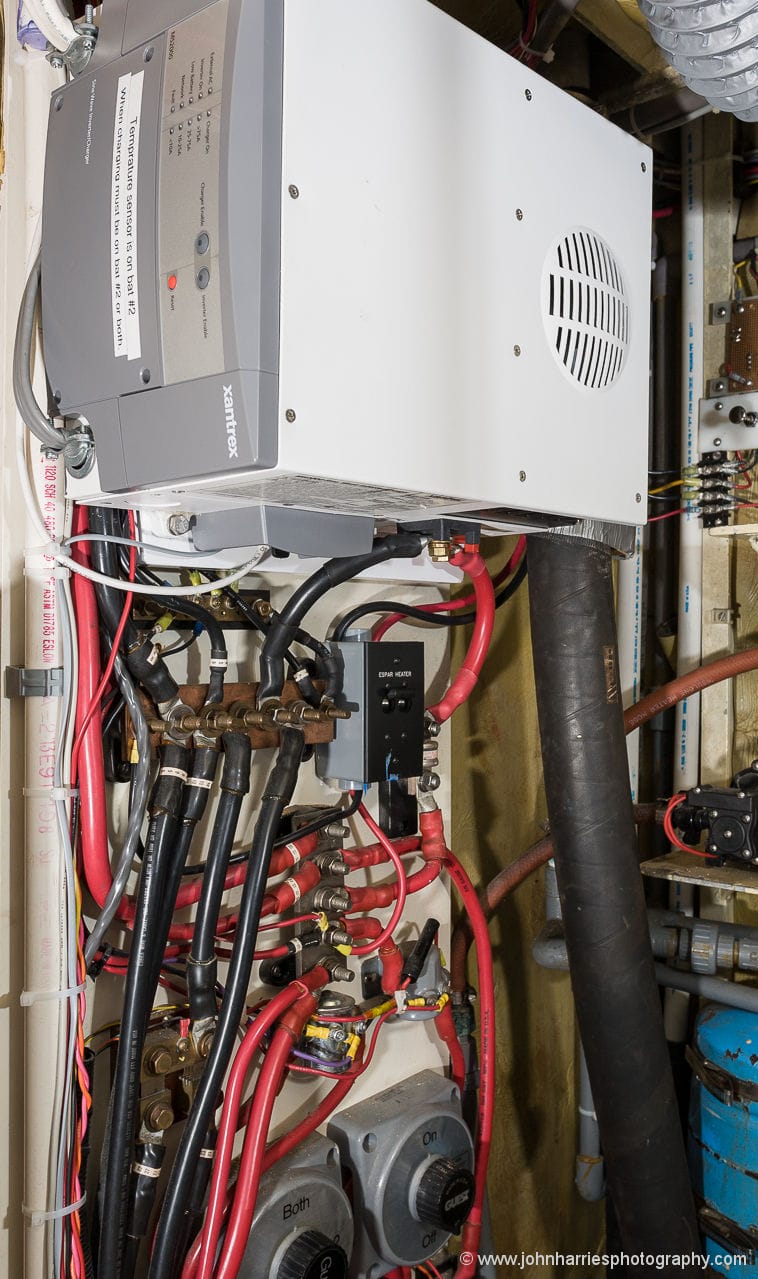
Combined inverters and chargers have become pretty standard on cruising sailboats but, in fact, that’s a really bad idea. In this chapter we will share why and what to do about it.
I’ll start this chapter with the story of some bozo (that would be me) plugging in a heavy chop-saw while forgetting that the shorepower was off and that our venerable Heart Interface was on—end of that charger/inverter.
First Lesson
Inverters may claim to have over-current protection but they are not idiot proof. Think about what you plug into them, particularly tools with heavy electric motors that produce very high start loads.
Perhaps we could have got the Heart Interface repaired, but since the inverter produced square waves, which some modern electronics don’t like, and not sine waves, and because the charger was not fitted with temperature sensors allowing automatic temperature compensation (required for AGM batteries and beneficial for all types), we decided to replace it.
After carefully studying the specifications, we bought a Xantrex 2000 watt inverter/charger, and so commenced a two year saga of frustration: The first unit had unstable charge voltage and, we suspect, AC ripple superimposed on the DC charging voltage. The result was the death of a brand new pair of AGM batteries in just six months.
The second unit worked fine, but had a 30 amp draw limit on the AC side when charging (in direct contravention of the published specification), which meant that we could not run our fridge and charge the batteries properly at the same time while running our generator. Not only was this a waste of fuel, it also meant we could not fully load the generator at any time during our daily charge cycle—very bad for it.
After much letter writing, Xantrex agreed to upgrade us to the 3000 watt model free of charge. But the 3000 watt unit had a design error resulting in the AC and DC grounds being tied together, an absolute no-no on an aluminum boat.
Second Lesson
Don’t combine the charger and inverter functions since you end up with one very complex and heavy single unit. And when any part of that machine fails you lose your entire electrical system since, in most installations, most, or even all, of the shorepower circuits are wired through the inverter. This also makes the inverter very vulnerable to Bozos.
We managed to convince Xantrex to take back the last inverter charger and give us a 1800 watt sine wave inverter (which has worked well for seven years) and two 40 amp three stage chargers in return.

Why two chargers you ask? Because most charger manufacturers have decided, for reasons that escape me, not to make large chargers unless integrated with inverters.
We now have three (we already had one) Xantrax TrueChargers. Each of the two 8D batteries that make up our house bank has its own charger wired directly to it with a temperature sensor and the third is wired to the “Both” side of the battery switch.
This is a reasonably good system that allows all three chargers to be used together to pump a theoretical 120 amps into the batteries and also allows us to equalize one battery while using the other.
And we have lots of redundancy, always a good thing on a cruising sailboat. We even have a small portable inverter to backup the big one.
I’m eagerly following the account of your experiences . . and wonder why you chose Xantrex over Mastervolt ? … was it because they combine the charger/inverter in one sgl unit? Where am I coming from?…The bareboat charter industry in The Whitsundays…that’s probably one-rung up the ladder in terms of Degrees of Difficulty…that is from the single vessel/private live-aboard situation. 20 years ago a bareboat was just that…today the punters want everything from surround-sound (and moving pictures) to hair driers…it sucks…I often wonder why we choose to charter in an area that has a World Heritage Listing!!! Regrettably, we have to deal with fools (rather than idiots) on a daily basis! Cheers from DV
We chose Xantrex because they had taken over the old Heart/Link line that we had had years of trouble free service from. Also because the Mastervolt would not fit in the space the Heart had vacated.
However, I don’t think the brand is so much the point. Rather, for me anyway, the key take-away, was that having the inverter and charger in the same unit was a bad plan—just too many eggs in one basket.
I hear you on the trend to too much stuff on boats. Although we do have three computers and a network on MC, so maybe I should not point the finger. But then again, she is our home, not a boat to sail on for a couple of weeks.
John:
I also had a year of frustration with the Xantrex 2000 installed with a 4 – 8 D battery system. From time to time the charger function would simply cease to work. Xantrex could not diagnose over the phone. The solution was a separate charger entirely and using the Xantrex only for the inverter function.
Hi John……it seems that we are progressing down the same path with Xantrex and the Prosiene 1800 that we installed 2 years ago now. Since we did not put the boat in the water in 2011, last summer….2012 was the first summer that we actually used the Inverter. It worked fine all last summer.
We are now getting an error message “System Shutdown”. After being advised to do a hard reset by disconnecting all cables and letting it sit for an hour ( this didn’t resolve the issue), they are now saying to send it back. Its within 2 years (warranty ) but I fear a lengthy back and forth process, as you describe above. They are saying that they may not have an exact replacement for our unit until 8/13, so they may issue a refund, after seeing it on the table to evaluate it. They are also attempting to offer a different unit with GFCI plug ins which would not work with our system. We specifically designed our system from the batteries up, inverter next in line, all hard wired in.
Since your original posting, have you any suggestions as to who might be able to supply us with quality true sine inverter, 1800-2000 watts that will stand up to the rigors of the boating world. I may just take the money and shop…..especially after reading the hassles that you went through.
thanks
Ernie
We too kept our inverters separate from chargers. We have two MasterVolt 5000W combi inverter/chargers which are not connected to AC, there therefore can only function as inverters. Separately we have an 100A 24V MasterVolt charger and an 80A 12V MasterVolt chargers. We just replaced our ten 8D gel batteries after atleast ten years of service simply because it was easier to do now than when we are far from the battery distribution infrastructure.
We charge by running the generator when away from shore or engine alternators when motoring (each 24V 200A “Ambulance” alternators regulated by Balmar 624’s and Centerfielder).
We installed a 24V to 12V charger from Sterling Power to charge the two 8D 12V batteries. It works much better than I expected.
We kept the batteries going fine over the years w/o equalizing. I discussed your experience with the AGM batteries with our gel battery manufacturer’s engineers and concluded we should continue our charging practices without a risk associated with equalizing.
Back to the inverter/chargers. We are very happy to have separate devices for each function. It keeps “what we are doing” with the electrical system in our consciousness.
Cheers
Don
Sorry,
I didn’t mention that the Sterling charger was for charging when the engines are running. Nonetheless, we also use it when sailing.
Hi Don,
Great information, thank you. We need a new and more powerful 12volt charger without inverter. How has the 80A Mastervolt performed for you?
And yes, I think that there is now enough anecdotal information in to say pretty conclusively that Gells, when taken care of by a charge system as good as yours, are less subject to sulphating than AGM’s and therefore the fact that most (all?) gells can’t be equalized is less of a problem than we once thought.
John,
We have the Mastervolt Mass 12/80 and 24/100 chargers. Both seem to work well for us fore quite a long time. We used them with the battery temperature monitors.
Having said that, the user interface is confusing as are the manuals on interpreting the user interface (no doubt we know too much for our own good). Because of this, should these chargers fail, we will consider alternatives from Victron and Magnum as well as current Mastervolt offerings.
Then again, we do not expect them to fail. The physical execution of the chargers is A+.
We also have the Masterlink MICC that we installed to monitor the batteries and chargers. Sadly, while happy with the chargers, I can’t say the same for the MICC. It appears that we and no one else we asked really understands the instructions sufficiently to make it useful (we did read them in several languages to make sure the interpreter didn’t interject misinformation). Right now it simply fills a panel hole. Sigh. Instead, we have added the Balmer SOC monitors. RC at Compass Marine made a convincing case that these are reliable and simple enough for the likes of us.
Cheers
Don
PS: I love the spam protection…… makes me temporarily feel somewhat competent.
Hi Don,
Great information, thank you. I will look at the three chargers you suggest. What a pity it is that so many marine manufacturers ruin what could be a good product with a poor manual.
I know this thread is a bit stale, but note also the last update at the top of the page is 2016 so will give it a try. One aspect I think is missing from the discussion is the ability of some inverter chargers to act as electrical traffic cops. I went with a Victron Multi inverter charger on both the last boat and our new Outbound because it has the ability to supplement the AC shore power with juice from the battery, which is exactly what’s needed to provide the inrush current to get motors started. The time duration of these events is fractions of a second, so the total amp-hr draw is quite small but it allows inductive loads like motors to be run with smaller gensets than would otherwise be necessary. Yes, it is big and heavy, but it allowed me to run air conditioning on my last boat using a 2kW Honda as well as being able to run a shop vac off the house batteries when necessary. I just turn a knob to set the max shore power current to match the source. There are probably other brands that do this as well, but since it’s managing the power synchronously with each 50/60 Hz cycle I would guess it’s pretty near impossible to do that except with an integrated unit.
Hi Jim,
Good point, and certainly a good use for an inverter/charger. Also, while you are right that other brands claim to have this feature, I gather from an extremely reliable and experienced source that Victron’s implementation of this feature is by far the most reliable.
John, my boat came with a Prosine 1800 pure sine wave inverter when we bought her. We mainly use wall mount conventional AC fans using the inverter (maybe 800W in total). Very occasionally we use the microwave. I think it cost us 1 to 2 amps continuous overheads when we use the inverter overnight and during the day for our fans mainly it is oversize for the fans. I am wondering if we could install a modified sine wave or any other inverter with a lower overhead when we are using the fans and use the Prosine only for the microwave (very expensive meal!). But I am not sure if this is a workable system.
Hi Rob,
You probably could, but to me it sounds like more complexity than it’s worth. Also, I’m not sure that modified sine wave inverters are intrinsically any more efficient.
Why not buy some 12 volt fans. cheaper than another inverter and more efficient.
Hi John, i forgot to mentioned that I I chucked all my Hella 6″ 12V fans after a few years of putting up with them. Small, noisy and just does not get enough volumn of air through them for cooling on very hot summer days. I couldnt find an equivalent 12V fan like our wall mounted 15″ ones. Do you know of any good high volumn 12V fans?
Hi Rob,
Sorry I don’t. We use the Hella fans. I agree they are not wonderful. Anyone else have a recommendation?
I’ve seen Caframos in action. Not great, but less noisy than the Hellas.
Hi John,
just digested the Xantrax TrueCharge2 manual out of interest (they don’t seem to sell the TrueCharge+ you have any more). The manual states that equalizing can only be done when the system is set to flooded acid, with gel or AGM equalizing cannot be started.
Do you actually reprogram/reset your chargers before equalizing? What is your trick?
Hi Ernest,
You are right, the TrueCharge requires me to switch it to “liquid filled” before equalizing. Not a big problem, particularly since our LifeLine AGM batteries are pretty robust, so forgetting to switch back is not really a problem as long as one does not leave it that way for months.
Hello John,
If you needed to replace your Xantrax TrueCharge2 battery chargers do you know what brand you would first consider?
Hi Scott,
I have not done a detailed analysis, but generally I’n a big Victron fan boy. I would also look at Mastervolt. Both more expensive options, but then a poor charger can wreck batteries, and so be a false economy.
I’d love to hear an update on the situation now. I’m planning a re-power of my whole electrical system (lipo batteries, new inverter charger (or separate), add solar… all of it. Vendor for the main components is key. It sounds like Xantrex did (eventually) stand behind their product, but did they ever acknowledge the design and specs errors? Having more than one of either is not a good look for an engineering company, would be a non-starter in my book, if substantiated.
Hi Bob,
If I were doing full system I would go to Victron or maybe Mastervolt, not Xantrex.
I would also think twice about lithium batteries and probably go Carbon Foam.
More on all of this in this Online Book: https://www.morganscloud.com/category/electrical/online-book-electrical-systems/
Hi Mal,
Sure, that’s a good design because, as you say, it makes the boat easily capable of plugging into both 110 and 220 volt sources world wide as long as the chargers are frequency agile, which most are these days. I believe I’m right in saying that a lot of larger yachts with high electricity needs are being wired this way these days.
One thought, it’s a pity you had to use four chargers. It would be great if larger chargers were available, but this has been a problem for years, although slowly getting better.
My other thought is what do you need 6 kW for? I guess being in Australia that’s air conditioning?
Hi John,
The AEG 1500W Pure Sinewave inverter installed on our new-to-us aluminium boat similarly ties together the AC ground and DC negative input. The documentation in most inverter manufacturer’s manuals in this regard is abysmal. Do you (or anyone else here!) know of any inverters on the European market where this is definitely not the case?
Just to give an example of the state of documentation: the attached screenshot is from the only Victron manual I could find that even mentioned this issue – and it turns out, that within the same product line some inverters make the cut and some don’t.
Hi Alwin,
No, I don’t know off hand. At least Victron is telling you, which is better than most. But I guess you want a bigger inverter? I’m guessing that all the Victron manuals will have something similar, so that’s probably the place to start I’m thinking? There are a lot of isolated ground aluminium boats built in Europe and that set up is specifically sanctioned in CE so I would be pretty sure Victron will have a bunch of isolated offerings.
Hi John, many thanks for those tips. Indeed a bit more than 650W would be desirable. I did have a look at pretty much all of the manuals for the other lines of Victron inverters, and while some hint that this is not the case, they are really rather unclear. Not something I fancy spending half a boat unit (or more!) on without knowing what I am getting. Unfortunately one does not seem to be able to just call Victron up – I’ve resorted to asking people in the boatyard to measure theirs. Will report back which ones make the grade!