
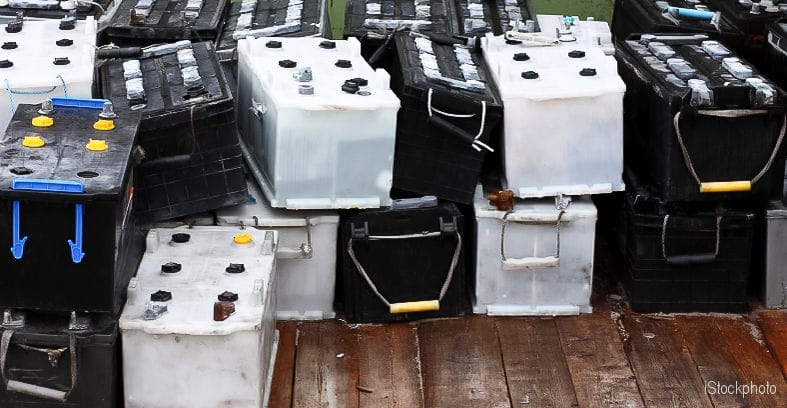
Why do we need to equalize lead acid batteries? Read on to find out how important regularly doing so is.
About eight years ago, we switched to Absorbed Glass Mat (AGM) batteries on Morgan’s Cloud, to get the following benefits over liquid filled lead-acid batteries:
- Shorter recharge times since AGM batteries accept a faster charge rate.
- About 10% more capacity in the same size battery.
However, our experience was not good: We went through four sets of house batteries from two different manufacturers.
In the process of solving that problem, we learnt a huge amount that can be applied to the care of any lead acid battery. Read on:
A known way to charge the battery close to 100% at each cycle without much trouble: split the battery into two separate banks. Each bank is used only every two days and the other bank is charged close to 100% during its “rest day” with solar, wind, engine or generator without increasing much the overall generator working time.
Very good point. The only trouble is that to do that, and still not cycle our batteries deeper than 50%, we would need to double the size of the battery bank, something we don’t have the space to do. Also, if we did double the size of the bank, we might be better served by using the whole bank and only discharging to 25%.
Finally, if we only charged half the bank at a time, we would not be able to fully load the generator since only half the bank would be in high absorbing mode.
Having said that, the system you propose might work great for a boat with lower power requirements than ours and with lots of solar and wind power. It would require some fairly complex wiring to route the charging current to the resting battery while making sure that it did not see any loads.
I think Robert’s advice on splitting battery banks, and maybe not having a starter battery, does not match with current thinking in that it is much more efficient to have just one large service bank and a much smaller starter battery.
There are 4 very good reasons why bigger is better:
1. Doubling the service bank size means the life cycle is longer as the DoD is unlikely to fall so close to 50% so often. Life cycle at 50% DoD may be 1000 charge and discharge cycles. At a DoD of only 25% the life cycle may be 2500 or more.
2. Doubling the service bank size also means the “apparent capacity” is greater. Peukert’s law says that the apparent Ah size of a bank changes depending on the current draw.
A bank is designed to deliver a capacity with a current discharge that will flatten the battery in 20 hours. (The 20 hour rate) So with a 100Ah battery, a 5A load will flatten the battery to 10.5v in 20 hours.
When drawing currents higher than 5 amps the “actual” bank size will be much smaller, so the bank will not last as long before it needs re-charging. Conversely when using much less than 5 amps the bank size will be larger and will deliver more Ah.
If a 100 Ah that battery has a Peukert value of 1.25, then higher or lower loads than 5 amps will change the actual capacity of the battery by the following amounts.
With a 10A load for 20 hours there are only 84Ah’s in the 100 Ah bank.
With a 1A load for 20 hours there are 150Ah’s in the 100 Ah bank.
3. Doubling the service bank size also means it will be more efficient and accept more Ah more quickly from all charging sources during the boost phase up to 80%.
It takes a bit of very over-simplified maths to prove the point, but a 100 Ah battery that is discharged to 50% may accept 20Ah in the first hour during the boosts stage, maybe 10Ah in the second hour during the start of the less efficient absorption phase, and the remaining 20Ah in another 5 hour. Doubling the battery size to 200Ah, with the same charging source of 20 amps, will accept 10Ah into each battery in 1 hour, that’s 20Ah into the bank. In the second hours it will store another 20Ah. That’s 40Ah replaced in two hours, as compared to 30Ah with a single bank. In the 3rd hour it may still accept 20 amps into the bank because a single battery in the start of the absorption phase could accept 10 amps. That’s 60Ah in three hours.The key point is that for two hours it is still in the more efficient boost stage where the battery is taking all the current the charge source can give it. Note that the initial boost charging stage has captured 40Ah in two hours, and 60 Ah in three hours. With the smaller bank it could only capture 20Ah in the first hour during boost and 30Ah after the second hour during the start of absorption. The third hour may add another 5 amps. That’s 35Ah with one batteries and 60Ah with two batteries. So a bigger bank will be more efficient and accept more Ah more quickly from all charging sources.
Since a lot of the time we are only charging up to the absorption stage which is about 80-85% then this increase in stored Ah is significant.
4. If you have a larger bank – or many smaller batteries in one large bank, it is easy when they start failing to just disconnect the bad ones and run on the others as long as you can until you can replace the whole bank. This may also allow skippers to search around and find the batteries they really want – not just be forced to buy the local “rubbish” because they are desperate.
Hi Matt,
All good points that I would agree with. However, there are also advantages to splitting into two banks too:
So, like so many things in voyaging the answer to which is best, one bank or two—I’m talking about splitting the house bank here, since I believe the engine start should always be separate from house—is that oh so unsatisfying “it depends”.
For me, I like to have the house bank split because it gives me the best of both worlds since most of the time I leave the switch that splits them on “both”, to get the advantages you explain so well, but when it makes sense I can split them up, say when equalizing.
A switch to split when you need to is a very good solution for equalizing. I just EQ one at a time by disconnecting the others. I think the advantages from the Peukert effect of having effectively a much larger bank means the batteries will last much longer. I have only 140 watts of solar that supplies the daily needs, and 400W wind. We have to find some shorepower every 3 weeks to get the bats to 100% – in between the 280 A DC genny and the motoring which we seem to do a lot of here in the med. My 1050 Ah Lifelines are now in their 10th year and standing up very well to individual 10 hour load tests right now. I only EQ them at the beginning and end of the season.
I’m as surprised as you were, John, that your AGMs would be dying so quickly. Hopefully your experiments will reveal the cause of the problem- I’m betting on charger programming, but that’s far from the only possibility.
More sophisticated batteries inevitably bring with them more potential problems and the need for more advanced monitoring systems. Taken to the extreme, this results in the lithium polymer battery packs we used to use on solar cars, and that have now evolved for modern electric cars: 5 kWh or so from a 30 kg battery (the equivalent of over 400 amp-hours at 12 V), but each string in the pack needed real-time monitoring for over-voltage, under-voltage, over-current and over-temperature- any of which could result in either a string failure or a cell breach.
One thing that those Li-Poly experiences taught me was that, whenever possible, it’s best to obtain protection and charging circuitry from the same engineering team that designed the battery. If that’s not possible, then the different suppliers have to be willing to work together and provide each other with detailed specifications and all the characterization curves for their respective products. The battery guy, for example, should be able to give the charger guy a book of graphs relating voltage, state of charge, input or output current, charge acceptance rate, etc. for all foreseeable operating conditions.
You are absolutely right. As you will see as the series unfolds, the big problem is that the battery and charger manufacturers, in the marine business, are not on the same page.
I have a friend living on his sailboat without shore power for several years. Only Solar panels and diesel generator. He uses standard industrial positive tubular motive power batteries, with two banks as previously mentioned, one day rest and 100% charged, one day in use and partially charged. After 7 years and about 1300 cycles, these batteries contain still about 70% of the initial Ah value.
The life time of this type of industrial batteries (2 volts elements) is about 1500 cycles at 50% discharge and C/5 discharge current, or 10 years floating. Their cost is much lower than AGM or gel batteries. About 1.5 – 2€ per Ah at 12 volt.
Thanks for the really good real world data. I’m sure it will be really useful to our readers.
Unless I’m missing something, this system requires a battery bank total capacity of four times daily use? That is unless the user is willing to run the generator more than once a day. For boats that can fit that number of batteries in, it would seem one of the best systems.
There is one other point: Most generators run at constant RPM and near constant fuel burn, regardless of load, therefore such a system will only be fuel efficient if the generator is sized to be fully loaded when charging half the bank (plus other loads) in absorb mode. Since the smallest diesel generators are around 5Kw this would, once again, imply about a 1000 amp hour battery bank at minimum. The other option would be a small gas generator, like the Hondas, or one of the newer technology variable RPM generators.
All of the above shows the importance of a total systems approach in all of this.
Hello All,
I am Justin Godber with Lifeline Batteries. I have been working with John and following this blog. I thought I would start by responding to some of the topics above and clarifying a few things and answer some of the questions that will follow.
AGM batteries ARE a lead acid battery. So are GEL batteries. They all just contain the electrolyte in different ways. There are three types of lead acid batteries: Wet Cell batteries, GEL Cell batteries and AGM batteries.
Wet cell batteries as we all know are the type that you have to refill with water. They are messy and can be more dangerous because of the volume of hydrogen that is emitted during recharge.
GEL batteries have taken wet electrolyte mixed with silica sand to make a GEL. We used to make these until about 1989. As most people think this is a “newer technology”, really it is quite old and as I stated we actually stopped making these in 1989. GEL batteries are sealed and work well with very strict charging regimes. The biggest problem with GEL batteries is the charging and the vibration. With vibration the GEL forms all these small air bubbles. Similar to what you would see in a bottle of hair gel. These air bubbles virtually cannot go anywhere so they stay in the GEL. All is fine until all these bubbles sit against the battery plate. Any and all bubbles that are against the plate will not be able to produce any capacity because there is air there, not electrolyte. This may not sound like a big deal but there could be thousands of bubbles in there covering more than 50% of the plates. Secondly, the charging. Charging GEL batteries can be very temperamental. GEL batteries require very strict charging voltages and cannot really deviate 1/10 of a volt either way to avoid premature death.
AGM Batteries. This is important. NOT ALL AGM BATTERIES ARE CREATED EQUAL. AGM batteries have all the electrolyte absorbed into a fiberglass matting. They are then charged and formed and then all the excess acid is dumped out. We then seal the caps on the battery permanently. This results in a completely sealed battery. You can charge these batteries with 100% of their amp hour rating. This is a big advantage. You can charge a 100 amp battery with 100 amps. In fact they actually respond better in lab conditions when they are charged up faster. A Wet cell and GEL cell can only take 35% of their rated capacity on recharge. Making an AGM battery is like making a cake. The recipe has to be just right. We take pride in our batteries, we make everything (proudly) in the USA, and I mean everything. We also manufacture everything by hand. We have 17 quality checks as we are going down the line. We make batteries for Marine, RV, Aircraft, and Solar industries. We make a true deep cycle battery for the marine industry. Besides being very expensive to manufacture we really have no cons over any of the aforementioned battery types.
Now that all battery types have been explained, here is the part you have been waiting for. ALL batteries need to be fully recharged to avoid sulfation build up on the plates. I am not sure if I can post links on here so before I do I am asking. I can send links for Trojan Battery, Deka Battery, Odyssey Batteries, etc…They all state the same thing. Batteries must be fully recharged to avoid damage and premature failure. This is why:
As I mentioned before these are all lead acid batteries. They all perform the same chemically when charging and discharging. These batteries are all made from lead and lead dioxide and electrolyte. When the battery is discharged the plates go under a chemical reaction called lead sulfate. When the batteries are recharged this reaction is reversed. This reversal changes the plates from lead sulfate back to lead and lead dioxide. When the batteries are left to sit in a discharged state the lead sulfate does not get reversed and starts to harden, or crystallize. When you look at it under a microscope it looks like crystals. The longer it sits like that the harder it gets and slowly starts to grow farther around the plates. This is the part where I will tell you how sailors eventually ruin batteries.
Trust me, if I was in most of your positions I would probably do the same thing even knowing what I know. Batteries are not like a fuel tank. You cannot refill them to 85% and expect to always have 85%. As I stated the hardened sulfate will start growing. So when you use the 50-85 rule it works great for the first six months and then as the resistance starts to build and the sulfate starts to grow it goes 50-84 and then 50-83 and then 50-82 etc…Even though your charger says you are back to 85% it doesn’t really know because the resistance starts confusing the charger. It thinks it is back to 85% when it is slowly deteriorating. Eventually you will not be able to get the batteries above 12.2 volts and then we get a phone call.
There are a few solutions to avoiding this scenario. The easiest one for us, but not for you, is fully recharging every time. This will keep the batteries healthy all their life.
The other scenario when cruising is to use the 50-85 rule but you must equalize your battery bank once or twice a month. This will stop the sulfate from hardening as much as it would normally. John is currently using a similar scenario as field and we have had success in the past with some Trans-Atlantic crossings and they end up on the other side of the pond with fully charged batteries.
That last paragraph will bring up the next question. “I thought you couldn’t equalize AGM batteries”. Well, as I stated earlier ALL AGM BATTERIES ARE NOT CREATED EQUAL. I can only speak for our batteries but you can equalize them. It is a great tool to use on the aforementioned scenario. Also a great tool just in general to help clean off the plates and gain some capacity back.
Sailors have always struggled with all this battery/battery charging and we know why. We also know why you will only charge to 85%. As I stated I probably would do the same thing but we have been working and simulating your scenarios in the lab for years and we think the program that John is on is going to be successful.
I want to write so much more but I will wait for questions, concerns and comments so I can be more specific.
-Justin Godber
Lifeline Batteries
Could someone give me a two-sentence explanation of equalization for an AGM battery? (what it is and how it is done?)
Hi Molly, Sorry, I should have defined my terms.
Equalization or conditioning—strictly they are different, but we are going for brevity here—is a process where a fully charged battery is intentionally subjected to a higher charge voltage than normal for a fixed period. The idea is to break down the sulfate crystals that form on the plates due to repeated under charging.
We will be dealing with the “how it is done” bit in the next post.
I have been researching replacement options for my 9 year old Surrette wet cell batteries, now in their last season as they no longer hold a charge and after weeks of research one thing I have concluded is that it is not simply a matter of replacing my batteries but one of upgrading my entire electrical system. It seems obvious that AGM batteries are the way to go for me and for the same reasons that John and others point out…long cold winters, poorly vented confined spaces and the ability to bulk charge quickly. What I have learned from my research is that to use AGM technology to its max you must also consider upgrading your recharging and regulation methods accordingly. For us, cruising on our Bayfield 36 for extended periods has revealed that we are power misers when we need to be and also that we do motor at least half of the time due mostly to the sailing characteristics of the Bayfield as well as the prevailing winds here in Nova Scotia.
The 44hp Yanmar onboard is equipped with a 55 amp alternator that only produces near its max output at 2800 rpm which is also the recommended max sustainable cruising revs, but for fuel economy we normally operate around the 2000 rpm range. All this to say that in addition to battery updates we are considering replacing our 55 amp alternator with a high temperature 120 amp alternator that produces 85% of its rated output at idle speeds! This is a huge plus when using high load applications such as a windlass or an inverter. Remember that if an AC appliance like a coffee maker draws 10 amps at 120 volts, then the DC draw on the battery bank will be 10 times the current or 100 amps. Having an alternator that can provide most of this draw for the short periods they are used will reduce the drain on the battery and hence a faster recovery when topping up the battery. I also believe that the smart regulators available today are ideal for our boat needs as they provide three levels of charging and will accept inputs from many sources including wind turbine, solar, generator and alternator. What remains to be settled for us is the selection of the components so that our preferred option AGM batteries are safely charged and have a long life cycle.
You may wish to wait for our next post before you actually buy anything in the way of regulators or chargers.
We have had some huge disappointments in that area over the last four years.
Bottom line, a lot of this stuff just does not work as advertised.
The offenders will be named.
I’m in need of new batteries so these posts are very interesting. In the past I had a catamaran with no real engine charging, just solar and wind, and we had gel cells that were totally abused. They were discharged completely numerous times, charged without any sort of regulation, etc. and they were the longest lasting batteries I’ve ever had. I finally retired the original Sonnenschein’s after I think 10 years of use and abuse just because I was worried they would soon die, but they were still OK at that point. By the way, that boat sat over winter in Maine with a couple of solar panels hooked up and I never had a battery freeze, even when the snow covered the panels—it would eventually melt off. Subsequently, I have a different boat and went back to wet cell, deep-cycle batteries and they have routinely lasted about 3 years, which is exactly what I have found on numerous other boats. I have not owned Rolls, but in the past Surettes, and I couldn’t justify the price. Wet cells of almost any brand seem to last 3 years onboard and then fade rapidly. So, in recent years I buy whatever I can get cheapest. I’m now tempted to reconfigure to allow me to use cheap golf cart 6-volt batteries that can be obtained places like Sam’s Club because so many have reported such good success with them.
Great input, thanks. I too have wondered about the 6 volt golf cart option, but did not know that they were so generally available. Sam’s Club, who knew? We would be really interested in knowing how that works for you if you decide to go that way.
Also, we had really good service from Gells, in our case Prevailers. I have hesitated to draw too many conclusions from that because our usage was very different then, but still it is interesting. Perhaps Gells are not as fragile as generally thought? Anybody else have any experience, good or bad, with Gells?
Another thing I really like about the golf cart route is that you can actually lift each battery by yourself, facilitating the change out when you need to do it. Having struggled with 8Ds in the past, I find them just too unwieldy. My current set up uses a bunch of Group 31 12-volt batteries, which are liftable by a normal human. One the other side of the coin, if a battery dies when you are in some area away from civilization the chances of finding 6-volt golf cart batteries is not too good, but anywhere you find people you can find some sort of 12-volt battery. It may not be the ideal deep cycle, but it might be OK to help you limp along for awhile. I keep enough battery cable and fittings onboard to reconfigure my battery set up if I need to. Even a good set of jumper cables might help you out in a pinch.
I’m a marine electrician and a sailor, and have had similar experiences to yours in regards to AGM batteries, both with my own boat and with multiple customer boats. I think the marketing hype behind AGM batteries made a lot of people jump on the bandwagon, and they are a poor choice for most cruising boats. If you find a way to increase the unacceptably short lifespan for AGMs on cruising boats I will be very interested to find out how, but I have tried many so-called solutions with no success. Also, I’m glad to see Justin is working to help you. My interactions with him and with Lifeline in general were so dismal that I won’t ever do business with his company again.
We had pretty much come to the same conclusion about AGM batteries for cruising boats. However, Justin (we have always found him helpful) convinced us to give them one more try.
We should have some solid data on whether or not they will last, using the protocol we have worked out with Justin, in six months or so, but our initial findings are encouraging. However if they don’t go at least three years with our daily deep cycles, we will go back to liquid filled. Stay tuned.
I use wet cells, but I am following the thread because your recommendations are going to apply equally well to wet cells – because they are ALL lead-acid batteries.
I use Trojan T-105 6V batteries. I got seven years from my last set. I probably would have gotten another year or two, but had a knock-down that drained about half their acid out (successfully captured by my battery box, thank goodness) and by the time the passage was over they were toasted. However I am pretty hard on batteries – never equalized them in their entire seven years. (I will change that habit now, if I can – awfully hard to equalize batteries on wind and solar). There were a few years in the middle where we were CLODs and weekend sailors so the solar panel would bring them back to 100% during the week.
On the life of an AGM in a constant full charge application: The starter battery on “Morgan’s Cloud” is a Lifeline 4D that is eight years old. Still turns the diesel great. That would seem to suggest that Justin is right about the whole problem with his batteries failing in a year or so being traced to undercharging.
After I had to replace on my Swedish Regina35 three 100AH LEOCH AGMs after only 3 years of useful life ( they are charged by a MASTERVOLT charging and monitoring system as well as a small solar charger), I spoke to a MasterVolt rep in the Bay Area, CA, about possible problems that may have lead to the batteries’ sudden death. He pointed out that often people don’t think to turn off the solar charger several hours before charging, which leads the controller to believe the batteries, showing higher voltage from the solar charger, are much fuller than they actually are, which leads to undercharging.
Another issue was the fact that we had to leave our boat after a cruise without fully charging the batteries, so the solar charger had to trickle charge them over days, and a third reason seemed to be the setup of the cables, which weren’t at the terminals at opposite ends of the 3 batteries in parallel. In the end the LifeLine Dealer tested my Leochs and found one in pretty good condition (80% capacity), the others, interestingly the ones further away from the pos and neg terminals where the main cables were positioned, in pretty bad condition. My LifeLine rep said they had tested different setups of connecting batteries in parallel and found that charging and discharging characteristics were quite different depending on where you connect the main cables to the terminals. We will see what comes out of my new LifeLines I just installed 3 weeks ago.
My guess is that a very slightly poor joint at one of the cables, rather than the position of the cables themselves, was the culprit. A very small elevation in resistance caused by just a bit of corrosion will cause a surprisingly large difference in the charge voltage at each battery, and that in turn will result in the battery on the far side of the bad contact being constantly undercharged.
A good test to prevent this is to discharge your batteries to say 50% and then check the voltage with a high quality digital meter, at the positive of each battery against the common ground point while the charger is on. A difference of over one tenth of a volt (.1) is a problem, and less than one twentieth (.05) is worth striving for by cleaning all the contacts.
I don’t believe that the elevated voltage caused by solar charger is meaningful. Whether or not the battery will accept charge is a function of its own internal resistance, which is in turn, an indication of its charge level. The solar panel will charge it to whatever level it achieves when it is connected. When the AC charger comes online it will take it the rest of the way. In fact, it would make no difference to leave the solar panel charging in parallel with the AC charger. All of this assumes that both the AC charger and the solar panel are properly regulated and those regulators are sensing the voltage at the battery.
Hi Harvey, here’s an article that beautifully describes the problem with (and the solution to) the way your batteries were wired in parallel. This was an eye-opener for me!
http://www.smartgauge.co.uk/batt_con.html
Best,
Chuck
Thank you for your very helpful tip about checking the connections during a bulk charge for voltage differences to find problems with the cables, etc. I sure will make use of this with my new LifeLine batteries. Regarding your suspicion of a weak link in the cables, I don’t think this was the case because not only did I check the cables and connectors, they also were in a like new condition: no corrosion or layers whatsoever, tight connections at the screws as well, threads shiny and clean. I don’t really know what to say was the culprit if not the solar charger.
On the contacts, when you are dealing with low voltages and high currents (amps) just because they look nice and shiny, does not mean that they are without resistance. A contact that looks perfect can have just enough oxidation to cause enough resistance to unbalance the batteries. The only way to know is to measure with a high quality meter.
On the varying opinions. Next time you are trying to decide on the veracity of an opinion, ask the person opining to quote ohms law and explain what it means in one clear sentence and how it should be applied to the problem at hand. I don’t mean to be facetious here, or arrogant, but the sad fact is that I would venture to guess that some 50% of the “professionals” in the marine electrical field would fail this test horribly. They simply don’t have the basic understanding of the underlying physics to adequately evaluate a theory about how to wire a boat. So what they do is take a popular myth and repeat it as fact to sound knowledgeable. That is why a good 50% of the “common wisdom” about batteries is just plain wrong.
On the bright side, most all of this stuff can be explained and understood using high school physics. I was fortunate enough to have ohms law banged into my thick skull by a very dedicated teacher some 45 years ago.
I wonder if a more accurate test might be to apply a load say around 50 amp? Its value is not critical but its consistency is. Ever test using the same load while measuring the voltage?
I’m assuming you are talking of a discharge test?
You are right that constancy is important, but having said that, you can get a reasonable idea with the protocol that we outline.
At 50 amps test discharge rate on an 8D, you would get a much lower capacity reading since that would represent over 20% of the batteries capacity, not a level that one would, or should, use regularly for long periods.
Hello John,
Thanks for all the good work with this battery issue.
Just a suggestion… for sake of completeness: how about adding an article about battery installation? It seems there’s plenty to think about…
Some points:
– How to connect the bank. Terminals cross-connected vs. end-connected.
– How to connect when splitting the bank (e.g. SB/PS)
– How to secure the bank. (Will single 1″ nylon strap with zinc/plastic lock do?)
– How to vent outgassing when equalizing?
– How to protect the bank from flooding with seawater during capsize?
– How to keep moisture out of battery base? (if wet it will drain eventually, like on wet concrete floor)
And some wet-cell specific:
– How to keep outgassing sufuric acid fumes out of terminals?
– How to keep acid in control when capsized upside down?
– How to orient the batteries to prevent celltop exposure on heeling?
– How to minimize water consumption (charger voltage/temp, water miser caps…)
I think many of these points are already discussed on comments. It would be very good to have them collected in a single article.
Cheers,
JC Flander
Yikes JC, that’s a carear! Seriously, some good ideas, I will add it to the editorial schedule. It may be some months before it sees the light of day, we have a large backlog. And to think I used to worry about running out of things to write about!
Hi, Thanks.
That is a collection from many sources, including
– Ed Sherman (ABYC, edsboattips.com)
– Nigel Calder (we all know him, right?)
– Steve D’Antonio articles on Professional Boatbuilder (www.proboat.com http://www.stevedmarineconsulting.com/ )
– RC Collins blogs, like: http://www.pbase.com/mainecruising/flooded_battery_orientation
– David Pascoe’s articles: http://www.marinesurvey.com/yacht/ElectricalSystems.htm
All excellent men, who have seen the trouble to share their experience with others. Ofcourse with article fee, sometimes, but still… sharing our knowledge makes the world better for all of us. I think that that’s what I like most on morgansloud.com. Sharing makes a difference.
…and also, some points collected from my own experience as Automation-engineer-come-boat-electrician.
On the subject of battery bank installation – it is just amazing how many sailboats have lost all their electric power even after small flooding.
There’s so much work to do to get this situation better. ABYC E-11 and ISO 10133 only define an absolute minimum baseline.
That’s just not enough for boats offshore – even less on the high oceans.
I try to collect and email you the complete reference list re. that battery installation thing.
Cheers,
JC Flander
John, I have been living aboard for 12 years and have been fighting the battery life issue also. Two areas that I did not read about and have been pointed out to me as a possible problem with my install are:
Use of both 4d and 8d batteries as part of one parallel 12volt house bank is not a good idea because the 8d’s never get fully charged?
The other is regarding the cabling. I was told that the batteries would charge more uniformly if all the connecting cables were all the same length?
Hi Clint,
Testing at lifeline indicates that there is actually no problem with mixing batteries of different sizes, as long as they are of the same type and age.
And yes, batteries in parallel will charge more evenly if the length of the cables from the charge source is same.
Does anyone have experience with non-electric (i.e., hydraulic, spring, etc.) starter motors on a cruising boat? At first glance it appears to be a feasible way to eliminate the starter electrical system AND have a manual way to start the engine. I’m wondering how well that works out in practice.
Cheers,
Chuck
Hi Chuck,
I have used a recoil (spring) starter before. They make a good backup but would be an incredible pain on a day to day basis and practically impossible to operate in some engine rooms. I have also used air start engines which are now pretty uncommon except for really big engines. These work okay but you need a compressor and associated plumbing which is just more stuff to break.
To me, a well designed electrical system is pretty darn reliable for engine starting so I don’t worry about it. We have a battery whose only job is to start the engine if the house bank isn’t working for some reason. I have one time had a main battery switch break but that takes 2 minutes to bypass with a single wrench. I have also had starter solenoids seize up and starter contacts wear out. With the solenoid not working, a screwdriver across the terminals is exciting but effective at starting the engine. With the bad contacts, you can usually get it to start several more times by either hitting the starter with something or rolling the engine over. I believe that long distance cruisers should carry a backup starter and have either a backup alternator or a different way of recharging such as solar or wind (and a backup alternator is still a good idea then).
Eric
Thank you Eric for sharing your experience. Guess it’s not the panacea I was hoping for. 🙂
Best,
Chuck
Eric, your mention of a spring starter intrigues me. Would you suggest that a good choice for a spare starter would be a spring starter? It seems to cover off the need for a spare and the possible failure of one’s electrical setup.
Hi Chuck,
I would agree 100% with Eric, keep it simple and go with a standard electrical starter motor. I also agree that any long distance voyaging boat should carry a spare starter motor. I have had two fail on me over the years and both times I had a spare, so the fix took less than an hour.
The other advantage with electrical starter motors is that they can generally be repaired or rewound by any decent electrical shop.
Thank you John. There’s an additional advantage that electrical starters are substantially cheaper! Just means battery, wiring, charging isolation, etc.
Best,
Chuck
John,
When I charge the batteries I always charge too minimum 85%. Normally I charge all the way up. I never ever discharge the batteries below 50%. When around 65-70% I normally start thinking of getting more charge into them.
I was originally sceptical to big black boxes doing everything. I normally go for one unit per operation. With my Struder – it is different. First of all, it has never missed a tick. Second I know the UK reseller very well. Rob was one of the first starting using this unit in a marine environment, and done so for many years. According to him the unit have never failed any of his many marine customers. It is remarkable, other brands got a % fail rate. The Struder just keeps on going. It is used in the most extreme environments, North Pole, high up in the mountains with extreme frost and snow. Salt, sea and damp conditions is a killer for any electronic component. This unit is doing remarkable well.
If it fails one day, I more likely need to replace the box. That is a calculated risk I took. If that happens I know for fact that the manufacture in Switzerland want me to send the unit to them for investigation. They are that supportive of their product.
The batteries and charger systems are now almost 6 years old. The boat is used hard, without being a live-on-board boat.
~
Terje
Yacht Maud
Hi Terje,
As I said, sounds like a great unit. All I wanted to make clear was that it’s not going to fix sulphation.
One topic not addressed in this discussion, were the manufacture’s maintenance instructions read, understood, and followed? I ask this, because another long-time experienced cruiser posted a question to their Facebook about their four 8D Lifeline batteries losing their capacity to hold a charge (installed for 7 months) and their question to the public was should they try equalization – (your website was mentioned in the comments as a possible source for the answer – this is actually how I became aware of your site.) In addition they proudly provided a picture of their battery installation – which when reviewed critically there were very obvious problems – revealing they failed to follow the manufacture’s recommended installation instructions and basic good practices.
Lifeline publishes a technical manual for Lifeline batteries (http://lifelinebatteries.com/wp-content/uploads/2015/12/6-0101-Rev-E-Lifeline-Technical-Manual.pdf) with very detailed installation and maintenance instructions.
Blunt question: Was part of the battery issues experienced here simply a failure to follow manufacturer’s printed instructions?
Hi Joe,
That’s the whole point of this online book: it’s fundamentally impossible for a cruising sailboat far from shore power to follow the manufactures charging instructions, particularly charge to 100% after every discharge. This book explains what to do about that in detail.
Other than that, the batteries were installed correctly.
Not to beleaguer the point, but to add clarity to the definition of the problem experienced:
From Lifeline’s website, Can I equalize AGM batteries? article: “After two rounds of AGM batteries failing within two years, John called us for advice. We provided John with two new batteries and a custom equalizing routine. His new batteries lasted him 5+ years in the same vessel.” I read into this that Lifeline’s battery maintenance instructions, which includes conditioning (equalization), was not followed until the third set of batteries – if my assumption is wrong, please correct.
This is the same issue the cruiser mentioned above is experiencing. They got 5-plus years on six GPL-4CT (why?), about 2.5 years on four GPL-8DA, and after about 7 months with four GPL-8DL they have capacity issues – they freely admit they never equalized and are now just considering it, despite what is clearly written in Lifeline’s battery instruction manual about conditioning, aka equalization.
The point to be made is to critically read the manufacturer’s instructions, and question the recommendations provided – is there possibly a better recommendation? Also question what the manual does not state – compare it to other manufacture’s manual.
Lifeline’s manual states: Continually recharging to less than 100% may result in premature capacity loss. It is recommended that batteries be recharged to 100% at least every 5-10 cycles. It then further states: It is recommended routine conditioning charge is applied approximately every two to four weeks if batteries are not fully recharged each cycle. Pretty clear concepts and consequences.
The Lifeline Technical Manual alludes even further: “The charging current during the Bulk stage should be set as high as practical; higher current levels mean faster recharge time and less time for the plates to become sulfated.” “…Lifeline batteries can tolerate in-rush current levels as high as 5C (500A for a 100Ah battery).”
“For repetitive deep cycling applications (deeper than 50% DOD), chargers should have an output current of at least 0.2C (20 Amps for a 100Ah battery). If the output current is less than this value, the cycle life of the battery may be negatively affected.”
So for a battery bank size of say one GPL-8DL battery rated at 255Ah; with a minimum charge rate of 0.2C, theoretically a charger with 51 amps minimum charge rate is needed – more would be better. So this advice, if heeded, should result in the consideration of what potential size charger should be procured. But this recommendation has another consideration – those out on the hook for extended periods that rely proudly on their green-sourced energy, are they meeting the minimum recommended charge rate or do they need to consider a change or just suffer the consequences. The old adage of every little bit helps (renewables), in some cases might be detrimental to battery longevity.
I surely don’t have the answers, but having just purchased five Lifeline batteries and at step 1 of the additional support requirements, I am absorbing and filtering all information encountered. As old as some of the battery types are, am constantly surprised by the difficulties that continued to be encountered.
Hi Joe,
Everything you say is correct. And I have certainly never claimed that I did not make mistakes. In fact this Online Book, is, in large part, about my mistakes and what I learned from that, as is much of the other information on this site.
That said, you are missing the point of this Online Book, which is that a with a standard sailboat charging system and no shore power there is simply no way to comply with the LifeLine manual.
This book explains how we, in cooperation with Justin at Lifeline, fixed that.
And, although I don’t remember for sure, I think I’m right in saying that LifeLine have much updated their manual based on the work we did together.
Look for more chapters in this book over the next year, with further improvements, and other alternative ways to get the job done, based on work we did over this summer.
Thanks for the response. Like your articles and really like the differing views in the comment sections. Like most, I desire to gain from other’s mistakes and successes, and that is only possible if they are disclosed and disscussed.
In my quest for detailed anything about batteries and their installation, I have found an area lacking information.
All the battery manufactures and most everyone else states heat adversely affects batteries and keep batteries in the magical temp range. Almost all agree of the critical importance of temperature regulated charging as batteries do heat up when charged. The Lifeline manual stated its battery capacity ratings were based on use at an optimum temperature of 77 F degrees (25 C) and battery lifespan decreases by 50% for every 10 C degree rise in temperature – i.e. 95 F degrees (35 C). So I get the emphasis that temperature is another important consideration.
This issue is compounded if batteries are contained in the universally recommended covered battery box usually located and sealed away behind compartment or locker doors, reliant in most cases on passive ventilation that is almost non-existent in confined spaces.
However, the manufactures, USCG (via CFR), ABYC, books, magazines, etc., all state the same vague thing, ensure “adequate” ventilation. Not one source quantifies with factual anything what “adequate” should mean – like XX cubic feet per minute airflow. I believe “adequate” ventilation is approached by most in the perspective of battery gas dispersion with no focus on battery heat dispersion – have yet to locate a site that discusses this. Via NFPA and NEC standards for land based battery rooms, extrapolated the cubic feet per minute airflow recommended for charging FLA batteries in a typical battery box and concluded that passive airflow could not achieve the safety factor recommended. FLA batteries have a known out gassing constant, but have not discovered a theoretically realistic out gassing constant for VRLA batteries. Regardless, the land based battery room standards are focused on the safe dispersion of battery gas emissions not heat, but these standards do have a larger between battery minimum clearances, why? Why is the recommended minimum clearance different even between battery manufactures and types of batteries?
Lastly battery temperature senor location also has widely different views, some with very specific factual reasons as to the location chosen. Some assert that improper placement of the sensor results in the removal of high charge rate before the internal cell temperature has significantly increased to warrant concern. Keep in mind the sensor is reporting the temperature where it is located, not internal cell temperature.
There are claims out there, that for some folks, AGMs have lasted much longer than most have experienced. I seek to understand why.
Hi Joe,
Re your comment: “There are claims out there, that for some folks, AGMs have lasted much longer than most have experienced. I seek to understand why.”
If you read this online book, you will understand why. Basically it’s all to do with usage profile and how the charge source voltage regulators are programmed.
As to temperature, as long as the voltage regulators are temperature compensated, it’s not that critical. That said, it is better, if possible, to mount batteries outside of engine spaces.
One more thing, in relation to your comment “I really like the differing views in the comment sections”. Be very careful of trying to crowd-source this kind of information either in the comments to this book or on forums. This is one of the many places where the so called “wisdom of the crowd” is non-existent since it takes clear understanding of electricity basics to discuss batteries competently and most people don’t have that understanding, but sadly that does not prevent them from putting forward their (wrong) opinions or repeating generally believed myths.
This is why, in the first few chapters, I explain some basic theory, such as Ohms law.
On the other hand, I do have that basic electrical understanding—electronics tech by trade—and what I say in this book has passed the eagle eye of several professional engineers with relevant training and experience, as well as Justin at LifeLine.
Now I need to get back to working on my latest chapters on weather analysis. Happy reading.
Hi John and all, my 6 Trojan 31 AGM batteries packed up after 2.5 years of use. The boat has been a marina boat 90% of the time with a solar charger keeping the batteries in full charge almost all the time as the boat is mostly used during the weekends. At no time was the battery discharged below 30%. Most times, it is in the marina being charged by teh solar panels (14.2V for 5 min and 13.2V float every day with trickle of load – gas detector, standby stereo). SIngapore is summer all year round with temperatures around 25 deg Celsius. The battery compartment can go up to 30 deg Celsius but no more. Last week, i noticed that the charger cannot charge above 12.7V and the temperature of the batteries were around 50 deg Celsius. I suspected they were due to sulphate build up. Trojan AGM cannot be equalized. Before buying the AGM batteries, i have read all the post here and i thought that keeping the batteries fully charged almost all the time would have resulted in something more than 2.5 years. Or is 2.5 years realistic in my situation. I am not looking for a new set of batteries and would like to hear from you guys prior. Thanks
Hi Robgoh,
No, two years is a terrible result, particularly with your usage.
I’m pretty sure I know what happened, or at least where to look for the problem so it does not happen again with your new batteries:
The batteries were never getting fully recharged after a discharge because the regulator on the solar was not staying in acceptance long enough. Even if a battery is only discharged 10% it will take at least two hours at acceptance to bring it up to full charge. Five minutes is nowhere near long enough at acceptance, and once the regulator drops to float, it will never bring the battery up to 100%.
The result is that each shallow cycle leaves sulphation on the plates and that in turn walks the capacity back each time it happens until the battery fails. This fail modality is particularly prevalent with AGM batteries.
So here are some thoughts for new batteries and changes to prevent a problem like this from happening again:
If you take those steps and continue to only use the boat for weekends, you will not have to equalize often, (perhaps not at all) but it will still be a good idea to do so say once a quarter. (I have an article coming that details how to recognize a battery that is sulphating before it’s wrecked.)
With these steps you should get at least 10 years from the new batteries, or 1500 deep cycles, whichever comes first.
Hi John,
Thanks for the enlightenment. I programmed my solar charger controller (Morningstar 45 MPPT) to charge at 5 min at 14.2V from their default 2 hours because i did not want to overcharge the batteries as the boat was not used during the weekdays. I thought that 5 days at float without load (almost) would surely bring it up to full charge!! Lesson learnt ! Lifeline does not have a distributor in Singapore as far as i know and I dont want to go back to liquid batteries due to the mess and checks needed… Do you have another (or a few) recommendation for AGM batteries that can be equalized?
Hi Rodgoh,
That was it, reprogramming the regulator. Don’t feel too bad, it’s a common mistake to think that holding batteries at float will fully charge them. In fact it does far more damage than holding a battery at acceptance after it’s fully charged.
As to the new bank, I’m afraid your choices are liquid filled or LifeLine, there are no other AGM batteries that can be equalized. If it were me in your situation I would go liquid filled. If you use recombining caps the mess and maintenance really is not that bad.
Hi John, Thanks for the tips. What is a recombining cap? Do you have a like for me to see how it works? Alternatively, i could still go back to the Trojan 31 and make sure that they are fully charge and not overcharge at acceptance… Is there a way to calculate, estimate the numbers of hours they should be at acceptance a day based on the Ah they draw per day?
Hi Rodgoh,
I strongly recommend not going back to Trojan AGM’s. As I have said many times, batteries that can’t be equalized have no place on a boat.
As to caps, I have not done any work on that, but I believe that Trojan make their own, so that’s the place to look first.
As to calculating required acceptance, yes, you can do that, but I think the default 2 hours is probably pretty good for your usage. However, the best way to manage this is to fit and calibrate a good battery monitor and use it to make sure you don’t frequently leave your batteries in a partially charged state. Bottom line, we each need to take control of these things and not guess.
That said, there as no way to practically make sure that partial charge never happens, and that’s why we need to be able to equalize.
Righto. Thanks John.
John, is the voltage of a set of batteries a good estimate of its state of charge? For example, if it maintains at 12.8V say 6 hours after the charging device is taken off and without load, can we assume that it is fully charged? My experience with battery monitor is not a good one (I have 2 on board, BEP (600 DCSM) and Xantrex Link 20 (previously Heart Interface Link 2000)). After about a few months, the Ah available or state of charge will drift to an extent to be unreliable. Therefore, i used the voltage of the batteries to determine its state of charge. After reading your comments above, may i know what battery monitoring system are you using? How frequent do you have to calibrate it? What reference do you use to calibrate it if the state of charge of the batteries is an unknown?
Hi Robgoh,
No voltage won’t work, not accurate enough and varies with battery age and condition.
The answers to all of these questions, as well as your previous questions, and including how to fix the battery monitor you have, as well as what I use, are in this Online Book, so I think the best bet is for you to read it through from beginning to end: https://www.morganscloud.com/category/anchoring-mooring/online-book-anchoring/
We just did a full update and edit on it, so it’s really concise and will only take you an hour or so
Once you have done that, if you have any other questions that are not covered in the book, I will be glad to answer them.
Hi John,
During a phone conversation with my brother in Holland, he told me his insurance co. wont allow him to charge batteries of forklift trucks and other machinery over night.
The reason, too many fires, caused by not proper care of the batteries. I have been guilty too at times of not filling up the batteries with distilled water in time. I knew low fluid levels would shorten the life of a battery, but didnt know it could cause a fire. In fact, a friends boat had a fire, apparently caused by batteries that were relatively old and because of difficult access, may well have had low acid/fluid levels.
Many boats during the winter season, are not checked frequently, while hooked up to shore power and its batteries kept in a full charge mode. Am not aware of any fires starting because of batteries while in hibernation, but was very suprised to hear an insurance co. not allowing un-supervised battery charging. Not very practical.
Rene
Hi Rene,
I can see this being a problem for your brother. That said, I agree with the insurance company that leaving chargers on all the time unsupervised is not a good idea. Better, I think, to fully charge the batteries and then shut down the loads on an unoccupied boat.
Due to a couple of serious, multiple-boat-destroying fires caused in boat yards locally that were traced to burning batteries, our yacht club does not allow “unattended” charging over winter, when the club’s 200 or so boats are cradled about one metre apart. This means, strictly, not even plugging in and going to our restaurant for lunch. I will be doing an equalization soon: I’ll have to stay aboard for several hours in order to be compliant. I suspect that insurance firms are behind this, but having seen a row of burnt boats, I can’t complain.
Thank you John and Marc.
My boat is hooked up to shore power all winter, in order to keep the lead/acid batteries charged and if the temps fall below 5C the (built-in) electric heaters kick in. Will see how to disconnect the batteries during my next visit .
Did hook up one of those pulse ¨chargers¨ on a few and it did appear to have made a difference, last time I checked.
I take it, when a boat starts a fire and the near by boats are affected, they all make a claim to the one that started it. So a few million $$ liability doesnt go far.
Rene
Hello John and aac members,
On our HR46 we have four Gel Sonnenchein 196AH to get an 400Ah 24v system. We also have 12v for electronics.
This bank is 7 years old and was working fine. …
I found the battery bank discharged probably because of the Mastervolt inverter that stayed in stand by mode for around a month.
The yacht manager tested the batteries with a load tester made in Catalonia called I200 and… he thinks the batteries will recoverafter recharging.
I will try to send a picture ofthe loadertester device that looks like a high value resisrance and a precision voltmeter, Antoni Villa isthe inventer of this device,
The test was done after three hours of charge, do you think or know how much time te battery bankshould be left without charge before the testimg?
Is it adapted to deep cycle gel batteries.
Thank s for your knowledge since I am a little confused.
Regards
Denis
Hibernia II
Hi Denis,
The web page is in Spanish but that looks like a load tester designed to check if a battery can produce a bunch of cranking amps. These are used by car dealers and others, quite rightly since that’s what’s important when testing an engine starting battery. However, said tester is not going to tell you much about the condition of a deep cycle house battery unless it also has a constant current discharge capability required for a capacity test. (Most boat yard staff don’t understand this and will argue, but they are simply wrong.)
That said, you can do your own capacity test with loads on the boat. The best description of how to do that is in the LifeLine battery manual: http://lifelinebatteries.com/wp-content/uploads/2015/12/6-0101-Rev-E-Lifeline-Technical-Manual.pdf
See section 5.7 for full instructions.
The manual is for AGM’s but there will be no difference with discharge test part of the manual for gells. Just make sure you use the Sonnenchein spec when charging and you will be good. Also do not condition the gells since it will wreck them and could even start a fire. Also make very sure that the batteries are in fact fully charged before starting the test: https://www.morganscloud.com/2011/02/10/eleven-steps-to-better-battery-life/. See #11 in the above chapter.
Here is the link tothebattey tester device
http://www.antoni-vilas.com/antoni-vilas/e_prod_xec.htm
Thank you John for your comments and advice. On antoni vilas website you have an english page.
We tested again after full charge the gel batteries. They are in the specifications that are presumed good for service.
So I am now doing real world test to see how the batteries accept charge and deliver working amps . So far so good.
As usual some problems arrive as squadron storming. The balmar mc 624 is irregularly working. This suggests a wiring/ contact problem either the regulator harness or the ignition connection from the Yanmar panel. If the alternator work some times it shows it is good.
In the meantime we are still sailing since generator FP is working well.
This illustrates the importance of redundancy and not relying on a single system.
As an M.D. in Interventional Radiology for over thirty years I appreciate your evidence based sailing approach to new technology. I like to know and understand why things work or fail and how to heal them. Redundancy is a sort of prevention which is the key to good health. In practice we always had a plan A,B,C all the way to Z since humans are far more fragile or so much valuable than yachts.
I really appreciate your no non sense behaviour, we also learn from our own errors or the errors of our fellow cruisers. Sharing experience is the key to improving safety being focused on crtical issues and not on secondary topics.
Just wanting to say again thank you John and AAC community for all this work that allows me to improve towards being a decent safe sailor for the ones I love and cherish. Evidence based Sailing.
Denis
Hi Denis,
Thanks very much for the kind words, and I totally agree on the importance of redundancy. Question: is your FP generator AC or DC. I’m trying to gather a bit of information on their products, and particularly their DC generators. Any insights you have would be great, thanks.
Hello John,
Our FP generator is AC,
A complicated machine. Besides Capacitors that had to be changed the first month of our use, it now works well.
I think you have to treat it very gently : start without load
Warmup for 3 minutes
Load progressively
Usefor less than two hours consecutively with a ventilation on.
Unload before shut down by letting it run for 3 minutes.
So far so good.
Regards
Denis
Hi Denis,
Thanks for the report. Everything I’m hearing seems to confirm your reading: complicated and a bit fragile. On the other hand there’s a lot to like about variable RPM from an efficiency stand point.
Hello John,
Looking at your instructive for sale video, I got back to read your onlline books on batteries and related services subjects.
Our HR46 has 24v and 12v.
Our house bank (not yet spilt my in two) is made of four Sonnenschein Gel 12V 196Ah that are nine years old, yes 9 years old and still working well. We discharge only to 70% charge back to 90% and once a week to 100% either on shore power or some times with generator and or motoring in the Med.
I know the day or replacement is coming, so studying the solutions:
– getting the same Gel batteries that have worked so well.
Or
– Going to AGM carbon foam Firefly oasis.
Or
– going to Lithium either Lithionics or Mastervolt.l or Battleborn. This LiFePo project is not at all a drop in project as some time advertised by vendors and some internet “fan boys”. And seems very costly not only the batteries that are supposed to last over 5000 cycles but the BMS and ancillary gadgets to protect alternator etc. AGM still needed for start and maybe bowthruster 8kw.
After all this long introduction what do you think of these three options mostly the last two since I have the experience of the first one.
Carbon Foam AGM seems to resist well sulphatation and does not need equalization?
Thank you for the great AAC.
Denis
Hi Dennis,
I wrote two chapters on exactly that decision:
https://www.morganscloud.com/2018/05/05/battery-options-part-1-lithium/
https://www.morganscloud.com/2018/05/11/battery-options-part-2-lead-acid/
Not much has changed since I wrote them, so I don’t have anything to add.