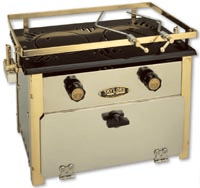
[While living on Polaris for a month, I wrote about the boat’s kerosene stove (cooker), which sparked a lively debate in the comments about the benefits and drawbacks of various cooking fuels on boats.
Continuing that theme, we just got a note from our good friend and Norwegian Correspondent for the Norwegian Cruising Guide, Hans Jacob Valderhaug, who cruises extensively with his wife Eli Husum on their Hallberg Rassy 32, Anna. In fact they are bound for Svalbard as I write.
If you are thinking of kerosene for cooking and/or heating, what follows by Hans Jakob will be useful.]
We have used paraffin/kerosene for heating and cooking for 30+ years. I quite agree with John that there is hassle involved, although we do not regularly sacrifice a small animal.
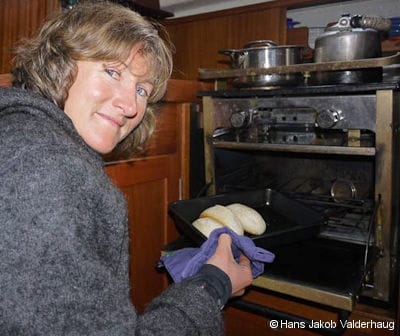
Cooking/heating with paraffin requires dedication. You need to get intimate with the burners at regular intervals, meaning a couple of hours bathed in paraffin once a month or so.
There are leaks, build up of carbon deposits, broken pricking needles – you name it. For users of the Optimus/Taylor range of cookers there is the added confusion of two different burners available, requiring different spare parts and the two-legged variety requiring longer pre-heating than the four-legged variety. There is also an issue with different types of aluminum washers required.
The pre-heating ritual is less of a problem, flare ups are rare once the routine is established. We pre-heat using methylated spirits [industrial alcohol]. We tried pre-heating using a blow torch one season but did not like it.
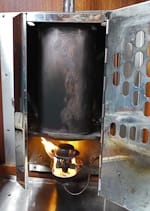
Our set-up for the last 10 years is from Taylor: A two burner stove with a one burner oven and their K 79 heater, both units run off the one tank. There are numerous joints in this set up, and we have had issues with leaks. I have no knowledge of the Bertschi burners, but they seem rather complex.
Paraffin/kerosene should only be considered if your boat, your cruising area or your safety hang-ups rule out propane/butane. If your decision is made I would strive for simplicity.
If making a new installation I would consider the two burner cooker Optimus 155W (now in production again) with integrated tank. I had one of these in a previous boat and it worked perfect until I brought it home one winter and put it in the dish washer—the cooker was fool proof but not idiot proof. [I was not able to find a source for these online, but the Taylor stoves are readily available.]
For heating I would go for a diesel heater of the Reflex type and a gravity-fed diesel supply. You need a long unsightly flue and there are issues with downdraught but these are issues that can be dealt with.
Eli informs me that we will NOT sail without an oven, so for us I guess it is sticking to our Taylor and accepting the ongoing maintenance battle.
[Me (John), I’m sticking with propane despite the dangers! Mind you, cooking and heating with kerosene saves Hans Jakob and Eli from the cruel fate of smelling faintly of diesel and musty bilges like most of us live-aboard voyagers. Instead they smell faintly of kerosene!
If anyone else has experience with kerosene, please leave a comment.]
Hi John and Hans,
We have been cruising with kerosene stove onboard our two previous boats for almost 20 years. Of course we went through all kinds of frustrations with these but they did the job and we always were sufficient and safe with that fuel. Things started to improve dramatically when we began to use pure mineral spirits as the combustible for the kerosene stove. Since then the clogging of burners and smelling are things of the past. Thanks to André on Mimosa from Treasure Cay, Bahamas who gave me the tip. At first we were reducing half and half with kerosene but we rapidly switched to pure mineral spirits. I wished I had known this at the beginning of our cruising.
We had a Force Ten with oven on our first sailboat and then onboard our Hallberg Rassy 31 (a Monsun—same as Hans). We used an Optimus 155 without the preheating device (we use methyl hydrate in the cup under the burner of the stove) which is very good and simpler even if we were told that the one with a preheater system gave also good results. We saw a few Optimus 155 W on E-Bay from Swedish sellers and bought a back-up. It’s the high quality Optimus original burners that kept us satisfied but they were hard to find new.
Our new boat is propane. It will be a whole new set of rules and we will certainly find it simpler. I think kerosene is also a good way of doing things if you can overcome the frustrations of the learning period and use pure mineral spirits only!
Yves & Elaine from Kluane
Yves from Kluane
Ditto the above on mineral spirits. I also used it in my kerosene refrigerator and found the wick lasted much much longer. Had I known then that mineral spirits’ flash point was only 105 degrees I would have been much more careful with it. Most kerosene lamp makers warn against it, because the font can get that hot, and vapor can find its way out to the flame, but a quality tubular wick burner with a metal tank (like my fridge), or a primus type burner seems OK.
Cruised for 17 years using a TAYLOR cooker/oven. Had different degrees of frustrations due to using the different qualities of kerosene that we could find around the world. Nevertheless overall we were very satisfied. Had our cooker reconditioned last year at the factory in G.B. To my great surprise new two legged burners were installed (we always had 4 legged burners). These new burners should be avoided at all cost. One little cup of methylated spirits won’t do the preheating job – instead it takes about 3 cups (very very long preheating time) with the added danger of putting methylated spirits in an already very hot cup. Of course there is always the possibility of using a blow torch but that annihilates our wish of not having natural gas on board. 4 legged burners are no longer available, but a co. in the UK: http://www.base-camp.co.uk is presently experimenting with new burners which will be easier to preheat than the 2 legged burners.
I cannot say that I have found much to disagree with here. Both LPG and kerosene have their pluses, assuming one pre-heats with a gas torch and uses mineral spirits in the kero stove. We knew this dodge back in the 70s in So-Cal. I have another demand of my cooker, it must be removable to the cockpit for warm weather use or stinky fried fish. So it’s a two burner propane cook top mounted in a movable stand for me.
I’m curious, John & Phyllis, what thoughts (if any) you might have regarding electric cooking.
Ten years ago, electric cooking on board anything short of a megayacht would have been insane. But I’ve been hearing some good stories about the latest induction cooktops and combination microwave/convection ovens; notably, it appears that Steve & Linda Dashew have become converts to induction burners and electric combination ovens; admittedly, their yacht is rather more sophisticated than most.
It’d be interesting to hear your thoughts on how these high-tech electric cookers compare to the kerosene/paraffin (or LPG) ones.
Thank you for all the good information on the practicalities of using kerosene for cooking.
As to electric cooking, we made a reference to it in an earlier post as something Steve and Linda Dashew are experimenting with and saying it is definitely worth looking into; maybe we can ask Steve and Linda to comment on it when we have a moment (John is presently at a week-long travel photography course in Maine having a great time but working all the hours God gave!).
We have used the Taylor “cooker” for a few seasons of cruising New England. Most unsatisfactory. The elaborate pre-cooking procedures and sooty overheads were too much. Now we keep it (perhaps) too simple with a Sea Swing, as we cannot find suitable storage for a propane tank (no pulpits or lockers). Any ideas?
cheers, Eric and Sue
Please tell me, I have just gotten an Optimus 155W. Can I pre-heat with lighter fluid that is used for Zippo lighters? or Charcoal starter? Thanks
Hi Dave
Have an Optimus, used x 4 yrs.
I use methylated spirits – that’s what we call it here in Ireland. Probably called denatured spirits in the US.
The issue is how safe is the liquid when there is a spill. You’re on a rocking boat & spills can get everywhere.
Flash flare-ups using meths don’t bother me – I just wait it out. This occurs when the stove is already hot and/or I spilled meths all over. It is safe, just stand by.
Meths burning on my hand take a while before it bothers me. Lots of time to react. Safe.
Once a flame jumped into the open meths bottle I was holding. There was a blue flame, low in intensity, coming an inch or 2 out of the bottle. I just screwed back the cap & it went out instantly. Again, safe. Since then I always close the bottle before lighting up.
See, I’ve done all of Murphy’s Laws! That’ll be ten bucks please…
You can imagine that other liquids, eg charcoal lighter fluid, in these situations, can be far more dangerous.
I have not looked into alternatives. Probably poteen at 2x the potency of whiskey, is as safe, is multifunctional, & is a lot cheaper here depending on whom you know.
A Johnson & Johnson shampoo bottle with the flip-top lid controls volume & directs the squirt very well. I keep 2 & refill them from 5 liter meths bottles.
The biggest bonus of using kero is the fact that it is far more readily stored than bottled gas, and 40 litres of the stuff lasts a verrry long time, making it a much easier proposition on a small boat away from civilisation for lengthy periods. I was fortunate in that I met several people in the aviation industry whilst cruising and managed to get my hands on good quantities if aviation kerro.
We have cooked on a mariner kerosene stove for all of the years we have had our yacht. Upward of ten. The advantages are that it fits the period of our 50 year old classic. There are no tanks on deck to spoil her line or get in the way in storms and heavy weather. there is less need for wight above the water line. The fuel is inert and safe. I get it free from the hospital helicopter trust. In NZ it contains no naphtha (an issue with this source in high latitudes as it is used as an anti freeze agent and can cause toxic reactions in confined spaces.
The thermal efficiency is greater. We have had issues with burners carbonning up and finding parts for old units can take a bit of work.
The roast dinners are absolutely lovely with moist chicken like you cannot believe. My wife loves the stove. The knowledge base/ fear factor of poorly primed burners does mean that guests who never went to scouts tend not to initiate meal prep for fear of giant yellow but innocuous flames. Some may consider this a draw back but I like the teaching and the opportunity for people to learn. There is a planning element and with kids on board you do have to fight not to get distracted while preheating and rushing the re light is not advisable. Meditative pauses are so rare these days.
The most chilling experience I have had with propane is waking up to the smell of propane on a friends yacht to find that the burners on the stove all looked like they were off but the unit was leaking due to a broken knob on the stove. Chilling thoughts 35 nautical miles offshore deep in the forties. Having seen burns victims at the hospital I have no wish to be covered in molten plastics (lets be real most yacht clothing is a form of plastic) with battle sign and a percussion injury to my soft organs groping to leave a burning ruptured hull into a melted life raft.
The worst issue with the kero stove has been setting the meths bottle on fire. Big bang lots of clear flames. No injury and put out with the kettle of water.
I have been using a Taylors paraffin stove, and a Taylors paraffin heater for full time living aboard and cruising, since 1996. I find them easy to use, safe and economical. Maintenance is minimal, and easy. Burners are readily available from Germany and Switzerland (expensive), and India (very cheap). I have used everthing from cheap rum, methylated spirits to whisky to preheat the burners. Kerosene/paraffin, Jet A1, are the fuels I use, often very cheap and Government subsidised. No problems with the wrong fittings etc I have a 70 L tank which lasts about 2 years. The only problem has been the enamelled cast iron top of the stove which rusted. I replaced this with a 304 stainless steel, lazer cut top.
Wallas 2 Burner Diesel Galley Stove/Oven, sold by www,scanmarineusa.com. No one in these posts seems to be aware that there is at least one product in the kerosene/diesel line of galley stoves that has done away with all alcohol preheating, flare-ups, smells, fumes and open flames. If interested check this web site out for yourselves. I am not associated with the manufacturer, nor am I familiar with the product, just a sailor trying to be of help. Fred Wittenberg
Fred et al,
I do not have direct experience with these but a friend bought one about 7-8 years ago. It was much like an Espar heater (probably more like a Wallas since they make them!) in that it has an electronic control system, electronic ignition etc. My friend did not have a lot of luck with it when it came time for repair. (That time came rather quickly too) My impression was that while it might be suitable for occasional use I would steer clear for long term use.
Just my opinion.
Ed
You mentioned that the Optimus 155W was now in production again. Where? I would like to buy one. Thanks!
Hi Eric,
I checked and the information we have is in the links in the post above.
The optimus 155W certainly is not back in production. There is a German retailer on the web advertising new 155W’s but strangely enough it’s never got any in stock. The Japanese love of all things Kerosene seems to ensure most of the 155W’s that are knocking around end up in the land of the rising sun.
I have installed a second-hand Taylors 028 paraffin cooker. I have had endless problems trying to get all the joints leak-free, and am now close to success. Just one of the burners has a leak underneath where the brazed union enters the bottom of the burner. There is a new burner available, called the Hansa No. 1, made in Germany. I bought this from Toplicht in Hamburg, Germany (www.toplicht.de). It is a one for one replacement for the standard Taylors burner, which is made in Portugal. I was so impressed with it that I have ordered a second. Benefits: 1) cheaper than Taylors; 2) easier to fit as as normal open-ended spanner can be used rather than the cheap and nasty pressed-metal spanner needed for the Taylors; 3) leak-free with a much improved sealing system underneath (my current problem area); 4) has 4 legs rather than the current 2 legs of the Taylors making pre-heating quicker. When I ordered the second I told Toplicht how delighted I was, and they said that Taylors would be changing to using the Hanse No. 1. They also said that the new burner had taken a long time to develop.
Based on my limited experience I can recommend the Hanse No 1. No idea if it is available outside Germany, but Toplicht do ship worldwide.
Hope this helps any other paraffin freaks out there.
Bill Attwood
You have to accept there is no perfect cooker fuel on board a boat don’t you?
Gas can blow you up if its not looked after. Kerosene stoves will on occasions leak an objectionable bad smelling hydrocarbon into your cabin and they are getting increasingly difficult to service as 207b burners become increasingly rare. Alcohol is expensive, can smell too and has little heat value which makes it slow to bring water to the boil. Diesel will heat your boat up something fierce in summer (unless you buy a Wallas in which case you’re in a world of pain because you’ve blown a fortune on something that will break down and you’ve got no hope of fixing it because it is so complicated).
Whatever you pick will be an imperfect compromise!
Lyn and Larry Pardey specifically decided they would never cruise with kerosene stoves and went propane. Me, I hate the idea of propane and am torn between kerosene and alcohol.
Hi Philip,
I agree, really no perfect solution. Having said that, I do think that propane risk can be managed—hope that’s not famous last words! Two keys to that:
A solenoid valve at the cylinder easily controlled from next to the stove and a good quality gas sniffer alarm.
John
Just to expand on what I was trying to say in the post below. every fuel has its downside that can be managed somehow with either money, technical know how, or a simple willingness to tolerate of its failings.
For me, I’ve never owned a piece of mechanical equipment I haven’t either neglected, failed to service on time or simply left to deteriorate because I can live with it. That’s just me, I’m that kind of person. Give someone like me a propane installation and I will blow myself up eventually. Give me a Wallas and I’ll turn it into a worthless piece of junk within 3 years.
However:
Give ma an Origo and even I cannot neglect the thing until it reaches a state of disrepair because Origo’s just don’t do disrepair. Give me a Taylors and the kerosene smell will motivate me to keep on top of it in a pretty short space of time. Even if it doesn’t, I will not kill myself.
Cooking fuel is really a very personal decision that has to take into account not only the characteristics of the fuel but also the habits, budget, preferences and tastes of the boat owner.
Cooking systems are a little like the old joke about cars. The part most likely to fail is the nut behind the wheel, or in this case at the wheel/tiller.
Hi Philip,
Great comment. It makes me realize that self awareness is probably the most important step to safety. Thanks
and a kerosene fan will tell you the smell issues can be managed with pre-heating. Alcoholics say their stove is fine as long as you are patient. Those who like their Wallas insist its a reliable piece of kit.
In the end the choice of fuel is about was subjective as the choice of boat. Sometimes the cooking fuel debate can get as heated (no pun intended) as the argument over “which is safer, a cat or a monohull?”
We have a Taylors paraffin cooker and are commited paraffin fans. There are drawbacks to the Taylors cooker, and one of them is the large number of joints which need to be made leakproof. The Hamburger firn Chr. Weimeister are now producing the burners for Taylors cookers. We changed to their burners on our second-hand Taylors cooker and were delighted with the improvement. They have just announced their own paraffin cooker with an integral paraffin tank, thus eliminating the leaky joint problem. This may be of interest to anyone thinking of changing to paraffin, or fed-up with leaking joints. The drawback is that the integral tank is only 1.5 liters, so it will need filling more frequently. If we didn´t already have a functioning (at last!) and reliable Taylors cooker, we should certainly look at these. I have no relationship with the firm, other than as satisfied customer.
Here´s the link to their website
http://www.weimeister.com/sortiment/kocher/
Regards,
Bill
This comment will only be of interest to the dinosaurs still using paraffin stoves for cooking. One of our difficulties is the pre-heating of the burner, which requires squirting meths into the cup surrounding the burner. I don´t need to elaborate for initiates of this ritual. But, be of good cheer, there is an improvement to the process, which I have just learned from a friend. This very low-tech idea is a stroke of genius, and just shows that even old technologies can be improved. If you have a paraffin cooker, you must buy one of these:
http://www.wooden-technology.de/ausruestung/vorwaermdocht/
Together with the wide-necked jar for the meths, this makes the pre-heating simple and safe.
No relationship with the firm, other than satisfied customer.
Yours aye,
Bill