We have now replaced this article with three in depth chapters in our Anchoring Online Book on shorefast gear and use. Membership required.
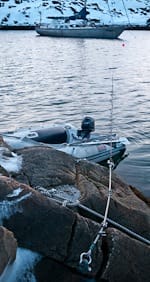
Question: We’re about to build a shoreline system. We have two reels from Easyroll that can take about 150 m of 12 mm line each. I’ve seen the system used by Polaris, and it looks very solid, but my concern is, obviously, the cost of using Dyneema [Spectra].
As far as I can see the only alternative to Dyneema will be polyamide [Nylon] lines, less cost, but also by far less strength. 12 mm gives about 3,4 metric tones breaking load, versus 10 mm Dyneema with 9 tons.
- How strong (breaking load) should a shoreline be to be sufficient to suit our 20 ton boat?
- What kind of, and how much shore line do you guys carry?
- Are they often used (normal anchorage situations during cruising season)?
- If you were about to make a system, like we are, which system would you choose, money taken into consideration?
Answer: Let’s start with our shorefast usage and then move on to our system on Morgan’s Cloud.
Despite the amount of information about shorefasts on this site—put “shorefast” in the Google Search box (above right) and you will see what I mean—we don’t use shorefasts ourselves very often at all, perhaps once or twice a season. Our reasons are:
- We have an oversized 55 kg (120 lb) SPADE anchor that we have huge confidence in that sets in almost any bottom type, so we don’t feel the need for shorefasts to replace or backup the anchor.
- We don’t like to anchor really close to the shore since such positioning would give us very little time and space to manoeuvre if anything went wrong. In fact, if we are expecting a really nasty blow, we often look for a larger anchorage than many people might choose, say half to a quarter mile across, and anchor well off the shore—it’s not the sea that kills sailors (and boats) but the hard bits around the edges.
- Shorefasts prevent the boat from swinging to face the wind, which puts huge strains on the shorefasts themselves and any anchor that’s down.

Having said that, there are times when only a shorefast(s) will do: Usually when the only available anchorage, like the one above in East Greenland, is too small to safely anchor in, or we are trying to get into very shallow water in the high latitudes to get away from ice. Incidentally, shorefasts can be a real pain if there is any ice drifting around since it tends to get hung up on the lines, producing truly frightening loads.
Our shorefast system consists of one 300 foot (91 meter) length of 1/2 inch (about 12 mm) Spectra single braid and a further 900 feet of 7/8 inch (22 mm) Nylon single braid in three lengths that double as secondary anchor rode(s) and for streaming a Galerider drogue.
All the lines have thimbles spliced into both ends so that they can be joined using shackles—knots would reduce the strength of the rope too much and will slip in Spectra—or be shackled to the two 50 foot (15 meter) 7/16 inch (11 mm) stainless steel wires with soft eyes spliced into each end that we use to go around boulders on the shore.
All of the lines are kept flaked, never coiled since that will cause tangles, in bags. The bags work fine, although line reels would be more convenient. However, we don’t like the clutter of reels, and since we don’t use shorefasts that often, bags are a good compromise.
In all our years of cruising we have always been able to get secure with this system, although there was one time when every dock line on the boat got co-opted as well; however, that was when we were still anchoring with a CQR, which was, as usual in the high latitudes in our experience, refusing to set properly.
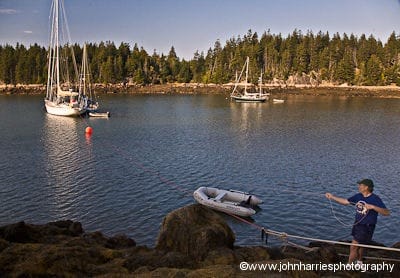


We plan to replace one of the Nylon lines with a second Spectra line simply because my aging back is starting to object to dragging over a hundred pounds of wet Nylon rope around. The Spectra will, as you point out, cost a bundle, but less than a back operation!
By the way, you can reduce the cost dramatically by sourcing Spectra or Dyneema from a commercial supply house rather than a yacht shop. We got ours from Machovec and they even custom dyed the rope high visibility red and spliced it for us.
As to a recommendation on the appropriate strength for shorefast lines, it’s hard to be precise. But given that the loads can be huge when the boat is caught on the beam by storm force winds—as was graphically brought home to us on Polaris last winter when we had winds gusting to well in excess of 50 knots on the beam—and the penalty for a shorefast failure close to land may be loss of the boat, we have sized our entire system for our 52,000 pound (23 metric ton) boat for a minimum break-load of 17,000 pounds (8 metric tons), including the shackles.
Your boat is a bit lighter than ours, but unless you can come up with some really good engineering to support it, I would not want a shorefast system that was much lighter, in relation to the boat’s weight and windage, than ours.
If you have a shorefast system that works well for you, or any other thoughts on the subject, please leave a comment. We would be particularly interested in hearing from any reader with an engineering background that could make a stab at calculating the loads on a shorefast with the boat caught abeam in storm-force winds.
A great post as usual, John… some very helpful insights.
As a very rough guess, a ‘typical’ 17 m monohull sailboat beam-on would present something like 30 square metres of hull, and perhaps 6 square metres of deckhouse to the wind.
Let’s say the air density is around 1.3 kg/m3, the beam-on hull has Cd of 0.8 or so, the superstructure closer to 0.5; this gives us about 11 kN of wind drag on the hull and deckhouse alone in a 50-knot wind.
What’ll the rigging add? Something like 120 m of wire (say it’s half-inch) for another 0.3 kN, more if the wire’s heavier; a 30 cm mast section 15 m high for another 0.9 kN (again, more if larger/taller)…by the time you add all this to the hull, you’re probably around 12-14 kN for static wind drag alone (or close to 2500 lb).
As for waves- well, let’s guess a 10-degree slope on the wave face, make a whole bunch of extremely unrealistic assumptions, and get something like 17% of the boat’s weight (you mentioned a 23 ton boat, so perhaps four tons- say 40 kN- due to the boat being bashed around by waves).
Based on this very hasty, very rough back-of-the-napkin guess, I’d say it’s not unreasonable to expect repeated loads of 50 kN or so (about five tons) on the shorefasts for a boat this size, with peak loads potentially much higher. Considering that the real killer is going to be the shock loading as the boat is kicked back and forth (not calculated here), the system John describes above would seem to be about right for a boat the size of MC, and I doubt I’d be comfortable with much less if I had to face these conditions.
(Thankfully, my boat is far, far too small to ever get in such a situation…. 😉 )
Hi Matt,
Thanks very much for running the numbers with what is obviously a lot of knowledge. It’s really great to have some solid engineering to back up our gut choices.
To our other readers,
Matt designs boats and has a web site that is well worth a look. Just click on his name above his comment. He has a particularly insightful post on situation awareness here.
John
Thank you for the detailed and highly useful information. Your website is very helpful for less experienced sailors, like ourselves. The comment regarding the physics, submitted by Matt, I also found very interesting, and for sure made me aware of the forces applied to the boat during high winds.
Once again, thank you so much for sharing your experiences with us.
When I cruised Norway I used shorelines only as a last resort, partly for the reasons discussed above, but also because single-handed I found it so difficult to extricate myself from the tangle if the weather turned difficult. Very time consuming and tiring. In an emergency weather deterioration, I felt shorelines greatly limited my options. The Norwegians thought I was crazy; without a history of using modern anchors, they were reluctant to trust an anchor and always opted for shore lines.
Thanks for the kind words, John, although I’m not sure I’d put too much faith in a back-of-the-napkin calculation with so many assumptions, as I gave above. (There’s a big difference between knowledge from books and calculations, and knowledge from actually being out there like you are!)
A proper answer to the question of “how much load must the shorefast take” should take into account the motion of the boat and the stretch of the lines, rather than the static approach (boat sits on wave face, gravity pulls down, line pulls sideways, buoyancy pushes normal to wave face) I used above. The choice of rope type (spectra, poly, nylon, etc.) will make a big difference in how the secured boat reacts to waves (stretchy vs. high-modulus) and will thus change the loads on the lines.
It’s not a trivial problem, and I agree with John’s recommendation to err on the beefy side.
In the Mediterranean it is very common to take lines ashore, or ‘shorefasts’ as you call them. Perhaps the primary reason for this is that anchorages are typically small and somewhat crowded, thus the use of shorelines allows many more boats to share the anchorage. A further reason is that anchorages in the eastern Mediterranean are often very steep-to, so that it would be necessary to free anchor in maybe 20 – 30 metres depth, whereas by taking lines ashore the boat can lie in much shallower water.
For many owners the material of choice for shorelines is polypropylene, which has the great advantage that it floats and will not snag underwater rocks when being rowed or swum ashore. Lengths of up to 100 metres are stowed on reels permanently mounted on the pushpit, if space allows. Tape reels are also seen frequently, especially on Turkish cruising boats, where steep-to anchoring is very common. Our narrow pushpit does not allow for a reel, so we stow our two 40-metre warps in homemade ‘flake bags’. Our warps are 12 mm braid-on-braid nylon, which is easily handled and has always been plenty strong enough.
High modulus line has much to offer for shore fasts, anchor line or drogues; strength, light weight (floats), etc., but the lack of stretch must create a different set of problems.
Have you thought about, or done anything to address the potentially overwhelming dynamic loads as you consider replacing your nylon lines with spectra or dyneema.
Also, can you elaborate on the specifics of using wire as an anchor around boulders, etc. and why you don’t use chain, please.
Thank you,
Hi Stedem,
I’m planning a post on our shorefast system sometime in the next few months that will address those issues. Thanks for the reminder that I need to get to it.
I think I’ve now read all your posts about shorefasts – and inspite of all the great data, it’s still been difficult to decide what I should do in preparation for our cruise to Patagonia.
I certainly agree with your theory of not using shorefasts when you can avoid them – let the boat swing to an anchor and thereby reduce loads by not being beam on in the first place. However, in Chile, I think there is little option – a few meters away from some of the anchoring spots, the depth plummets to more than my rode will allow. Shorefasts appear to be mandatory equipment and getting as close to shore as possible becomes the order of the day in order to get out of the wind.
This is where I come unstuck with Matt’s math… unless one always puts out 4 shorefasts – one for each corner – before the loads build to the levels Matt suggests, even your honking great anchor is going to pull itself out. Heck, with some of the loads being bandied about, my chain would break!
We are having to balance a number of objectives with the shorefasts – not only safety within the anchoring spot, but also ease of deployment, ease of storage and cost (ours are not bottomless pockets).
So, with our 44ft Outbound, which has quite a high freeboard and weighs in at about 30,000 lbs in cruise mode, I’m thinking I will add two bags of 5/16″ Dyneema (13,700lb tensile strength) 300ft long with eyes in both ends and supplement them with our 1″ x 300ft brait drogue line, and our spare, mostly nylon 300′ anchor rode when absolutely necessary. What do you think?
I’ve talked to several folk about the methodology of establishing shorefasts when shorthanded – Tony Gooch had the most amusing description… “Set the anchor and back into the cove – keep the power in reverse as you board the dingy and row like crazy to shore (kelp prevents use of motor) with the first shorefast.” He said that “it gets really interesting if the anchor begins to drag while setting the first shoreline!!”
Hi Bill,
Damn! I still need to get to that post on jacklines, sorry. So many posts to write, so little time!
Anyway, I thing what you are proposing will work very well, and I agree that shorefasts will likely see more use in the south than I have experienced. The only suggestion I would make would be to go up to 3/8 diameter, not so much for strength, but to give a safety margin against chafe.
As to the loads. Based on my experiences on shorefasts, I’m pretty sure Matt’s numbers are close. On Polaris we had five shorefasts and a big anchor sharing the load and when it blew storm force on the beam it felt like barely enough.
I think that things are much better in this regard in Chile because most of the coves, at least in the channels, are tree surrounded, unlike the north—trees make a huge difference.
I note that you sized your 12mm spectra shorelines at about 1/3 of your boats displacement. I have a 11 tonnes (loaded) Lagoon 400 catamaran. Is it correct to calculate the size needed for my shorelines as 1/3 of 11 tonnes equals around 4 tonnes? And then 8mm Spectra with a minimum tensile strength of 4 tonnes?
Thanks
Brian Rodwell
Hi Brian,
Hum, I’m not sure that displacement is the only variable we should be looking at here, (although it probably is the most important one because of impact loading when the boat surges against the lines). We also need to think about windage and chafe. Given that, and that cats often have quite a bit more windage than monohulls, I guess I would not go below 3/8″ or 10mm.
I’ve been doing some instrumented load testing with wind an chop from different directions as part of an article on dock lines (I can calculate too, but at some point there are just too many variables).
a. Assuming only chop from the beam (if there are real waves anchor beam on will fail), the surge loads from the side are little higher than from the bow. The reason, of course, is that the keel inhibits moving sideways. The static wind load, of course, is 3-4 times. But since it is the surges that matter, the difference is much less than you would think. Note that this is in the absence of waves only!!
b. I think rigging a moderate amount of nylon into the system is required, perhaps 20′, like you might on a snubber at anchor. I did some testing with all-dyneema on anchors (no chain, no snubber, much like a shore fast) and in just 5 knots and broke a 2500-pound load cell in 3-7 knots, when the static load was no more than 20 pounds! It was a small wake, we barely even noticed, but I saw the reading climb and the unit fail before my eyes. It is absolutely the worse case, with no shock absorption.
Hi Drew,
Interesting stuff, thank you. I think the key to all this, as you say, is the absence or presence of waves. In my experience—including hurricane force winds on two occasions while on shorefasts—if one is in very sheltered waters, as we were, you actually want to reduce stretch in the system to the absolute minimum so the boat stays in one place and does not serge around.
On the other hand, if there are any waves at all, even say a .5 meter chop, you then need to add a bit of stretch.
Interestingly more stretch is not always better. Too much stretch and the boat starts surging around which seems to increase the chances of something breaking.
Bottom line, from my experience, while some stretch is sometimes good you need a lot less stretch than most people think.
Yes, everything you said, particularly regarding fore-aft surging. In one set of tests I varied the amount of dock line slack. It did not change the forces much, because the motion and the gusts were generally out of phase. However, in testing I did with snubbers, they generally were in phase, and it did no good to add momentum to wind force. This is why I suggested only 20′ of nylon; enough to take the sting out, but not enough to add for than a few feet of motion. A bit of dockline (even 10′ would help) at the shore end will take the chafe (and be replaced) and the rest could be nice light and non-stretch Amsteel.
Climbing guides (I did that a little) use the acronym SERENE to describe a good anchor; Solid, Redundant, Equalized, No Extension should one fail (this is to avoid equalizing systems that use pulleys or such and add movement if one element fails–no common sailing analog, though lazy jacks offer an illustration). Your no-stretch axiom mirrors this logic, holding that horsing around and changing the directions of pull can do more harm than any theoretical advantage stretch lines might bring. Though climbers use very stretchy ropes, anchors were made with lower stretch webbing and steel cables before Dyneema came along.
Hi Drew,
Yes, I think you are right, about 20′ of Nylon sounds about right at the shore end if there is any chance of waves. Great to have your testing to backup what we have observed.
On snubbers, we changed to 3/4″ braid from 5/8″ three strand at the beginning of this season (to match the chain strength) and found no problems with shock loading, but a noticeable reduction in hunting back and forth, so all good.
OK, so it looks like the ideal shorefast is made of appropriately sized Dyneema (3/8″ for us) for it’s low stretch, flotation and abrasion resistance with a length of 20ft of appropriately sized Nylon (5/8 Brait for us) (probably make that 30ft so it can be tied to something…) then attach the two… how?
I imagine the whole process can be quite tense if there’s any wind up and therefore getting the shorefast tied off quickly is essential. I don’t see messing about with anchor/mooring shackles as sensible – pins flying left, right and center as we struggle to hold 3 components in the same place… But a snap shackle type arrangement falls short of meeting the strength that has been acquired in investing in Dyneema in the first place…
So, wondering what you think of this: The length of nylon has a loop (eye?) in one end and one attaches the two lines together by passing the nylon through the eye at the end of the Dyneema and then through the eye of the nylon, allowing the bitter end to be tied to shore. How much strength in the nylon have I just compromised? If this is doable, is it better to use an eye in the nylon or just splice an open loop?
Thanks!
Bill
Hi Bill,
The first thing is that in my experience the way to go is that the I attach the shorefast to the shore first and then run it back to the boat, rather than the other way around. This allows the crew on shore to take all the time they like getting a good solid anchor with no loads coming on, while the crew on the boat hangs off.
Once the shore anchor is in, then just run the shore fast out to the boat, and pass it to the boat crew, who can quickly cleat it off. (We store our shorefast in bags, not reels.)
For shore attachment we use 7×19 SS wire, to go around rocks or 1″ nylon to go around trees. Keep in mind when doing this that you need to allow a lot for chafe. The reason we use wire.
Anyway, don’t fixate too much on the shore attachment, in that every situation will be different. (I can remember once in Newfoundland with a hurricane on the way taking over two hours to build a really good distributed load attachment point using most every dock line on the boat attached a to a bunch of different trees.) Just makes sure you have a bunch stuff: wires, bits of chain, heavy rope, and shackles to build your attachment with.