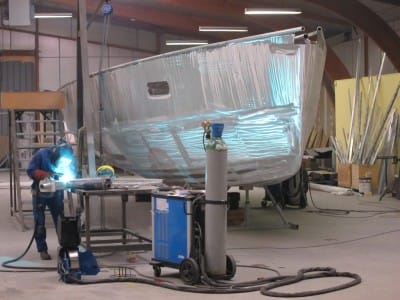


For most of us, our boat is a compromise—very few of us can afford a pure custom built boat for our chosen form of voyaging, especially if that includes high latitudes. Of course, there are boats that can be modified for more ‘off piste’ voyaging with greater or lesser difficulty and cost, but even then the choice is not extensive. So when I heard about the Boréal 44, which seemed to have many attractive features designed and built in, I was, to say the least intrigued.
And so it would seem were many of you, judging by the response to my short original piece on the boat. This led to a contact from the builders, with an invitation to come and see and sail the boat at the lovely French port of Treguier, an offer that I snapped up.
I think the picture you have labeled “The daggerboards aft help trim and balance on all points of sailing” is actually the centerboard. Am I mistaken? Your point regarding the daggerboard helping trim still stands.
Hi Tom,
No, that photograph correctly shows one of the two slots aft for the dagger boards. The centre board pivots out of a trunk further forward.
You can see more in this chapter: https://www.morganscloud.com/2010/06/10/rudder-options/
And you can also read lots more about the boats here: https://www.morganscloud.com/category/boat-design-selection/boreal/boreal-44-47/
John look at the next photograph with the same caption, that is what I was referencing. Sorry for the confusion.
Hi Tom,
Oops, thanks for the catch. Fixed now.
John, Last Aug/Sept an Onni 435 was crushed and sunk in the Bellot Straight of the North West Passage. She was named ANAHITA, was French flagged and owned and sailed by two Argentinians, both of whom were rescued by Canadian Coast Guard. I was surprised that an Aluminum yacht with a lifting keel would suffer such a fate so easily. Boreal advertises their yachts are designed for high latitude cruising presumably where ice is present. I am curious if you have any additional details of this tragedy specificially exactly where the hull was breached. Peter
Hi Peter,
Having spent many years taking an aluminium boat north I can say pretty categorically that no yacht will withstand being nipped by ice regardless of how strongly built or the keel configuration, and I’m sure the guys at Boreal would agree. The power of even a small piece of ice being driven by wind or current is pretty much the unstoppable force, at least for yachts.
Bottom line, these guys took stupid risks, put their boat in a dangerous place, and paid the price. Particularly foolhardy since the Canadian Coast Guard had issued a warning that the passage was no place for yachts this year.
Here are some more thoughts on ice navigation and the NW passage: https://www.morganscloud.com/2014/10/09/enough-with-the-northwest-passage-already/